



 Chat with AI
Exam 11: Neutron Stars and Black Holes

Exam 1: Here and Now97 Questions
Exam 2: A Users Guide to the Sky116 Questions
Exam 3: Cycles of the Sun and Moon154 Questions
Exam 4: The Origin of Modern Astronomy144 Questions
Exam 5: Light and Telescopes156 Questions
Exam 6: Atoms and Spectra125 Questions
Exam 7: The Sun146 Questions
Exam 8: The Family of Stars190 Questions
Exam 9: The Formation and Structure of Stars136 Questions
Exam 10: The Deaths of Stars127 Questions
Exam 11: Neutron Stars and Black Holes99 Questions
Exam 12: The Milky Way Galaxy117 Questions
Exam 13: Galaxies: Normal and Active151 Questions
Exam 14: Modern Cosmology112 Questions
Exam 15: The Origin of the Solar System108 Questions
Exam 16: Earth and Moon: Bases for Comparative Planetology98 Questions
Exam 17: Mercury, Venus, and Mars83 Questions
Exam 18: The Outer Solar System136 Questions
Exam 19: Meteorites, Asteroids, and Comets91 Questions
Exam 20: Astrobiology: Life on Other Worlds97 Questions
Select questions type


The slowing of clocks in strongly curved space time is known as
(Multiple Choice)
4.7/5  (72)
(72) The above cartoon is of a neutron star with a strong magnetic field. We call this a pulsar planet. 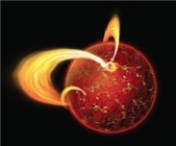
(True/False)
5.0/5 (72)
(72) Complete the reaction: e + p → _______________; the reaction applies to ________________.
(Multiple Choice)
4.9/5 (87)
(87) Which of the following objects is considered to possibly contain a black hole
(Multiple Choice)
4.8/5 (82)
(82) When a star of mass comparable to the Sun dies it become a black hole.
(True/False)
4.9/5 (77)
(77) The first pulsar was discovered by _________ in November of 1967.
(Multiple Choice)
4.9/5 (74)
(74) _________ occurs when light travels out of a gravitational field, loses energy, and its wavelength grows longer.
(Multiple Choice)
5.0/5 (77)
(77) How can an old pulsar have a very short pulsar period, say less than 0.03 seconds
(Essay)
4.8/5 (80)
(80) The above cartoon drawing is of a pulsar with its rotation axis aligned with it magnetic axis. 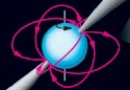
(True/False)
4.8/5 (75)
(75) The lighthouse in the following picture represents which model for which compact object 
(Multiple Choice)
4.9/5 (81)
(81) What happens when a core's density exceeds that which electron degeneracy pressure can support
(Multiple Choice)
5.0/5 (88)
(88) We expect neutron stars to spin rapidly because they conserve angular momentum.
(True/False)
4.9/5 (76)
(76) To tell the difference between a neutron star and a black hole in an X-ray binary, we must find the temperature of the object.
(True/False)
5.0/5 (91)
(91) What happens when a core's mass is less than 3 solar masses but greater than 1.44 solar masses
(Multiple Choice)
4.8/5 (72)
(72) What happens when a core's mass exceeds 3 solar masses and its density exceeds that which electron degeneracy pressure can support
(Multiple Choice)
4.7/5 (78)
(78) 
Filters
- Essay(0)
- Multiple Choice(0)
- Short Answer(0)
- True False(0)
- Matching(0)