



 Chat with AI
Exam 12: Fiscal Policy

Exam 1: The Nature of Economics346 Questions
Exam 2: Scarcity and the World of Trade-Offs410 Questions
Exam 3: Demand and Supply448 Questions
Exam 4: Extensions of Demand and Supply Analysis398 Questions
Exam 5: Public Spending and Public Choice359 Questions
Exam 6: Funding the Public Sector201 Questions
Exam 7: The Macroeconomy: Unemployment, Inflation, and Deflation412 Questions
Exam 8: Global Economic Growth and Development282 Questions
Exam 9: Real GDP and the Price Level in the Long Run291 Questions
Exam 10: Classical and Keynesian Macro Analyses365 Questions
Exam 11: Consumption, Real GDP, and the Multiplier445 Questions
Exam 12: Fiscal Policy273 Questions
Exam 13: Deficit Spending and the Public Debt145 Questions
Exam 14: Money Banking and Central Banking516 Questions
Exam 15: Domestic and International Dimensions of Monetary Policy356 Questions
Exam 16: Stabilization in an Integrated World Economy305 Questions
Exam 17: Policies and Prospects for Global Economic Growth216 Questions
Exam 18: Comparative Advantage and the Open Economy314 Questions
Exam 19: Exchange Rates and the Balance of Payments300 Questions
Select questions type


In the traditional Keynesian model, an increase in taxes leads to all of the following EXCEPT
(Multiple Choice)
4.9/5  (92)
(92) Suppose the government pursues expansionary fiscal policy by lowering taxes. What are the expected demand-side effects?
What are the possible offsets to the demand-side effect?
How might supply-side effects change these results?
(Essay)
4.9/5 (75)
(75) 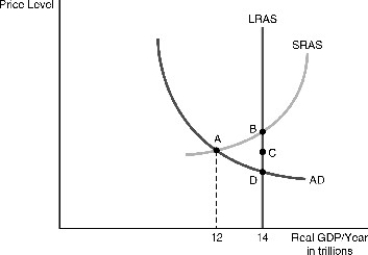 -Refer to the above figure. Suppose the economy is at point A. By the proper use of fiscal policy, the government can
 (Multiple Choice)
4.7/5 (76)
(76) All of the following are automatic fiscal stabilizers EXCEPT
(Multiple Choice)
4.8/5 (84)
(84) Government spending conducted for the purpose of achieving full employment, price stability, or economic growth is an example of
(Multiple Choice)
4.8/5 (80)
(80) Which of the following statements about fiscal policy is TRUE?
(Multiple Choice)
4.8/5 (77)
(77) The proposition that an increase in the federal budget deficit caused entirely by a current tax cut has no effect on aggregate demand is called the
(Multiple Choice)
4.7/5 (89)
(89) What does research tell us about the impact of Ricardian equivalence effects on the economy?
(Multiple Choice)
4.9/5 (79)
(79) The amount of time it takes Congress to debate the size of a tax cut is known as the
(Multiple Choice)
4.8/5 (81)
(81) Fiscal policy may end up being destabilizing to an economy because
(Multiple Choice)
4.8/5 (82)
(82) The permanent income hypothesis implies that the effect of a temporary tax cut on economic activity
(Multiple Choice)
5.0/5 (70)
(70) When supply-side policy is successful in pushing up equilibrium real Gross Domestic Product (GDP), the reason is that the policy generates
(Multiple Choice)
4.8/5 (76)
(76) According to the traditional Keynesian analysis, if the government increases spending and pays for all of it by raising current taxes, then
(Multiple Choice)
5.0/5 (77)
(77) Provisions that cause changes in government spending and taxes that do not require action of the President or Congress are called
(Multiple Choice)
5.0/5 (80)
(80) The crowding-out effect refers to the tendency of expansionary fiscal policy to
(Multiple Choice)
4.9/5 (86)
(86) 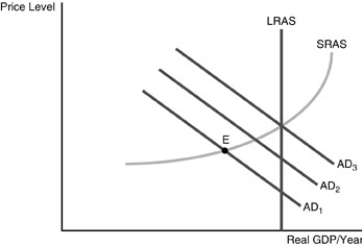 -Refer to the above figure. Suppose the economy is at E and the government uses an expansionary fiscal policy to move the aggregate demand curve to AD₂. In the end, the aggregate demand curve is still AD₁. A possible reason for this is that
 (Multiple Choice)
4.8/5 (82)
(82) Suppose there are two economies that are identical in every way with the following exception. Economy A has an unemployment compensation system while economy B does NOT have an unemployment compensation system. Now suppose both economies experience the same drop in planned investment. Which of the following is correct?
(Multiple Choice)
4.7/5 (82)
(82) 
Filters
- Essay(0)
- Multiple Choice(0)
- Short Answer(0)
- True False(0)
- Matching(0)