



 Chat with AI
Exam 15: Domestic and International Dimensions of Monetary Policy

Exam 1: The Nature of Economics346 Questions
Exam 2: Scarcity and the World of Trade-Offs410 Questions
Exam 3: Demand and Supply448 Questions
Exam 4: Extensions of Demand and Supply Analysis398 Questions
Exam 5: Public Spending and Public Choice359 Questions
Exam 6: Funding the Public Sector201 Questions
Exam 7: The Macroeconomy: Unemployment, Inflation, and Deflation412 Questions
Exam 8: Global Economic Growth and Development282 Questions
Exam 9: Real GDP and the Price Level in the Long Run291 Questions
Exam 10: Classical and Keynesian Macro Analyses365 Questions
Exam 11: Consumption, Real GDP, and the Multiplier445 Questions
Exam 12: Fiscal Policy273 Questions
Exam 13: Deficit Spending and the Public Debt145 Questions
Exam 14: Money Banking and Central Banking516 Questions
Exam 15: Domestic and International Dimensions of Monetary Policy356 Questions
Exam 16: Stabilization in an Integrated World Economy305 Questions
Exam 17: Policies and Prospects for Global Economic Growth216 Questions
Exam 18: Comparative Advantage and the Open Economy314 Questions
Exam 19: Exchange Rates and the Balance of Payments300 Questions
Select questions type


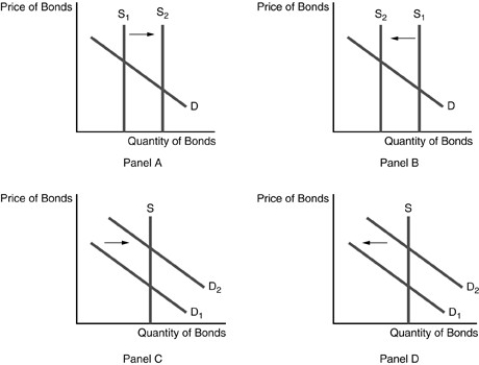 -Refer to the above figure. Which panels could represent the situation if the Fed had engaged in open market operations?
Free
(Multiple Choice)
4.7/5  (77)
(77) Correct Answer: Verified
A
An increase in the price level means that
Free
(Multiple Choice)
4.9/5 (91)
(91) Correct Answer:Verified
VerifiedD
Suppose a family is holding $1000 in its checking account for normal transactions, $500 in cash for emergencies, and $1500 as a store of value when the interest rate is 4 percent. If the interest rate rises to 10 percent, which of the following patterns of holding money would be most likely and why?
Free
(Multiple Choice)
4.7/5 (64)
(64) Correct Answer:Verified
VerifiedA
The number of times per year, on average, that a dollar is spent on final goods and services is known as
(Multiple Choice)
4.7/5 (73)
(73) The interest-rate-based transmission mechanism assumes that the Fed can stimulate investment by
(Multiple Choice)
4.7/5 (72)
(72) How is the effect of expansionary monetary policy depicted in an aggregate supply-aggregate demand graph?
(Multiple Choice)
4.8/5 (90)
(90) Typically, increasing the difference between the discount and federal funds rates causes
(Multiple Choice)
4.9/5 (76)
(76) An open market sale of government securities by the Fed will cause which of the following?
(Multiple Choice)
4.8/5 (80)
(80) 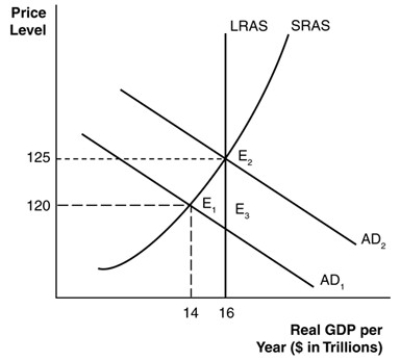 -In the above figure, if the economy is at equilibrium at E₁, the Fed would most likely
 (Multiple Choice)
4.7/5 (76)
(76)  -In the above figure, assume the economy is in equilibrium at point d. Then the Fed decreases the money supply so that the new aggregate demand curve is AD₁. In the long run, the new price level will be
 (Multiple Choice)
4.8/5 (81)
(81) Javier has been thinking about purchasing a bond but is afraid that the bond will lose value. He has decided to hold money instead. This is known as the
(Multiple Choice)
4.8/5 (68)
(68) According to the simple quantity theory of money, which of the following variables are considered either constant or relatively stable?
(Multiple Choice)
4.8/5 (60)
(60) Suppose Tim has $1,000 in cash on hand to buy collectable baseball cards at a swap meet. Tim often sells these cards at a profit. This is an example of the
(Multiple Choice)
4.9/5 (79)
(79) In an economy that is at full employment, an increase in money supply will result in inflation, unless
(Multiple Choice)
4.9/5 (80)
(80) As a result of an increase in the money supply, some banks may end up with excess reserves. What is the likely result?
(Multiple Choice)
4.9/5 (86)
(86) Asset demand for money is related to money functioning as a
(Multiple Choice)
4.9/5 (70)
(70)  -In the above figure, if the economy is initially at an equilibrium output at point A and the interest rate is r₁, then an open market purchase of bonds by the Fed will
 (Multiple Choice)
4.9/5 (97)
(97) 
Filters
- Essay(0)
- Multiple Choice(0)
- Short Answer(0)
- True False(0)
- Matching(0)