



 Chat with AI
Exam 15: Domestic and International Dimensions of Monetary Policy

Exam 1: The Nature of Economics346 Questions
Exam 2: Scarcity and the World of Trade-Offs410 Questions
Exam 3: Demand and Supply448 Questions
Exam 4: Extensions of Demand and Supply Analysis398 Questions
Exam 5: Public Spending and Public Choice359 Questions
Exam 6: Funding the Public Sector201 Questions
Exam 7: The Macroeconomy: Unemployment, Inflation, and Deflation412 Questions
Exam 8: Global Economic Growth and Development282 Questions
Exam 9: Real GDP and the Price Level in the Long Run291 Questions
Exam 10: Classical and Keynesian Macro Analyses365 Questions
Exam 11: Consumption, Real GDP, and the Multiplier445 Questions
Exam 12: Fiscal Policy273 Questions
Exam 13: Deficit Spending and the Public Debt145 Questions
Exam 14: Money Banking and Central Banking516 Questions
Exam 15: Domestic and International Dimensions of Monetary Policy356 Questions
Exam 16: Stabilization in an Integrated World Economy305 Questions
Exam 17: Policies and Prospects for Global Economic Growth216 Questions
Exam 18: Comparative Advantage and the Open Economy314 Questions
Exam 19: Exchange Rates and the Balance of Payments300 Questions
Select questions type


In the equation of exchange, if the money supply is $3 billion, the price level is 2, and the real GDP is $6 billion, the velocity is
(Multiple Choice)
4.9/5  (84)
(84)  -In the above figure, suppose the economy is in short-run equilibrium at point D. Which of the following is the best policy option for the Fed?
 (Multiple Choice)
4.7/5 (81)
(81) A major difference between the transactions demand for money and the precautionary demand is that the
(Multiple Choice)
4.7/5 (84)
(84) According to the interest-rate-based monetary policy transmission mechanism
(Multiple Choice)
4.9/5 (83)
(83)  -In the above figure, assume the economy starts out in equilibrium at point d. If the Fed increases the money supply so that the new aggregate demand curve is AD₃, then the new short-run equilibrium will be at point
 (Multiple Choice)
4.9/5 (72)
(72) According to proponents of the interest-rate-based monetary policy transmission mechanism, any increase in the money supply
(Multiple Choice)
4.9/5 (84)
(84) According to the interest-rate-based monetary policy transmission mechanism, a decrease in the money supply will
(Multiple Choice)
4.8/5 (93)
(93) The rate at which banks can borrow excess reserves from other banks is equal to
(Multiple Choice)
4.9/5 (98)
(98) Suppose the economy has a recessionary gap. By using an expansionary monetary policy, the Fed can
(Multiple Choice)
5.0/5 (89)
(89) Expansionary monetary policy during periods of underutilized resources can cause
(Multiple Choice)
4.9/5 (85)
(85) 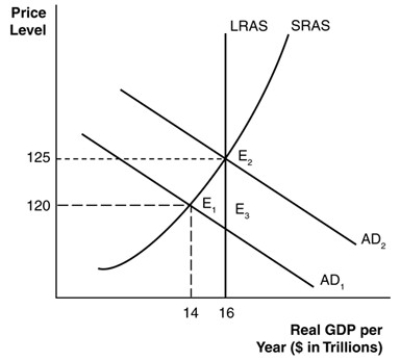 -In the above figure, if the economy is in equilibrium at E₁, then
 (Multiple Choice)
4.8/5 (81)
(81) Suppose the Fed increases the money supply. As a result of this, people deposit excess funds into their bank accounts, causing banks to have excess reserves. As a result, the banks lower the interest rates that they charge on loans, and investment rises, causing an increase in aggregate spending. This is known as a(n)
(Multiple Choice)
4.9/5 (86)
(86) Which of the following has been the most likely effect of the Fed's credit policy?
(Multiple Choice)
4.7/5 (81)
(81) 
Filters
- Essay(0)
- Multiple Choice(0)
- Short Answer(0)
- True False(0)
- Matching(0)