



 Chat with AI
Exam 15: Domestic and International Dimensions of Monetary Policy

Exam 1: The Nature of Economics346 Questions
Exam 2: Scarcity and the World of Trade-Offs410 Questions
Exam 3: Demand and Supply448 Questions
Exam 4: Extensions of Demand and Supply Analysis398 Questions
Exam 5: Public Spending and Public Choice359 Questions
Exam 6: Funding the Public Sector201 Questions
Exam 7: The Macroeconomy: Unemployment, Inflation, and Deflation412 Questions
Exam 8: Global Economic Growth and Development282 Questions
Exam 9: Real GDP and the Price Level in the Long Run291 Questions
Exam 10: Classical and Keynesian Macro Analyses365 Questions
Exam 11: Consumption, Real GDP, and the Multiplier445 Questions
Exam 12: Fiscal Policy273 Questions
Exam 13: Deficit Spending and the Public Debt145 Questions
Exam 14: Money Banking and Central Banking516 Questions
Exam 15: Domestic and International Dimensions of Monetary Policy356 Questions
Exam 16: Stabilization in an Integrated World Economy305 Questions
Exam 17: Policies and Prospects for Global Economic Growth216 Questions
Exam 18: Comparative Advantage and the Open Economy314 Questions
Exam 19: Exchange Rates and the Balance of Payments300 Questions
Select questions type


According to Keynes, the effect on planned real investment spending resulting from the interest-rate impact of a decrease in the money supply
(Multiple Choice)
4.8/5  (67)
(67) According to the text, the main reason for people to hold money is
(Multiple Choice)
4.8/5 (68)
(68) If the Fed sells bonds through its open market operations, then there is
(Multiple Choice)
4.9/5 (76)
(76) As nominal Gross Domestic Product (GDP)rises, people will wish to
(Multiple Choice)
4.9/5 (82)
(82) 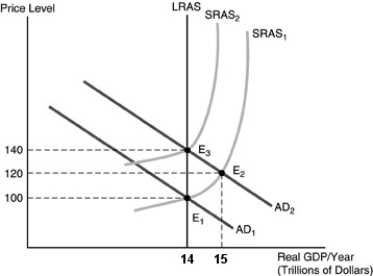 -Using a graph above, show the short-run and long-run effects of an expansionary monetary policy.
 (Essay)
4.9/5 (73)
(73) A person puts a $100 bill in the glove compartment of his car in case of an emergency. This is an example of
(Multiple Choice)
4.9/5 (85)
(85) Which of the following is NOT a type of demand for holding money?
(Multiple Choice)
4.8/5 (80)
(80) Suppose the typical household holds $1,000 when the interest rate is 5 percent. When the interest rate rises to 6 percent, the typical household would most likely hold
(Multiple Choice)
5.0/5 (76)
(76) The interest-rate-based monetary policy transmission mechanism suggests that the changes in the money supply affect aggregate spending
(Multiple Choice)
4.7/5 (93)
(93) John gets paid monthly and pays for everything with cash. When he cashes his check he keeps $200 for food, $100 for utilities, $900 for rent, $50 for transportation, $100 for entertainment and $300 for unexpected expenditures. Which of the following statements is TRUE?
(Multiple Choice)
4.8/5 (88)
(88) The interest rate that the Fed charges banks to borrow funds from the Fed is the
(Multiple Choice)
4.9/5 (77)
(77) Money's use in non-barter transactions relates to its role as a
(Multiple Choice)
4.9/5 (76)
(76) A person keeps $500 in his home in order to be prepared for some unforeseen future event. This reflects his
(Multiple Choice)
4.9/5 (65)
(65) Suppose the Fed conducts an open market sale of bonds. This monetary policy action will tend to cause
(Multiple Choice)
4.8/5 (64)
(64) 
Filters
- Essay(0)
- Multiple Choice(0)
- Short Answer(0)
- True False(0)
- Matching(0)