



 Chat with AI
Exam 15: Domestic and International Dimensions of Monetary Policy

Exam 1: The Nature of Economics346 Questions
Exam 2: Scarcity and the World of Trade-Offs410 Questions
Exam 3: Demand and Supply448 Questions
Exam 4: Extensions of Demand and Supply Analysis398 Questions
Exam 5: Public Spending and Public Choice359 Questions
Exam 6: Funding the Public Sector201 Questions
Exam 7: The Macroeconomy: Unemployment, Inflation, and Deflation412 Questions
Exam 8: Global Economic Growth and Development282 Questions
Exam 9: Real GDP and the Price Level in the Long Run291 Questions
Exam 10: Classical and Keynesian Macro Analyses365 Questions
Exam 11: Consumption, Real GDP, and the Multiplier445 Questions
Exam 12: Fiscal Policy273 Questions
Exam 13: Deficit Spending and the Public Debt145 Questions
Exam 14: Money Banking and Central Banking516 Questions
Exam 15: Domestic and International Dimensions of Monetary Policy356 Questions
Exam 16: Stabilization in an Integrated World Economy305 Questions
Exam 17: Policies and Prospects for Global Economic Growth216 Questions
Exam 18: Comparative Advantage and the Open Economy314 Questions
Exam 19: Exchange Rates and the Balance of Payments300 Questions
Select questions type


Suppose the economy currently has an inflationary gap. The Fed engages in contractionary monetary policy. The impact of contractionary monetary policy will be to
(Multiple Choice)
4.8/5  (81)
(81) If we assume that velocity is constant, and if the money supply increases by 6 percent, we would expect, ceteris paribus, that the price level would
(Multiple Choice)
4.8/5 (81)
(81) If a bond sells for $2,000 and pays $200 per year in interest, the interest rate on the bond is
(Multiple Choice)
4.8/5 (92)
(92) 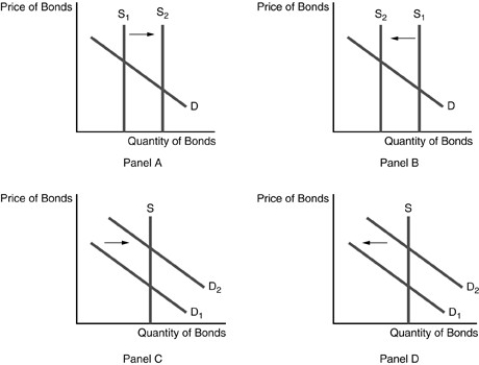 -Refer to the above figure. Which panel is consistent with the Fed selling bonds?
 (Multiple Choice)
4.8/5 (75)
(75) Which of the following is a TRUE statement about the relationship between the price of bonds and the interest rate?
(Multiple Choice)
4.8/5 (65)
(65) According to both the equation of exchange and the quantity theory of money
(Multiple Choice)
4.9/5 (75)
(75) The amount of money people wish to hold shows an inverse relationship to
(Multiple Choice)
4.8/5 (75)
(75) According to traditional Keynesians, monetary policy is ineffective in affecting the economy during a recession because
(Multiple Choice)
4.9/5 (75)
(75) According to the equation of exchange, if V = 10, P = 3, and Y = $50, then the money supply equals
(Multiple Choice)
4.8/5 (80)
(80) The asset demand for money is related to the function of money called
(Multiple Choice)
4.9/5 (94)
(94) If the economy is operating below its full employment level, the Fed can
(Multiple Choice)
5.0/5 (95)
(95) George makes $250 a week working as a student aid. When he cashes his check he takes $100 to the cashiers office to pay part of his tuition. $25 goes to paying off his books, $75 goes for entertainment and $50 he keeps for unexpected expenditures. Which of the following statements is TRUE?
(Multiple Choice)
4.9/5 (83)
(83) A key causal link in the interest-rate-based transmission mechanism for monetary policy is from
(Multiple Choice)
4.9/5 (80)
(80) A bond is selling for $1000 and it pays $150 in interest a year. If the interest rate changes to 20 percent, then
(Multiple Choice)
5.0/5 (93)
(93) 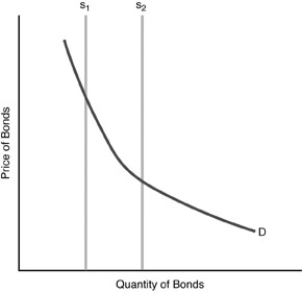 -In the above figure, if we begin at S₁ and the Fed sells bonds
 (Multiple Choice)
4.8/5 (76)
(76) Under the Fed's current interest-rate-targeting approach to monetary policy, if the demand for federal funds by depository institutions increases today, then, other things being equal
(Multiple Choice)
4.8/5 (75)
(75) 
Filters
- Essay(0)
- Multiple Choice(0)
- Short Answer(0)
- True False(0)
- Matching(0)