



 Chat with AI
Exam 15: Domestic and International Dimensions of Monetary Policy

Exam 1: The Nature of Economics346 Questions
Exam 2: Scarcity and the World of Trade-Offs410 Questions
Exam 3: Demand and Supply448 Questions
Exam 4: Extensions of Demand and Supply Analysis398 Questions
Exam 5: Public Spending and Public Choice359 Questions
Exam 6: Funding the Public Sector201 Questions
Exam 7: The Macroeconomy: Unemployment, Inflation, and Deflation412 Questions
Exam 8: Global Economic Growth and Development282 Questions
Exam 9: Real GDP and the Price Level in the Long Run291 Questions
Exam 10: Classical and Keynesian Macro Analyses365 Questions
Exam 11: Consumption, Real GDP, and the Multiplier445 Questions
Exam 12: Fiscal Policy273 Questions
Exam 13: Deficit Spending and the Public Debt145 Questions
Exam 14: Money Banking and Central Banking516 Questions
Exam 15: Domestic and International Dimensions of Monetary Policy356 Questions
Exam 16: Stabilization in an Integrated World Economy305 Questions
Exam 17: Policies and Prospects for Global Economic Growth216 Questions
Exam 18: Comparative Advantage and the Open Economy314 Questions
Exam 19: Exchange Rates and the Balance of Payments300 Questions
Select questions type


According to Keynes, the impact of a decrease in the money supply is a
(Multiple Choice)
4.8/5  (77)
(77) When interest rates rise, the transactions demand for money usually
(Multiple Choice)
5.0/5 (70)
(70) The short-run effect of an increase in the money supply is to
(Multiple Choice)
4.8/5 (68)
(68) A open market purchase of government securities by the Fed will cause which of the following?
(Multiple Choice)
4.8/5 (86)
(86) An increase in the money supply will affect aggregate demand
(Multiple Choice)
4.9/5 (77)
(77) When the rate of interest in the economy falls, there will be
(Multiple Choice)
4.9/5 (77)
(77) Which of the following is a variable in the equation of exchange?
(Multiple Choice)
4.9/5 (70)
(70) When the interest rate increases, people will adjust their precautionary demand for money
(Multiple Choice)
4.9/5 (99)
(99) An assumption used in the quantity theory of money is that
(Multiple Choice)
4.9/5 (93)
(93) If the Fed thought the economy was experiencing a recessionary gap, and it wanted to correct this gap, it would
(Multiple Choice)
4.8/5 (96)
(96) The "direct effect" of an increase in the money supply is to
(Multiple Choice)
4.9/5 (88)
(88)  -In the above figure, assume the economy starts out in equilibrium at point d. If the Fed increases the money supply so that the new aggregate demand curve is AD₃, then the long-run equilibrium will be at point
 (Multiple Choice)
4.9/5 (84)
(84) The hypothesis that changes in the money supply lead to an equiproportional change in the price level is called
(Multiple Choice)
4.8/5 (80)
(80) 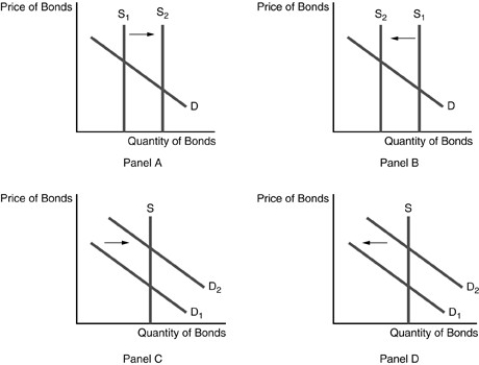 -Refer to the above figure. Which panel is consistent with the Fed buying bonds?
 (Multiple Choice)
4.7/5 (85)
(85) Which Federal Reserve Bank now regularly tracks target levels for the federal funds rate predicted by a basic Taylor-rule equation?
(Multiple Choice)
5.0/5 (82)
(82) Other things being equal, the quantity theory of money suggests that any increase in the money supply
(Multiple Choice)
4.8/5 (79)
(79) 
Filters
- Essay(0)
- Multiple Choice(0)
- Short Answer(0)
- True False(0)
- Matching(0)