



 Chat with AI
Exam 12: Fiscal Policy

Exam 1: The Nature of Economics346 Questions
Exam 2: Scarcity and the World of Trade-Offs410 Questions
Exam 3: Demand and Supply448 Questions
Exam 4: Extensions of Demand and Supply Analysis398 Questions
Exam 5: Public Spending and Public Choice359 Questions
Exam 6: Funding the Public Sector201 Questions
Exam 7: The Macroeconomy: Unemployment, Inflation, and Deflation412 Questions
Exam 8: Global Economic Growth and Development282 Questions
Exam 9: Real GDP and the Price Level in the Long Run291 Questions
Exam 10: Classical and Keynesian Macro Analyses365 Questions
Exam 11: Consumption, Real GDP, and the Multiplier445 Questions
Exam 12: Fiscal Policy273 Questions
Exam 13: Deficit Spending and the Public Debt145 Questions
Exam 14: Money Banking and Central Banking516 Questions
Exam 15: Domestic and International Dimensions of Monetary Policy356 Questions
Exam 16: Stabilization in an Integrated World Economy305 Questions
Exam 17: Policies and Prospects for Global Economic Growth216 Questions
Exam 18: Comparative Advantage and the Open Economy314 Questions
Exam 19: Exchange Rates and the Balance of Payments300 Questions
Select questions type


According to traditional Keynesian economics, expansionary fiscal policy initiated by the federal government
(Multiple Choice)
4.9/5  (84)
(84) If the government began providing free textbooks to college students who would otherwise have bought their books from the private sector, the government's action would result in
(Multiple Choice)
4.9/5 (72)
(72) By definition, a direct expenditure offset will occur whenever
(Multiple Choice)
4.9/5 (74)
(74) 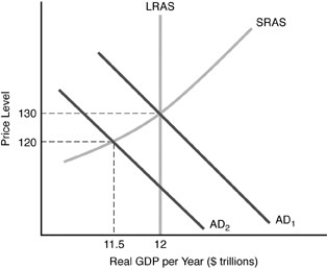 -Refer to the above figure. Suppose the relevant aggregate demand curve is AD₂. If the government wants to use discretionary fiscal policy to close the existing gap, it should
 (Multiple Choice)
4.8/5 (85)
(85) If the government increases spending while holding taxes constant, we expect
(Multiple Choice)
5.0/5 (87)
(87) The theory that government borrowing may function like an increase in taxes, that is, reducing current consumption and business expenditures, is known as
(Multiple Choice)
4.8/5 (78)
(78) Tax policy conducted for the purpose of achieving full employment, price stability, or economic growth is an example of
(Multiple Choice)
4.9/5 (78)
(78) The government might engage in expansionary fiscal policy if it wanted to
(Multiple Choice)
4.8/5 (74)
(74)  -Refer to the above figure. Suppose that the economy starts at AD₁. If the government reduces taxes, then the economy goes to AD₂, but then falls back to AD₃. This is an example of
 (Multiple Choice)
4.9/5 (76)
(76) The idea that a tax reduction funded by government borrowing has no effect on aggregate demand is known as
(Multiple Choice)
4.9/5 (72)
(72) What are the effects of fiscal policy during normal times?
What are the effects of fiscal policy during abnormal times?
(Essay)
4.8/5 (83)
(83) Which of the following is an example of an automatic stabilizer?
(Multiple Choice)
4.8/5 (66)
(66) Suppose there are two policy options facing a vote in the Senate. In the first, government spending will increase $50 billion, while the second option is to cut taxes by $50 billion. A Keynesian economist would argue for
(Multiple Choice)
4.9/5 (85)
(85) The idea that creating incentives for individuals and firms to increase productivity leading to an increase in long-run aggregate supply is
(Multiple Choice)
4.8/5 (87)
(87) Which of the following is an example of a discretionary fiscal policy action?
(Multiple Choice)
4.9/5 (87)
(87) 
Filters
- Essay(0)
- Multiple Choice(0)
- Short Answer(0)
- True False(0)
- Matching(0)