



 Chat with AI
Exam 12: Fiscal Policy

Exam 1: The Nature of Economics346 Questions
Exam 2: Scarcity and the World of Trade-Offs410 Questions
Exam 3: Demand and Supply448 Questions
Exam 4: Extensions of Demand and Supply Analysis398 Questions
Exam 5: Public Spending and Public Choice359 Questions
Exam 6: Funding the Public Sector201 Questions
Exam 7: The Macroeconomy: Unemployment, Inflation, and Deflation412 Questions
Exam 8: Global Economic Growth and Development282 Questions
Exam 9: Real GDP and the Price Level in the Long Run291 Questions
Exam 10: Classical and Keynesian Macro Analyses365 Questions
Exam 11: Consumption, Real GDP, and the Multiplier445 Questions
Exam 12: Fiscal Policy273 Questions
Exam 13: Deficit Spending and the Public Debt145 Questions
Exam 14: Money Banking and Central Banking516 Questions
Exam 15: Domestic and International Dimensions of Monetary Policy356 Questions
Exam 16: Stabilization in an Integrated World Economy305 Questions
Exam 17: Policies and Prospects for Global Economic Growth216 Questions
Exam 18: Comparative Advantage and the Open Economy314 Questions
Exam 19: Exchange Rates and the Balance of Payments300 Questions
Select questions type


If the government increases aggregate demand when the economy is at both short-run and long-run equilibrium, the full long-run effect of this fiscal policy will be to
(Multiple Choice)
4.8/5  (78)
(78) Which of the following fiscal policy actions would definitely cause an increase in the size of a recessionary gap?
(Multiple Choice)
4.8/5 (85)
(85) In the traditional Keynesian model, if the government increases spending, then
(Multiple Choice)
4.8/5 (82)
(82) 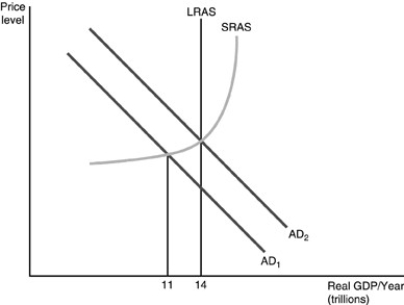 -Refer to the above figure. The government has just engaged in expansionary fiscal policy shifting the aggregate demand curve from AD₁ to AD₂. Interest rates have started to rise. Which of the following statements is TRUE in the short run?
 (Multiple Choice)
4.9/5 (82)
(82) If the government wishes to promote a higher rate of growth of real GDP, a supply-side economist would argue the appropriate policy is
(Multiple Choice)
4.8/5 (74)
(74) When private expenditures decrease as a result of increased government spending, this is known as
(Multiple Choice)
4.7/5 (68)
(68) Suppose that real GDP is initially $13 trillion and the government attempts to increase real GDP to $14 trillion. The marginal propensity to consume is 0.75, and every $1.00 increase in real government spending crowds out $0.50 in real planned investment expenditures. How much increase in real government spending could lead to the desired level of real GDP?
(Multiple Choice)
4.8/5 (63)
(63) Which of the following best explains why the federal tax rebates in 2008 and 2009 had almost no effects on aggregate demand?
(Multiple Choice)
4.8/5 (76)
(76) The government wants to increase its spending by $1 billion to stimulate the economy and is counting on the government spending multiplier to help. Taking into account direct expenditure offset effects, what is its best spending option?
(Multiple Choice)
4.8/5 (86)
(86) An increase in government spending that is not financed by an increase in taxes will cause which of the following?
(Multiple Choice)
4.8/5 (61)
(61) Supply-side economists argue that changes in tax rates cause changes in
(Multiple Choice)
5.0/5 (68)
(68) If other factors are held constant, what happens when the federal government finances a growing budget deficit by increasing the amount it borrows from the private sector?
(Multiple Choice)
4.8/5 (75)
(75) 
Filters
- Essay(0)
- Multiple Choice(0)
- Short Answer(0)
- True False(0)
- Matching(0)