



 Chat with AI
Exam 12: Fiscal Policy

Exam 1: The Nature of Economics346 Questions
Exam 2: Scarcity and the World of Trade-Offs410 Questions
Exam 3: Demand and Supply448 Questions
Exam 4: Extensions of Demand and Supply Analysis398 Questions
Exam 5: Public Spending and Public Choice359 Questions
Exam 6: Funding the Public Sector201 Questions
Exam 7: The Macroeconomy: Unemployment, Inflation, and Deflation412 Questions
Exam 8: Global Economic Growth and Development282 Questions
Exam 9: Real GDP and the Price Level in the Long Run291 Questions
Exam 10: Classical and Keynesian Macro Analyses365 Questions
Exam 11: Consumption, Real GDP, and the Multiplier445 Questions
Exam 12: Fiscal Policy273 Questions
Exam 13: Deficit Spending and the Public Debt145 Questions
Exam 14: Money Banking and Central Banking516 Questions
Exam 15: Domestic and International Dimensions of Monetary Policy356 Questions
Exam 16: Stabilization in an Integrated World Economy305 Questions
Exam 17: Policies and Prospects for Global Economic Growth216 Questions
Exam 18: Comparative Advantage and the Open Economy314 Questions
Exam 19: Exchange Rates and the Balance of Payments300 Questions
Select questions type


If an increase in government spending causes an increase in government borrowing, this could induce
(Multiple Choice)
4.7/5  (62)
(62) Which of the following fiscal policy actions would be appropriate if the economy is experiencing an inflationary gap?
(Multiple Choice)
4.9/5 (77)
(77) If there is a dollar-for-dollar direct expenditure offset, then
(Multiple Choice)
4.7/5 (89)
(89) To the extent that the political process of moving legislation through Congress is slow
(Multiple Choice)
4.8/5 (73)
(73) Supply-side economists argue that decreasing marginal tax rates
(Multiple Choice)
4.8/5 (73)
(73) The time required to acquire information about the state of the economy is referred to as
(Multiple Choice)
4.8/5 (77)
(77) When real Gross Domestic Product (GDP)falls, which of the following will automatically occur?
(Multiple Choice)
4.9/5 (76)
(76) When there is an interval between when the fiscal policy changes and corresponding changes in aggregate spending, we have a(n)
(Multiple Choice)
4.9/5 (79)
(79) Suppose policy makers pass a budget that results in a reduction in government spending and no change in taxes. This reduction in government spending will likely
(Multiple Choice)
4.9/5 (87)
(87) Government-provided unemployment insurance is an example of
(Multiple Choice)
4.8/5 (63)
(63) In 2009, Congress passed a bill that involved government spending increases and tax cuts with the purpose of stimulating the U.S. economy. This policy is an example of
(Multiple Choice)
4.8/5 (72)
(72) According to supply-side economists, lower marginal tax rates will not necessarily lead to lower tax revenues because
(Multiple Choice)
4.9/5 (83)
(83) Keynes believed that the way to prevent recessions and depressions was to
(Multiple Choice)
4.9/5 (68)
(68) The notion that a decline in tax rates and other incentives will spur individuals and firms to increase productivity is typically referred to as
(Multiple Choice)
4.9/5 (69)
(69) 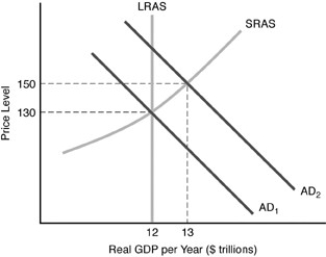 -Refer to the above figure. If the relevant aggregate demand curve is AD₁, then the economy is experiencing
 (Multiple Choice)
4.7/5 (88)
(88) 
Filters
- Essay(0)
- Multiple Choice(0)
- Short Answer(0)
- True False(0)
- Matching(0)