



 Chat with AI
Exam 12: Fiscal Policy

Exam 1: The Nature of Economics346 Questions
Exam 2: Scarcity and the World of Trade-Offs410 Questions
Exam 3: Demand and Supply448 Questions
Exam 4: Extensions of Demand and Supply Analysis398 Questions
Exam 5: Public Spending and Public Choice359 Questions
Exam 6: Funding the Public Sector201 Questions
Exam 7: The Macroeconomy: Unemployment, Inflation, and Deflation412 Questions
Exam 8: Global Economic Growth and Development282 Questions
Exam 9: Real GDP and the Price Level in the Long Run291 Questions
Exam 10: Classical and Keynesian Macro Analyses365 Questions
Exam 11: Consumption, Real GDP, and the Multiplier445 Questions
Exam 12: Fiscal Policy273 Questions
Exam 13: Deficit Spending and the Public Debt145 Questions
Exam 14: Money Banking and Central Banking516 Questions
Exam 15: Domestic and International Dimensions of Monetary Policy356 Questions
Exam 16: Stabilization in an Integrated World Economy305 Questions
Exam 17: Policies and Prospects for Global Economic Growth216 Questions
Exam 18: Comparative Advantage and the Open Economy314 Questions
Exam 19: Exchange Rates and the Balance of Payments300 Questions
Select questions type


 -Refer to the above figure. Suppose that the economy starts at AD₁. If the government reduces taxes, then the economy goes to AD₂, but then falls back to AD₁. This is an example of
 (Multiple Choice)
5.0/5  (60)
(60) According to the traditional Keynesian analysis, if the government increases spending by $10 million, then
(Multiple Choice)
4.9/5 (85)
(85) Whenever government spending is a substitute for private spending
(Multiple Choice)
4.8/5 (93)
(93) Which one of the following is an example of discretionary fiscal policy used to correct a recessionary gap?
(Multiple Choice)
4.8/5 (77)
(77) A problem with using fiscal policy to fine-tune the economy is that
(Multiple Choice)
4.7/5 (74)
(74) According to the Ricardian equivalence theorem, budget deficits resulting from tax cuts
(Multiple Choice)
4.8/5 (78)
(78) What are the automatic stabilizers the United States has in place, and how do they function differently from discretionary fiscal policy?
(Essay)
4.9/5 (75)
(75) Suppose that real GDP is initially $14 trillion and the government attempts to increase real GDP to $15 trillion. The marginal propensity to consume is 0.8, and every $1.00 increase in real government spending crowds out $0.50 in real planned investment expenditures. Which increase in government spending below could yield the desired level of real GDP?
(Multiple Choice)
5.0/5 (72)
(72) 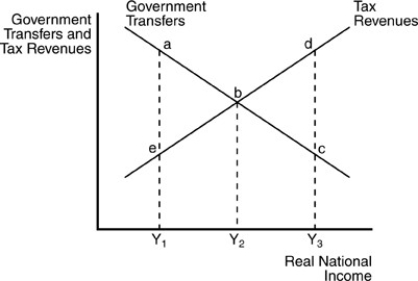 -Refer to the above figure. A budget deficit occurs when real national income is
 (Multiple Choice)
4.8/5 (79)
(79) Many government programs, such as unemployment compensation, operate on a deficit during recessions and a surplus during periods of economic expansion. The programs are referred to as
(Multiple Choice)
4.9/5 (82)
(82)
-Refer to the above figure. Suppose that the economy initially is operating along AD₁. If the government seeks to close the recessionary gap by raising government spending without any change in taxation, which moves the aggregate demand curve from AD₁ to AD₂, then to AD₃. Which of the following scenarios is TRUE?
-Refer to the above figure. Suppose that the economy initially is operating along AD₁. If the government seeks to close the recessionary gap by raising government spending without any change in taxation, which moves the aggregate demand curve from AD₁ to AD₂, then to AD₃. Which of the following scenarios is TRUE? (Multiple Choice)
4.8/5 (82)
(82) A direct expenditure offset occurs when an increase in government spending
(Multiple Choice)
4.8/5 (84)
(84) 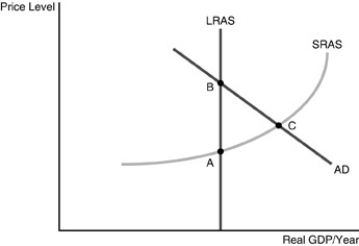 -Refer to the above figure. If the economy is currently operating at point C, then there is
 (Multiple Choice)
4.9/5 (73)
(73) The government has decided to give every person in the U.S. a $5 coupon that they can use at the grocery store to purchase their choice of cheese. We would expect this policy to lead to
(Multiple Choice)
4.8/5 (92)
(92) Suppose the economy is experiencing a recessionary gap at the current level of GDP. Which of the following fiscal policy actions would be most appropriate given this recessionary gap?
(Multiple Choice)
4.8/5 (91)
(91) According to supply-side economics, changes in marginal tax rates will have which of the following effects?
(Multiple Choice)
4.7/5 (78)
(78) 
Filters
- Essay(0)
- Multiple Choice(0)
- Short Answer(0)
- True False(0)
- Matching(0)