



 Chat with AI
Exam 53: Nursing Management: Acute Intracranial Problems

Exam 1: The Importance of Nursing21 Questions
Exam 3: Health Disparities and Cultural Care18 Questions
Exam 4: Pain Management25 Questions
Exam 5: Palliative Care16 Questions
Exam 6: Substance Use and Dependency25 Questions
Exam 8: Nursing Management: Inflammation and Wound Healing22 Questions
Exam 9: Genetics and Genomics7 Questions
Exam 10: Altered Immune Responses and Transplantation26 Questions
Exam 11: Nursing Management: Infection and Human Immunodeficiency Virus Infection26 Questions
Exam 12: Cancer43 Questions
Exam 13: Nursing Management: Fluid,electrolyte and Acidbase Imbalances37 Questions
Exam 14: Nursing Management: Preoperative Care21 Questions
Exam 15: Nursing Management: Intraoperative Care18 Questions
Exam 16: Nursing Management: Postoperative Care25 Questions
Exam 17: Nursing Assessment: Visual and Auditory Systems26 Questions
Exam 18: Nursing Management: Visual and Auditory Problems47 Questions
Exam 19: Nursing Assessment: Integumentary System13 Questions
Exam 20: Nursing Management: Integumentary Problems26 Questions
Exam 21: Nursing Management: Burns31 Questions
Exam 22: Nursing Assessment: Respiratory System24 Questions
Exam 23: Nursing Management: Upper Respiratory Problems25 Questions
Exam 24: Nursing Management: Lower Respiratory Problems51 Questions
Exam 25: Nursing Management: Obstructive Pulmonary Diseases44 Questions
Exam 26: Nursing Assessment: Haematological System16 Questions
Exam 27: Nursing Management: Haematological Problems48 Questions
Exam 28: Nursing Assessment: Cardiovascular System24 Questions
Exam 29: Nursing Management: Hypertension24 Questions
Exam 30: Nursing Management: Coronary Artery Disease and Acute Coronary Syndrome43 Questions
Exam 31: Nursing Management: Heart Failure26 Questions
Exam 32: Nursing Management: Ecg Monitoring and Arrhythmias31 Questions
Exam 33: Nursing Management: Inflammatory and Structural Heart Disorders35 Questions
Exam 34: Nursing Management: Vascular Disorders36 Questions
Exam 35: Nursing Assessment: Gastrointestinal System18 Questions
Exam 36: Nursing Management: Nutritional Problems24 Questions
Exam 37: Nursing Management: Obesity20 Questions
Exam 38: Nursing Management: Upper Gastrointestinal Problems47 Questions
Exam 39: Nursing Management: Lower Gastrointestinal Problems56 Questions
Exam 40: Nursing Management: Liver,pancreas and Biliary Tract Problems46 Questions
Exam 41: Nursing Assessment: Urinary System24 Questions
Exam 42: Nursing Management: Renal and Urological Problems45 Questions
Exam 43: Nursing Management: Acute Kidney Injury and Chronic Kidney Disease39 Questions
Exam 44: Nursing Assessment: Endocrine System22 Questions
Exam 45: Nursing Management: Diabetes Mellitus49 Questions
Exam 46: Nursing Management: Endocrine Problems46 Questions
Exam 47: Nursing Assessment: Reproductive System19 Questions
Exam 48: Nursing Management: Breast Disorders28 Questions
Exam 49: Nursing Management: Sexually Transmitted Infections19 Questions
Exam 50: Nursing Management: Female Reproductive Problems49 Questions
Exam 51: Nursing Management: Male Reproductive Problems35 Questions
Exam 52: Nursing Assessment: Nervous System21 Questions
Exam 53: Nursing Management: Acute Intracranial Problems40 Questions
Exam 54: Nursing Management: the Patient With a Stroke30 Questions
Exam 55: Nursing Management: Chronic Neurological Problems36 Questions
Exam 56: Nursing Management: Delirium,depression and Dementia21 Questions
Exam 57: Nursing Management: Peripheral Nerve and Spinal Cord Problems33 Questions
Exam 58: Nursing Assessment: Musculoskeletal System16 Questions
Exam 59: Nursing Management: Musculoskeletal Trauma and Orthopaedic Surgery47 Questions
Exam 60: Nursing Management: Musculoskeletal Problems25 Questions
Exam 61: Nursing Management: Arthritis and Connective Tissue Diseases47 Questions
Exam 62: Nursing Management: Critical Care Environment41 Questions
Exam 63: Nursing Management: Shock,systemic Inflammatory Response Syndrome and Multiple Organ Dysfunction Syndrome29 Questions
Exam 64: Nursing Management: Respiratory Failure and Acute Respiratory Distress Syndrome27 Questions
Exam 65: Nursing Management: Emergency Care Situations26 Questions
Select questions type


After the emergency department nurse has received a status report on the following patients who have been admitted with head injuries,which patient should the nurse assess first?
(Multiple Choice)
4.9/5  (92)
(92) A college athlete is seen in the clinic 6 weeks after a concussion.Which assessment information will the nurse collect to determine whether a patient is developing postconcussion syndrome?
(Multiple Choice)
4.9/5 (71)
(71) A patient has been admitted with meningococcal meningitis.Which observation by the nurse requires action?
(Multiple Choice)
4.9/5 (76)
(76) A male patient who has possible cerebral edema has a serum sodium level of 116 mEq/L (116 mmol/L)and a decreasing level of consciousness (LOC).He is now complaining of a headache.Which prescribed interventions should the nurse implement first?
(Multiple Choice)
4.8/5 (70)
(70) The charge nurse observes an inexperienced staff nurse caring for a patient who has had a craniotomy for resection of a brain tumor.Which action by the inexperienced nurse requires the charge nurse to intervene?
(Multiple Choice)
4.9/5 (72)
(72) An unconscious 39-year-old male patient is admitted to the emergency department (ED)with a head injury.The patient's spouse and teenage children stay at the patient's side and ask many questions about the treatment being given.What action is best for the nurse to take?
(Multiple Choice)
4.8/5 (79)
(79) A patient being admitted with bacterial meningitis has a temperature of 102.5° F (39.2° C)and a severe headache.Which order for collaborative intervention should the nurse implement first?
(Multiple Choice)
4.7/5 (88)
(88) To assess for functional deficits,which question will the nurse ask a patient who has been admitted for treatment of a benign occipital lobe tumor?
(Multiple Choice)
4.9/5 (73)
(73) When a brain-injured patient responds to nail bed pressure with internal rotation,adduction,and flexion of the arms,the nurse reports the response as
(Multiple Choice)
4.8/5 (75)
(75) After evacuation of an epidural hematoma,a patient's intracranial pressure (ICP)is being monitored with an intraventricular catheter.Which information obtained by the nurse is most important to communicate to the health care provider?
(Multiple Choice)
4.9/5 (74)
(74) Which patient is most appropriate for the intensive care unit (ICU)charge nurse to assign to a registered nurse (RN)who has floated from the medical unit?
(Multiple Choice)
4.7/5 (86)
(86) Admission vital signs for a brain-injured patient are blood pressure 128/68,pulse 110,and respirations 26.Which set of vital signs,if taken 1 hour after admission,will be of most concern to the nurse?
(Multiple Choice)
4.9/5 (104)
(104) Which is the correct point on the accompanying figure where the nurse will assess for ecchymosis when admitting a patient with a basilar skull fracture? 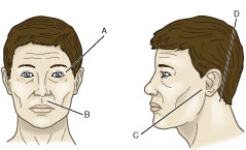
(Multiple Choice)
4.7/5 (90)
(90) The public health nurse is planning a program to decrease the incidence of meningitis in adolescents and young adults.Which action is most important?
(Multiple Choice)
4.9/5 (83)
(83) Which information about a 30-year-old patient who is hospitalized after a traumatic brain injury requires the most rapid action by the nurse?
(Multiple Choice)
4.9/5 (84)
(84) When admitting a 42-year-old patient with a possible brain injury after a car accident to the emergency department (ED),the nurse obtains the following information.Which finding is most important to report to the health care provider?
(Multiple Choice)
4.8/5 (86)
(86) The nurse is caring for a patient who was admitted the previous day with a basilar skull fracture after a motor vehicle crash.Which assessment finding is most important to report to the health care provider?
(Multiple Choice)
4.9/5 (86)
(86) After having a craniectomy and left anterior fossae incision,a 64-year-old patient has a nursing diagnosis of impaired physical mobility related to decreased level of consciousness and weakness.An appropriate nursing intervention is to
(Multiple Choice)
4.8/5 (94)
(94) The nurse is caring for a patient who has a head injury and fractured right arm after being assaulted.Which assessment information requires the most rapid action by the nurse?
(Multiple Choice)
4.9/5 (87)
(87) Which action will the public health nurse take to reduce the incidence of epidemic encephalitis in a community?
(Multiple Choice)
4.7/5 (87)
(87) 
Filters
- Essay(0)
- Multiple Choice(0)
- Short Answer(0)
- True False(0)
- Matching(0)