



 Chat with AI
Exam 63: Nursing Management: Shock,systemic Inflammatory Response Syndrome and Multiple Organ Dysfunction Syndrome

Exam 1: The Importance of Nursing21 Questions
Exam 3: Health Disparities and Cultural Care18 Questions
Exam 4: Pain Management25 Questions
Exam 5: Palliative Care16 Questions
Exam 6: Substance Use and Dependency25 Questions
Exam 8: Nursing Management: Inflammation and Wound Healing22 Questions
Exam 9: Genetics and Genomics7 Questions
Exam 10: Altered Immune Responses and Transplantation26 Questions
Exam 11: Nursing Management: Infection and Human Immunodeficiency Virus Infection26 Questions
Exam 12: Cancer43 Questions
Exam 13: Nursing Management: Fluid,electrolyte and Acidbase Imbalances37 Questions
Exam 14: Nursing Management: Preoperative Care21 Questions
Exam 15: Nursing Management: Intraoperative Care18 Questions
Exam 16: Nursing Management: Postoperative Care25 Questions
Exam 17: Nursing Assessment: Visual and Auditory Systems26 Questions
Exam 18: Nursing Management: Visual and Auditory Problems47 Questions
Exam 19: Nursing Assessment: Integumentary System13 Questions
Exam 20: Nursing Management: Integumentary Problems26 Questions
Exam 21: Nursing Management: Burns31 Questions
Exam 22: Nursing Assessment: Respiratory System24 Questions
Exam 23: Nursing Management: Upper Respiratory Problems25 Questions
Exam 24: Nursing Management: Lower Respiratory Problems51 Questions
Exam 25: Nursing Management: Obstructive Pulmonary Diseases44 Questions
Exam 26: Nursing Assessment: Haematological System16 Questions
Exam 27: Nursing Management: Haematological Problems48 Questions
Exam 28: Nursing Assessment: Cardiovascular System24 Questions
Exam 29: Nursing Management: Hypertension24 Questions
Exam 30: Nursing Management: Coronary Artery Disease and Acute Coronary Syndrome43 Questions
Exam 31: Nursing Management: Heart Failure26 Questions
Exam 32: Nursing Management: Ecg Monitoring and Arrhythmias31 Questions
Exam 33: Nursing Management: Inflammatory and Structural Heart Disorders35 Questions
Exam 34: Nursing Management: Vascular Disorders36 Questions
Exam 35: Nursing Assessment: Gastrointestinal System18 Questions
Exam 36: Nursing Management: Nutritional Problems24 Questions
Exam 37: Nursing Management: Obesity20 Questions
Exam 38: Nursing Management: Upper Gastrointestinal Problems47 Questions
Exam 39: Nursing Management: Lower Gastrointestinal Problems56 Questions
Exam 40: Nursing Management: Liver,pancreas and Biliary Tract Problems46 Questions
Exam 41: Nursing Assessment: Urinary System24 Questions
Exam 42: Nursing Management: Renal and Urological Problems45 Questions
Exam 43: Nursing Management: Acute Kidney Injury and Chronic Kidney Disease39 Questions
Exam 44: Nursing Assessment: Endocrine System22 Questions
Exam 45: Nursing Management: Diabetes Mellitus49 Questions
Exam 46: Nursing Management: Endocrine Problems46 Questions
Exam 47: Nursing Assessment: Reproductive System19 Questions
Exam 48: Nursing Management: Breast Disorders28 Questions
Exam 49: Nursing Management: Sexually Transmitted Infections19 Questions
Exam 50: Nursing Management: Female Reproductive Problems49 Questions
Exam 51: Nursing Management: Male Reproductive Problems35 Questions
Exam 52: Nursing Assessment: Nervous System21 Questions
Exam 53: Nursing Management: Acute Intracranial Problems40 Questions
Exam 54: Nursing Management: the Patient With a Stroke30 Questions
Exam 55: Nursing Management: Chronic Neurological Problems36 Questions
Exam 56: Nursing Management: Delirium,depression and Dementia21 Questions
Exam 57: Nursing Management: Peripheral Nerve and Spinal Cord Problems33 Questions
Exam 58: Nursing Assessment: Musculoskeletal System16 Questions
Exam 59: Nursing Management: Musculoskeletal Trauma and Orthopaedic Surgery47 Questions
Exam 60: Nursing Management: Musculoskeletal Problems25 Questions
Exam 61: Nursing Management: Arthritis and Connective Tissue Diseases47 Questions
Exam 62: Nursing Management: Critical Care Environment41 Questions
Exam 63: Nursing Management: Shock,systemic Inflammatory Response Syndrome and Multiple Organ Dysfunction Syndrome29 Questions
Exam 64: Nursing Management: Respiratory Failure and Acute Respiratory Distress Syndrome27 Questions
Exam 65: Nursing Management: Emergency Care Situations26 Questions
Select questions type


Which data collected by the nurse caring for a patient who has cardiogenic shock indicate that the patient may be developing multiple organ dysfunction syndrome (MODS)?

Free
(Multiple Choice)
4.8/5  (80)
(80) Correct Answer: Verified
A
A 198-lb patient is to receive a dobutamine infusion at 5 mcg/kg/minute.The label on the infusion bag states: dobutamine 250 mg in 250 mL normal saline.When setting the infusion pump,the nurse will set the infusion rate at how many mL per hour?
Free
(Short Answer)
4.8/5 (86)
(86) Correct Answer:Verified
Verified27
In order to administer the dobutamine at the prescribed rate of 5 mcg/kg/minute from a concentration of 250 mg in 250 mL,the nurse will need to infuse 27 mL/hour.
Which intervention will the nurse include in the plan of care for a patient who has cardiogenic shock?
Free
(Multiple Choice)
4.9/5 (75)
(75) Correct Answer:Verified
VerifiedB
The health care provider orders the following interventions for a 67-kg patient who has septic shock with a BP of 70/42 mm Hg and oxygen saturation of 90% on room air.In which order will the nurse implement the actions? (Put a comma and a space between each answer choice [A,B,C,D,E].)
(Multiple Choice)
4.7/5 (75)
(75) A patient with cardiogenic shock has the following vital signs: BP 102/50,pulse 128,respirations 28.The pulmonary artery wedge pressure (PAWP)is increased and cardiac output is low.The nurse will anticipate an order for which medication?
(Multiple Choice)
4.7/5 (74)
(74) Which finding is the best indicator that the fluid resuscitation for a patient with hypovolemic shock has been effective?
(Multiple Choice)
5.0/5 (89)
(89) A nurse is caring for a patient with shock of unknown etiology whose hemodynamic monitoring indicates BP 92/54,pulse 64,and an elevated pulmonary artery wedge pressure.Which collaborative intervention ordered by the health care provider should the nurse question?
(Multiple Choice)
4.9/5 (77)
(77) After receiving 2 L of normal saline,the central venous pressure for a patient who has septic shock is 10 mm Hg,but the blood pressure is still 82/40 mm Hg.The nurse will anticipate an order for
(Multiple Choice)
4.9/5 (91)
(91) A patient with septic shock has a BP of 70/46 mm Hg,pulse 136,respirations 32,temperature 104° F,and blood glucose 246 mg/dL.Which intervention ordered by the health care provider should the nurse implement first?
(Multiple Choice)
4.8/5 (87)
(87) The nurse is caring for a patient who has septic shock.Which assessment finding is most important for the nurse to report to the health care provider?
(Multiple Choice)
5.0/5 (69)
(69) Norepinephrine (Levophed)has been prescribed for a patient who was admitted with dehydration and hypotension.Which patient data indicate that the nurse should consult with the health care provider before starting the norepinephrine?
(Multiple Choice)
4.8/5 (80)
(80) The emergency department (ED)nurse receives report that a patient involved in a motor vehicle crash is being transported to the facility with an estimated arrival in 1 minute.In preparation for the patient's arrival,the nurse will obtain
(Multiple Choice)
4.9/5 (66)
(66) A patient who has been involved in a motor vehicle crash arrives in the emergency department (ED)with cool,clammy skin; tachycardia; and hypotension.Which intervention ordered by the health care provider should the nurse implement first?
(Multiple Choice)
4.9/5 (79)
(79) The patient with neurogenic shock is receiving a phenylephrine (Neo-Synephrine)infusion through a right forearm IV.Which assessment finding obtained by the nurse indicates a need for immediate action?
(Multiple Choice)
4.8/5 (77)
(77) Which preventive actions by the nurse will help limit the development of systemic inflammatory response syndrome (SIRS)in patients admitted to the hospital (select all that apply)?
(Multiple Choice)
4.8/5 (89)
(89) After reviewing the information shown in the accompanying figure for a patient with pneumonia and sepsis,which information is most important to report to the health care provider? 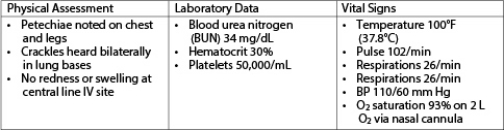
(Multiple Choice)
4.8/5 (69)
(69) A 78-kg patient with septic shock has a urine output of 30 mL/hr for the past 3 hours.The pulse rate is 120/minute and the central venous pressure and pulmonary artery wedge pressure are low.Which order by the health care provider will the nurse question?
(Multiple Choice)
4.8/5 (76)
(76) When the nurse educator is evaluating the skills of a new registered nurse (RN)caring for patients experiencing shock,which action by the new RN indicates a need for more education?
(Multiple Choice)
4.8/5 (98)
(98) A patient is admitted to the emergency department (ED)for shock of unknown etiology.The first action by the nurse should be to
(Multiple Choice)
5.0/5 (81)
(81) After change-of-shift report in the progressive care unit,who should the nurse care for first?
(Multiple Choice)
4.8/5 (74)
(74) 
Filters
- Essay(0)
- Multiple Choice(0)
- Short Answer(0)
- True False(0)
- Matching(0)