



 Chat with AI
Exam 48: Nursing Management: Breast Disorders

Exam 1: The Importance of Nursing21 Questions
Exam 3: Health Disparities and Cultural Care18 Questions
Exam 4: Pain Management25 Questions
Exam 5: Palliative Care16 Questions
Exam 6: Substance Use and Dependency25 Questions
Exam 8: Nursing Management: Inflammation and Wound Healing22 Questions
Exam 9: Genetics and Genomics7 Questions
Exam 10: Altered Immune Responses and Transplantation26 Questions
Exam 11: Nursing Management: Infection and Human Immunodeficiency Virus Infection26 Questions
Exam 12: Cancer43 Questions
Exam 13: Nursing Management: Fluid,electrolyte and Acidbase Imbalances37 Questions
Exam 14: Nursing Management: Preoperative Care21 Questions
Exam 15: Nursing Management: Intraoperative Care18 Questions
Exam 16: Nursing Management: Postoperative Care25 Questions
Exam 17: Nursing Assessment: Visual and Auditory Systems26 Questions
Exam 18: Nursing Management: Visual and Auditory Problems47 Questions
Exam 19: Nursing Assessment: Integumentary System13 Questions
Exam 20: Nursing Management: Integumentary Problems26 Questions
Exam 21: Nursing Management: Burns31 Questions
Exam 22: Nursing Assessment: Respiratory System24 Questions
Exam 23: Nursing Management: Upper Respiratory Problems25 Questions
Exam 24: Nursing Management: Lower Respiratory Problems51 Questions
Exam 25: Nursing Management: Obstructive Pulmonary Diseases44 Questions
Exam 26: Nursing Assessment: Haematological System16 Questions
Exam 27: Nursing Management: Haematological Problems48 Questions
Exam 28: Nursing Assessment: Cardiovascular System24 Questions
Exam 29: Nursing Management: Hypertension24 Questions
Exam 30: Nursing Management: Coronary Artery Disease and Acute Coronary Syndrome43 Questions
Exam 31: Nursing Management: Heart Failure26 Questions
Exam 32: Nursing Management: Ecg Monitoring and Arrhythmias31 Questions
Exam 33: Nursing Management: Inflammatory and Structural Heart Disorders35 Questions
Exam 34: Nursing Management: Vascular Disorders36 Questions
Exam 35: Nursing Assessment: Gastrointestinal System18 Questions
Exam 36: Nursing Management: Nutritional Problems24 Questions
Exam 37: Nursing Management: Obesity20 Questions
Exam 38: Nursing Management: Upper Gastrointestinal Problems47 Questions
Exam 39: Nursing Management: Lower Gastrointestinal Problems56 Questions
Exam 40: Nursing Management: Liver,pancreas and Biliary Tract Problems46 Questions
Exam 41: Nursing Assessment: Urinary System24 Questions
Exam 42: Nursing Management: Renal and Urological Problems45 Questions
Exam 43: Nursing Management: Acute Kidney Injury and Chronic Kidney Disease39 Questions
Exam 44: Nursing Assessment: Endocrine System22 Questions
Exam 45: Nursing Management: Diabetes Mellitus49 Questions
Exam 46: Nursing Management: Endocrine Problems46 Questions
Exam 47: Nursing Assessment: Reproductive System19 Questions
Exam 48: Nursing Management: Breast Disorders28 Questions
Exam 49: Nursing Management: Sexually Transmitted Infections19 Questions
Exam 50: Nursing Management: Female Reproductive Problems49 Questions
Exam 51: Nursing Management: Male Reproductive Problems35 Questions
Exam 52: Nursing Assessment: Nervous System21 Questions
Exam 53: Nursing Management: Acute Intracranial Problems40 Questions
Exam 54: Nursing Management: the Patient With a Stroke30 Questions
Exam 55: Nursing Management: Chronic Neurological Problems36 Questions
Exam 56: Nursing Management: Delirium,depression and Dementia21 Questions
Exam 57: Nursing Management: Peripheral Nerve and Spinal Cord Problems33 Questions
Exam 58: Nursing Assessment: Musculoskeletal System16 Questions
Exam 59: Nursing Management: Musculoskeletal Trauma and Orthopaedic Surgery47 Questions
Exam 60: Nursing Management: Musculoskeletal Problems25 Questions
Exam 61: Nursing Management: Arthritis and Connective Tissue Diseases47 Questions
Exam 62: Nursing Management: Critical Care Environment41 Questions
Exam 63: Nursing Management: Shock,systemic Inflammatory Response Syndrome and Multiple Organ Dysfunction Syndrome29 Questions
Exam 64: Nursing Management: Respiratory Failure and Acute Respiratory Distress Syndrome27 Questions
Exam 65: Nursing Management: Emergency Care Situations26 Questions
Select questions type


A patient who is scheduled for a lumpectomy and axillary lymph node dissection tells the nurse,"I would rather not know much about the surgery." Which response by the nurse is best?

Free
(Multiple Choice)
4.8/5  (81)
(81) Correct Answer: Verified
A
The nurse notes bilateral enlargement of the breasts during examination of a 62-year-old man.Which action should the nurse take first?
Free
(Multiple Choice)
5.0/5 (73)
(73) Correct Answer:Verified
VerifiedB
When using the accompanying illustration to teach a patient about breast self-examination,the nurse will include the information that most breast cancers are located in which part of the breast? 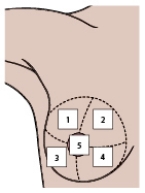
Free
(Multiple Choice)
4.9/5 (72)
(72) Correct Answer:Verified
VerifiedA
Which action will the nurse include in the plan of care for a patient with right arm lymphedema?
(Multiple Choice)
4.8/5 (91)
(91) The nurse provides discharge teaching for a 61-year-old patient who has had a left modified radical mastectomy and lymph node dissection.Which statement by the patient indicates that teaching has been successful?
(Multiple Choice)
4.8/5 (81)
(81) Which nursing action should be included in the plan of care for a patient returning to the surgical unit following a left modified radical mastectomy with dissection of axillary lymph nodes?
(Multiple Choice)
4.8/5 (75)
(75) A 33-year-old patient has a saline breast implant inserted in the outpatient surgery area.Which instruction will the nurse include in the discharge teaching?
(Multiple Choice)
4.8/5 (80)
(80) Which information should the nurse include in teaching a patient who is scheduled for external beam radiation to the breast?
(Multiple Choice)
4.9/5 (76)
(76) During a well woman physical exam,a 43-year-old patient asks about her risk for breast cancer.Which question is most pertinent for the nurse to ask?
(Multiple Choice)
4.9/5 (84)
(84) After a 48-year-old patient has had a modified radical mastectomy,the pathology report identifies the tumor as an estrogen-receptor positive adenocarcinoma.The nurse will plan to teach the patient about
(Multiple Choice)
4.9/5 (90)
(90) A student nurse prepares a list of teaching topics for a patient with a new diagnosis of breast cancer.Which item should the charge nurse suggest that the student nurse omit from the teaching topic list about breast cancer diagnostic testing?
(Multiple Choice)
4.7/5 (86)
(86) Which assessment finding in a 36-year-old patient is most indicative of a need for further evaluation?
(Multiple Choice)
5.0/5 (84)
(84) Which information will the nurse include in patient teaching for a 36-year-old patient who is scheduled for stereotactic core biopsy of the breast?
(Multiple Choice)
4.9/5 (91)
(91) The nurse is admitting a patient scheduled this morning for lumpectomy and axillary lymph node dissection.Which action should the nurse take first?
(Multiple Choice)
4.8/5 (81)
(81) When the nurse is working in the women's health care clinic,which action is appropriate to take?
(Multiple Choice)
4.8/5 (81)
(81) The outpatient clinic receives telephone calls from four patients.Which patient should the nurse call back first?
(Multiple Choice)
4.9/5 (71)
(71) The nurse is providing preoperative teaching about the transverse rectus abdominis musculocutaneous (TRAM)procedure to a patient.Which information will the nurse include?
(Multiple Choice)
4.8/5 (86)
(86) The nurse will anticipate teaching a 56-year-old patient who is diagnosed with lobular carcinoma in situ (LCIS)about
(Multiple Choice)
4.7/5 (87)
(87) Which patient statement indicates that the nurse's teaching about tamoxifen (Nolvadex)has been effective?
(Multiple Choice)
4.8/5 (91)
(91) The nurse will teach a patient with metastatic breast cancer who has a new prescription for trastuzumab (Herceptin)that
(Multiple Choice)
4.8/5 (77)
(77) 
Filters
- Essay(0)
- Multiple Choice(0)
- Short Answer(0)
- True False(0)
- Matching(0)