



 Chat with AI
Exam 30: Nursing Management: Coronary Artery Disease and Acute Coronary Syndrome

Exam 1: The Importance of Nursing21 Questions
Exam 3: Health Disparities and Cultural Care18 Questions
Exam 4: Pain Management25 Questions
Exam 5: Palliative Care16 Questions
Exam 6: Substance Use and Dependency25 Questions
Exam 8: Nursing Management: Inflammation and Wound Healing22 Questions
Exam 9: Genetics and Genomics7 Questions
Exam 10: Altered Immune Responses and Transplantation26 Questions
Exam 11: Nursing Management: Infection and Human Immunodeficiency Virus Infection26 Questions
Exam 12: Cancer43 Questions
Exam 13: Nursing Management: Fluid,electrolyte and Acidbase Imbalances37 Questions
Exam 14: Nursing Management: Preoperative Care21 Questions
Exam 15: Nursing Management: Intraoperative Care18 Questions
Exam 16: Nursing Management: Postoperative Care25 Questions
Exam 17: Nursing Assessment: Visual and Auditory Systems26 Questions
Exam 18: Nursing Management: Visual and Auditory Problems47 Questions
Exam 19: Nursing Assessment: Integumentary System13 Questions
Exam 20: Nursing Management: Integumentary Problems26 Questions
Exam 21: Nursing Management: Burns31 Questions
Exam 22: Nursing Assessment: Respiratory System24 Questions
Exam 23: Nursing Management: Upper Respiratory Problems25 Questions
Exam 24: Nursing Management: Lower Respiratory Problems51 Questions
Exam 25: Nursing Management: Obstructive Pulmonary Diseases44 Questions
Exam 26: Nursing Assessment: Haematological System16 Questions
Exam 27: Nursing Management: Haematological Problems48 Questions
Exam 28: Nursing Assessment: Cardiovascular System24 Questions
Exam 29: Nursing Management: Hypertension24 Questions
Exam 30: Nursing Management: Coronary Artery Disease and Acute Coronary Syndrome43 Questions
Exam 31: Nursing Management: Heart Failure26 Questions
Exam 32: Nursing Management: Ecg Monitoring and Arrhythmias31 Questions
Exam 33: Nursing Management: Inflammatory and Structural Heart Disorders35 Questions
Exam 34: Nursing Management: Vascular Disorders36 Questions
Exam 35: Nursing Assessment: Gastrointestinal System18 Questions
Exam 36: Nursing Management: Nutritional Problems24 Questions
Exam 37: Nursing Management: Obesity20 Questions
Exam 38: Nursing Management: Upper Gastrointestinal Problems47 Questions
Exam 39: Nursing Management: Lower Gastrointestinal Problems56 Questions
Exam 40: Nursing Management: Liver,pancreas and Biliary Tract Problems46 Questions
Exam 41: Nursing Assessment: Urinary System24 Questions
Exam 42: Nursing Management: Renal and Urological Problems45 Questions
Exam 43: Nursing Management: Acute Kidney Injury and Chronic Kidney Disease39 Questions
Exam 44: Nursing Assessment: Endocrine System22 Questions
Exam 45: Nursing Management: Diabetes Mellitus49 Questions
Exam 46: Nursing Management: Endocrine Problems46 Questions
Exam 47: Nursing Assessment: Reproductive System19 Questions
Exam 48: Nursing Management: Breast Disorders28 Questions
Exam 49: Nursing Management: Sexually Transmitted Infections19 Questions
Exam 50: Nursing Management: Female Reproductive Problems49 Questions
Exam 51: Nursing Management: Male Reproductive Problems35 Questions
Exam 52: Nursing Assessment: Nervous System21 Questions
Exam 53: Nursing Management: Acute Intracranial Problems40 Questions
Exam 54: Nursing Management: the Patient With a Stroke30 Questions
Exam 55: Nursing Management: Chronic Neurological Problems36 Questions
Exam 56: Nursing Management: Delirium,depression and Dementia21 Questions
Exam 57: Nursing Management: Peripheral Nerve and Spinal Cord Problems33 Questions
Exam 58: Nursing Assessment: Musculoskeletal System16 Questions
Exam 59: Nursing Management: Musculoskeletal Trauma and Orthopaedic Surgery47 Questions
Exam 60: Nursing Management: Musculoskeletal Problems25 Questions
Exam 61: Nursing Management: Arthritis and Connective Tissue Diseases47 Questions
Exam 62: Nursing Management: Critical Care Environment41 Questions
Exam 63: Nursing Management: Shock,systemic Inflammatory Response Syndrome and Multiple Organ Dysfunction Syndrome29 Questions
Exam 64: Nursing Management: Respiratory Failure and Acute Respiratory Distress Syndrome27 Questions
Exam 65: Nursing Management: Emergency Care Situations26 Questions
Select questions type


Which information given by a patient admitted with chronic stable angina will help the nurse confirm this diagnosis?

Free
(Multiple Choice)
4.9/5  (76)
(76) Correct Answer: Verified
D
After the nurse has finished teaching a patient about the use of sublingual nitroglycerin (Nitrostat),which patient statement indicates that the teaching has been effective?
Free
(Multiple Choice)
4.7/5 (82)
(82) Correct Answer:Verified
VerifiedC
When admitting a patient with a non-ST-segment-elevation myocardial infarction (NSTEMI)to the intensive care unit,which action should the nurse perform first?
Free
(Multiple Choice)
4.8/5 (78)
(78) Correct Answer:Verified
VerifiedB
After reviewing information shown in the accompanying figure from the medical records of a 43-year-old,which risk factor modification for coronary artery disease should the nurse include in patient teaching? 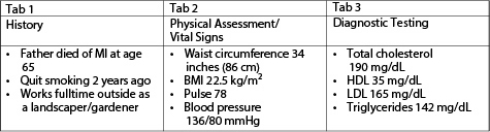
(Multiple Choice)
4.8/5 (79)
(79) A patient who has had chest pain for several hours is admitted with a diagnosis of rule out acute myocardial infarction (AMI).Which laboratory test should the nurse monitor to help determine whether the patient has had an AMI?
(Multiple Choice)
4.9/5 (77)
(77) A patient who is being admitted to the emergency department with intermittent chest pain gives the following list of medications to the nurse.Which medication has the most immediate implications for the patient's care?
(Multiple Choice)
4.9/5 (83)
(83) A patient who has recently started taking pravastatin (Pravachol)and niacin (Nicobid)reports the following symptoms to the nurse.Which is most important to communicate to the health care provider?
(Multiple Choice)
4.9/5 (81)
(81) After reviewing a patient's history,vital signs,physical assessment,and laboratory data,which information shown in the accompanying figure is most important for the nurse to communicate to the health care provider? 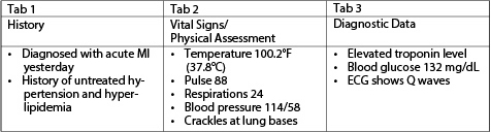
(Multiple Choice)
4.7/5 (76)
(76) A patient is recovering from a myocardial infarction (MI)and develops chest pain on day 3 that increases when taking a deep breath and is relieved by leaning forward.Which action should the nurse take next?
(Multiple Choice)
4.8/5 (80)
(80) Which nursing intervention will be most effective when assisting the patient with coronary artery disease (CAD)to make appropriate dietary changes?
(Multiple Choice)
4.8/5 (65)
(65) When developing a teaching plan for a 61-year-old man with the following risk factors for coronary artery disease (CAD),the nurse should focus on the
(Multiple Choice)
4.8/5 (87)
(87) When caring for a patient with acute coronary syndrome who has returned to the coronary care unit after having angioplasty with stent placement,the nurse obtains the following assessment data.Which data indicate the need for immediate action by the nurse?
(Multiple Choice)
4.9/5 (78)
(78) Which assessment finding by the nurse caring for a patient who has had coronary artery bypass grafting using a right radial artery graft is most important to communicate to the health care provider?
(Multiple Choice)
4.9/5 (75)
(75) After receiving change-of-shift report about the following four patients,which patient should the nurse assess first?
(Multiple Choice)
4.9/5 (81)
(81) Following an acute myocardial infarction (AMI),a patient ambulates in the hospital hallway.When the nurse is evaluating the patient's response to the activity,which assessment data would indicate that the exercise level should be decreased?
(Multiple Choice)
4.8/5 (82)
(82) When caring for a patient who has just arrived on the medical-surgical unit after having cardiac catheterization,which nursing intervention should the nurse delegate to a licensed practical/vocational nurse (LPN/LVN)?
(Multiple Choice)
4.8/5 (83)
(83) A patient with diabetes mellitus and chronic stable angina has a new order for captopril (Capoten).The nurse should teach the patient that the primary purpose of captopril is to
(Multiple Choice)
4.9/5 (88)
(88) After the nurse teaches the patient about the use of carvedilol (Coreg)in preventing anginal episodes,which statement by a patient indicates that the teaching has been effective?
(Multiple Choice)
4.8/5 (79)
(79) When titrating IV nitroglycerin (Tridil)for a patient with a myocardial infarction (MI),which action will the nurse take to evaluate the effectiveness of the medication?
(Multiple Choice)
4.9/5 (70)
(70) A patient had a non-ST-segment-elevation myocardial infarction (NSTEMI)3 days ago.Which nursing intervention included in the plan of care is most appropriate for the registered nurse (RN)to delegate to an experienced licensed practical/vocational nurse (LPN/LVN)?
(Multiple Choice)
4.8/5 (66)
(66) 
Filters
- Essay(0)
- Multiple Choice(0)
- Short Answer(0)
- True False(0)
- Matching(0)