



 Chat with AI
Exam 53: Nursing Management: Acute Intracranial Problems

Exam 1: The Importance of Nursing21 Questions
Exam 3: Health Disparities and Cultural Care18 Questions
Exam 4: Pain Management25 Questions
Exam 5: Palliative Care16 Questions
Exam 6: Substance Use and Dependency25 Questions
Exam 8: Nursing Management: Inflammation and Wound Healing22 Questions
Exam 9: Genetics and Genomics7 Questions
Exam 10: Altered Immune Responses and Transplantation26 Questions
Exam 11: Nursing Management: Infection and Human Immunodeficiency Virus Infection26 Questions
Exam 12: Cancer43 Questions
Exam 13: Nursing Management: Fluid,electrolyte and Acidbase Imbalances37 Questions
Exam 14: Nursing Management: Preoperative Care21 Questions
Exam 15: Nursing Management: Intraoperative Care18 Questions
Exam 16: Nursing Management: Postoperative Care25 Questions
Exam 17: Nursing Assessment: Visual and Auditory Systems26 Questions
Exam 18: Nursing Management: Visual and Auditory Problems47 Questions
Exam 19: Nursing Assessment: Integumentary System13 Questions
Exam 20: Nursing Management: Integumentary Problems26 Questions
Exam 21: Nursing Management: Burns31 Questions
Exam 22: Nursing Assessment: Respiratory System24 Questions
Exam 23: Nursing Management: Upper Respiratory Problems25 Questions
Exam 24: Nursing Management: Lower Respiratory Problems51 Questions
Exam 25: Nursing Management: Obstructive Pulmonary Diseases44 Questions
Exam 26: Nursing Assessment: Haematological System16 Questions
Exam 27: Nursing Management: Haematological Problems48 Questions
Exam 28: Nursing Assessment: Cardiovascular System24 Questions
Exam 29: Nursing Management: Hypertension24 Questions
Exam 30: Nursing Management: Coronary Artery Disease and Acute Coronary Syndrome43 Questions
Exam 31: Nursing Management: Heart Failure26 Questions
Exam 32: Nursing Management: Ecg Monitoring and Arrhythmias31 Questions
Exam 33: Nursing Management: Inflammatory and Structural Heart Disorders35 Questions
Exam 34: Nursing Management: Vascular Disorders36 Questions
Exam 35: Nursing Assessment: Gastrointestinal System18 Questions
Exam 36: Nursing Management: Nutritional Problems24 Questions
Exam 37: Nursing Management: Obesity20 Questions
Exam 38: Nursing Management: Upper Gastrointestinal Problems47 Questions
Exam 39: Nursing Management: Lower Gastrointestinal Problems56 Questions
Exam 40: Nursing Management: Liver,pancreas and Biliary Tract Problems46 Questions
Exam 41: Nursing Assessment: Urinary System24 Questions
Exam 42: Nursing Management: Renal and Urological Problems45 Questions
Exam 43: Nursing Management: Acute Kidney Injury and Chronic Kidney Disease39 Questions
Exam 44: Nursing Assessment: Endocrine System22 Questions
Exam 45: Nursing Management: Diabetes Mellitus49 Questions
Exam 46: Nursing Management: Endocrine Problems46 Questions
Exam 47: Nursing Assessment: Reproductive System19 Questions
Exam 48: Nursing Management: Breast Disorders28 Questions
Exam 49: Nursing Management: Sexually Transmitted Infections19 Questions
Exam 50: Nursing Management: Female Reproductive Problems49 Questions
Exam 51: Nursing Management: Male Reproductive Problems35 Questions
Exam 52: Nursing Assessment: Nervous System21 Questions
Exam 53: Nursing Management: Acute Intracranial Problems40 Questions
Exam 54: Nursing Management: the Patient With a Stroke30 Questions
Exam 55: Nursing Management: Chronic Neurological Problems36 Questions
Exam 56: Nursing Management: Delirium,depression and Dementia21 Questions
Exam 57: Nursing Management: Peripheral Nerve and Spinal Cord Problems33 Questions
Exam 58: Nursing Assessment: Musculoskeletal System16 Questions
Exam 59: Nursing Management: Musculoskeletal Trauma and Orthopaedic Surgery47 Questions
Exam 60: Nursing Management: Musculoskeletal Problems25 Questions
Exam 61: Nursing Management: Arthritis and Connective Tissue Diseases47 Questions
Exam 62: Nursing Management: Critical Care Environment41 Questions
Exam 63: Nursing Management: Shock,systemic Inflammatory Response Syndrome and Multiple Organ Dysfunction Syndrome29 Questions
Exam 64: Nursing Management: Respiratory Failure and Acute Respiratory Distress Syndrome27 Questions
Exam 65: Nursing Management: Emergency Care Situations26 Questions
Select questions type


Which finding for a patient who has a head injury should the nurse report immediately to the health care provider?

Free
(Multiple Choice)
4.8/5  (73)
(73) Correct Answer: Verified
B
The nurse is admitting a patient with a basal skull fracture.The nurse notes ecchymoses around both eyes and clear drainage from the patient's nose.Which admission order should the nurse question?
Free
(Multiple Choice)
4.9/5 (79)
(79) Correct Answer:Verified
VerifiedB
A 68-year-old male patient is brought to the emergency department (ED)by ambulance after being found unconscious on the bathroom floor by his spouse.Which action will the nurse take first?
Free
(Multiple Choice)
4.8/5 (81)
(81) Correct Answer:Verified
VerifiedA
A patient admitted with a diffuse axonal injury has a systemic blood pressure (BP)of 106/52 mm Hg and an intracranial pressure (ICP)of 14 mm Hg.Which action should the nurse take first?
(Multiple Choice)
4.8/5 (79)
(79) A patient with possible viral meningitis is admitted to the nursing unit after lumbar puncture was performed in the emergency department.Which action prescribed by the health care provider should the nurse question?
(Multiple Choice)
4.8/5 (79)
(79) The nurse has administered prescribed IV mannitol (Osmitrol)to an unconscious patient.Which parameter should the nurse monitor to determine the medication's effectiveness?
(Multiple Choice)
4.9/5 (73)
(73) Family members of a patient who has a traumatic brain injury ask the nurse about the purpose of the ventriculostomy system being used for intracranial pressure monitoring.Which response by the nurse is best?
(Multiple Choice)
4.8/5 (85)
(85) The nurse admitting a patient who has a right frontal lobe tumor would expect the patient may have
(Multiple Choice)
4.9/5 (84)
(84) A patient has increased intracranial pressure and a ventriculostomy after a head injury.Which action can the nurse delegate to unlicensed assistive personnel (UAP)who regularly work in the intensive care unit?
(Multiple Choice)
4.9/5 (85)
(85) An unconscious patient with a traumatic head injury has a blood pressure of 130/76 mm Hg,and an intracranial pressure (ICP)of 20 mm Hg.The nurse will calculate the cerebral perfusion pressure (CPP)as ____ mm Hg.
(Short Answer)
4.9/5 (88)
(88) A 42-year-old patient who has bacterial meningitis is disoriented and anxious.Which nursing action will be included in the plan of care?
(Multiple Choice)
4.8/5 (76)
(76) A 46-year-old patient with a head injury opens the eyes to verbal stimulation,curses when stimulated,and does not respond to a verbal command to move but attempts to push away a painful stimulus.The nurse records the patient's Glasgow Coma Scale score as
(Multiple Choice)
4.8/5 (85)
(85) After endotracheal suctioning,the nurse notes that the intracranial pressure for a patient with a traumatic head injury has increased from 14 to 17 mm Hg.Which action should the nurse take first?
(Multiple Choice)
4.8/5 (84)
(84) When assessing a 53-year-old patient with bacterial meningitis,the nurse obtains the following data.Which finding should be reported immediately to the health care provider?
(Multiple Choice)
4.9/5 (81)
(81) A 23-year-old patient who is suspected of having an epidural hematoma is admitted to the emergency department.Which action will the nurse plan to take?
(Multiple Choice)
5.0/5 (92)
(92) During change-of-shift report,the nurse learns that a patient with a head injury has decorticate posturing to noxious stimulation.Which positioning shown in the accompanying figure will the nurse expect to observe? 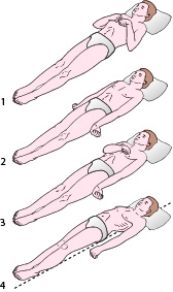
(Multiple Choice)
4.9/5 (84)
(84) A 41-year-old patient who is unconscious has a nursing diagnosis of ineffective cerebral tissue perfusion related to cerebral tissue swelling.Which nursing intervention will be included in the plan of care?
(Multiple Choice)
4.8/5 (84)
(84) Which action will the emergency department nurse anticipate for a patient diagnosed with a concussion who did not lose consciousness?
(Multiple Choice)
4.7/5 (70)
(70) A 20-year-old male patient is admitted with a head injury after a collision while playing football.After noting that the patient has developed clear nasal drainage,which action should the nurse take?
(Multiple Choice)
5.0/5 (83)
(83) Which statement by a 40-year-old patient who is being discharged from the emergency department (ED)after a concussion indicates a need for intervention by the nurse?
(Multiple Choice)
4.9/5 (80)
(80) 
Filters
- Essay(0)
- Multiple Choice(0)
- Short Answer(0)
- True False(0)
- Matching(0)