



 Chat with AI
Exam 33: Nursing Management: Inflammatory and Structural Heart Disorders

Exam 1: The Importance of Nursing21 Questions
Exam 3: Health Disparities and Cultural Care18 Questions
Exam 4: Pain Management25 Questions
Exam 5: Palliative Care16 Questions
Exam 6: Substance Use and Dependency25 Questions
Exam 8: Nursing Management: Inflammation and Wound Healing22 Questions
Exam 9: Genetics and Genomics7 Questions
Exam 10: Altered Immune Responses and Transplantation26 Questions
Exam 11: Nursing Management: Infection and Human Immunodeficiency Virus Infection26 Questions
Exam 12: Cancer43 Questions
Exam 13: Nursing Management: Fluid,electrolyte and Acidbase Imbalances37 Questions
Exam 14: Nursing Management: Preoperative Care21 Questions
Exam 15: Nursing Management: Intraoperative Care18 Questions
Exam 16: Nursing Management: Postoperative Care25 Questions
Exam 17: Nursing Assessment: Visual and Auditory Systems26 Questions
Exam 18: Nursing Management: Visual and Auditory Problems47 Questions
Exam 19: Nursing Assessment: Integumentary System13 Questions
Exam 20: Nursing Management: Integumentary Problems26 Questions
Exam 21: Nursing Management: Burns31 Questions
Exam 22: Nursing Assessment: Respiratory System24 Questions
Exam 23: Nursing Management: Upper Respiratory Problems25 Questions
Exam 24: Nursing Management: Lower Respiratory Problems51 Questions
Exam 25: Nursing Management: Obstructive Pulmonary Diseases44 Questions
Exam 26: Nursing Assessment: Haematological System16 Questions
Exam 27: Nursing Management: Haematological Problems48 Questions
Exam 28: Nursing Assessment: Cardiovascular System24 Questions
Exam 29: Nursing Management: Hypertension24 Questions
Exam 30: Nursing Management: Coronary Artery Disease and Acute Coronary Syndrome43 Questions
Exam 31: Nursing Management: Heart Failure26 Questions
Exam 32: Nursing Management: Ecg Monitoring and Arrhythmias31 Questions
Exam 33: Nursing Management: Inflammatory and Structural Heart Disorders35 Questions
Exam 34: Nursing Management: Vascular Disorders36 Questions
Exam 35: Nursing Assessment: Gastrointestinal System18 Questions
Exam 36: Nursing Management: Nutritional Problems24 Questions
Exam 37: Nursing Management: Obesity20 Questions
Exam 38: Nursing Management: Upper Gastrointestinal Problems47 Questions
Exam 39: Nursing Management: Lower Gastrointestinal Problems56 Questions
Exam 40: Nursing Management: Liver,pancreas and Biliary Tract Problems46 Questions
Exam 41: Nursing Assessment: Urinary System24 Questions
Exam 42: Nursing Management: Renal and Urological Problems45 Questions
Exam 43: Nursing Management: Acute Kidney Injury and Chronic Kidney Disease39 Questions
Exam 44: Nursing Assessment: Endocrine System22 Questions
Exam 45: Nursing Management: Diabetes Mellitus49 Questions
Exam 46: Nursing Management: Endocrine Problems46 Questions
Exam 47: Nursing Assessment: Reproductive System19 Questions
Exam 48: Nursing Management: Breast Disorders28 Questions
Exam 49: Nursing Management: Sexually Transmitted Infections19 Questions
Exam 50: Nursing Management: Female Reproductive Problems49 Questions
Exam 51: Nursing Management: Male Reproductive Problems35 Questions
Exam 52: Nursing Assessment: Nervous System21 Questions
Exam 53: Nursing Management: Acute Intracranial Problems40 Questions
Exam 54: Nursing Management: the Patient With a Stroke30 Questions
Exam 55: Nursing Management: Chronic Neurological Problems36 Questions
Exam 56: Nursing Management: Delirium,depression and Dementia21 Questions
Exam 57: Nursing Management: Peripheral Nerve and Spinal Cord Problems33 Questions
Exam 58: Nursing Assessment: Musculoskeletal System16 Questions
Exam 59: Nursing Management: Musculoskeletal Trauma and Orthopaedic Surgery47 Questions
Exam 60: Nursing Management: Musculoskeletal Problems25 Questions
Exam 61: Nursing Management: Arthritis and Connective Tissue Diseases47 Questions
Exam 62: Nursing Management: Critical Care Environment41 Questions
Exam 63: Nursing Management: Shock,systemic Inflammatory Response Syndrome and Multiple Organ Dysfunction Syndrome29 Questions
Exam 64: Nursing Management: Respiratory Failure and Acute Respiratory Distress Syndrome27 Questions
Exam 65: Nursing Management: Emergency Care Situations26 Questions
Select questions type


While caring for a patient with aortic stenosis,the nurse identifies a nursing diagnosis of acute pain related to decreased coronary blood flow.A priority nursing intervention for this patient would be to
(Multiple Choice)
4.8/5  (78)
(78) The nurse suspects cardiac tamponade in a patient who has acute pericarditis.To assess for the presence of pulsus paradoxus,the nurse should
(Multiple Choice)
4.9/5 (69)
(69) The nurse is admitting a patient with possible rheumatic fever.Which question on the admission health history will be most pertinent to ask?
(Multiple Choice)
4.8/5 (70)
(70) During the assessment of a 25-year-old patient with infective endocarditis (IE),the nurse would expect to find
(Multiple Choice)
4.8/5 (79)
(79) When planning care for a patient hospitalized with a streptococcal infective endocarditis (IE),which intervention is a priority for the nurse to include?
(Multiple Choice)
4.8/5 (81)
(81) Two days after an acute myocardial infarction (MI),a patient complains of stabbing chest pain that increases with a deep breath.Which action will the nurse take first?
(Multiple Choice)
4.7/5 (79)
(79) Which admission order written by the health care provider for a patient admitted with infective endocarditis (IE)and a fever would be a priority for the nurse to implement?
(Multiple Choice)
4.9/5 (87)
(87) During discharge teaching with a 68-year-old patient who had a mitral valve replacement with a mechanical valve,the nurse instructs the patient on the
(Multiple Choice)
4.8/5 (68)
(68) The nurse is caring for a patient with mitral regurgitation.Referring to the figure below,where should the nurse listen to best hear any murmur that the patient has? 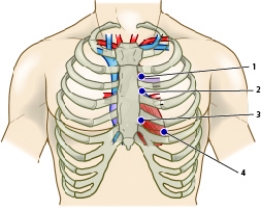
(Multiple Choice)
4.9/5 (82)
(82) When caring for a patient with infective endocarditis of the tricuspid valve,the nurse should monitor the patient for the development of
(Multiple Choice)
4.9/5 (82)
(82) After receiving the following information about four patients during change-of-shift report,which patient should the nurse assess first?
(Multiple Choice)
4.9/5 (68)
(68) Which statement by a patient with restrictive cardiomyopathy indicates that the nurse's discharge teaching about self-management has been most effective?
(Multiple Choice)
4.8/5 (76)
(76) Which assessment finding in a patient who is admitted with infective endocarditis (IE)is most important to communicate to the health care provider?
(Multiple Choice)
4.9/5 (73)
(73) The nurse is assessing a patient with myocarditis before administering the scheduled dose of digoxin (Lanoxin).Which finding is most important for the nurse to communicate to the health care provider?
(Multiple Choice)
4.8/5 (80)
(80) When developing a community health program to decrease the incidence of rheumatic fever,which action would be most important for the community health nurse to include?
(Multiple Choice)
5.0/5 (91)
(91) 
Filters
- Essay(0)
- Multiple Choice(0)
- Short Answer(0)
- True False(0)
- Matching(0)