



 Chat with AI
Exam 13: Nursing Management: Fluid,electrolyte and Acidbase Imbalances

Exam 1: The Importance of Nursing21 Questions
Exam 3: Health Disparities and Cultural Care18 Questions
Exam 4: Pain Management25 Questions
Exam 5: Palliative Care16 Questions
Exam 6: Substance Use and Dependency25 Questions
Exam 8: Nursing Management: Inflammation and Wound Healing22 Questions
Exam 9: Genetics and Genomics7 Questions
Exam 10: Altered Immune Responses and Transplantation26 Questions
Exam 11: Nursing Management: Infection and Human Immunodeficiency Virus Infection26 Questions
Exam 12: Cancer43 Questions
Exam 13: Nursing Management: Fluid,electrolyte and Acidbase Imbalances37 Questions
Exam 14: Nursing Management: Preoperative Care21 Questions
Exam 15: Nursing Management: Intraoperative Care18 Questions
Exam 16: Nursing Management: Postoperative Care25 Questions
Exam 17: Nursing Assessment: Visual and Auditory Systems26 Questions
Exam 18: Nursing Management: Visual and Auditory Problems47 Questions
Exam 19: Nursing Assessment: Integumentary System13 Questions
Exam 20: Nursing Management: Integumentary Problems26 Questions
Exam 21: Nursing Management: Burns31 Questions
Exam 22: Nursing Assessment: Respiratory System24 Questions
Exam 23: Nursing Management: Upper Respiratory Problems25 Questions
Exam 24: Nursing Management: Lower Respiratory Problems51 Questions
Exam 25: Nursing Management: Obstructive Pulmonary Diseases44 Questions
Exam 26: Nursing Assessment: Haematological System16 Questions
Exam 27: Nursing Management: Haematological Problems48 Questions
Exam 28: Nursing Assessment: Cardiovascular System24 Questions
Exam 29: Nursing Management: Hypertension24 Questions
Exam 30: Nursing Management: Coronary Artery Disease and Acute Coronary Syndrome43 Questions
Exam 31: Nursing Management: Heart Failure26 Questions
Exam 32: Nursing Management: Ecg Monitoring and Arrhythmias31 Questions
Exam 33: Nursing Management: Inflammatory and Structural Heart Disorders35 Questions
Exam 34: Nursing Management: Vascular Disorders36 Questions
Exam 35: Nursing Assessment: Gastrointestinal System18 Questions
Exam 36: Nursing Management: Nutritional Problems24 Questions
Exam 37: Nursing Management: Obesity20 Questions
Exam 38: Nursing Management: Upper Gastrointestinal Problems47 Questions
Exam 39: Nursing Management: Lower Gastrointestinal Problems56 Questions
Exam 40: Nursing Management: Liver,pancreas and Biliary Tract Problems46 Questions
Exam 41: Nursing Assessment: Urinary System24 Questions
Exam 42: Nursing Management: Renal and Urological Problems45 Questions
Exam 43: Nursing Management: Acute Kidney Injury and Chronic Kidney Disease39 Questions
Exam 44: Nursing Assessment: Endocrine System22 Questions
Exam 45: Nursing Management: Diabetes Mellitus49 Questions
Exam 46: Nursing Management: Endocrine Problems46 Questions
Exam 47: Nursing Assessment: Reproductive System19 Questions
Exam 48: Nursing Management: Breast Disorders28 Questions
Exam 49: Nursing Management: Sexually Transmitted Infections19 Questions
Exam 50: Nursing Management: Female Reproductive Problems49 Questions
Exam 51: Nursing Management: Male Reproductive Problems35 Questions
Exam 52: Nursing Assessment: Nervous System21 Questions
Exam 53: Nursing Management: Acute Intracranial Problems40 Questions
Exam 54: Nursing Management: the Patient With a Stroke30 Questions
Exam 55: Nursing Management: Chronic Neurological Problems36 Questions
Exam 56: Nursing Management: Delirium,depression and Dementia21 Questions
Exam 57: Nursing Management: Peripheral Nerve and Spinal Cord Problems33 Questions
Exam 58: Nursing Assessment: Musculoskeletal System16 Questions
Exam 59: Nursing Management: Musculoskeletal Trauma and Orthopaedic Surgery47 Questions
Exam 60: Nursing Management: Musculoskeletal Problems25 Questions
Exam 61: Nursing Management: Arthritis and Connective Tissue Diseases47 Questions
Exam 62: Nursing Management: Critical Care Environment41 Questions
Exam 63: Nursing Management: Shock,systemic Inflammatory Response Syndrome and Multiple Organ Dysfunction Syndrome29 Questions
Exam 64: Nursing Management: Respiratory Failure and Acute Respiratory Distress Syndrome27 Questions
Exam 65: Nursing Management: Emergency Care Situations26 Questions
Select questions type


The nurse is caring for a patient who has a central venous access device (CVAD).Which action by the nurse is appropriate?
(Multiple Choice)
4.9/5  (74)
(74) The nurse assesses a patient who has been hospitalized for 2 days.The patient has been receiving normal saline IV at 100 mL/hr,has a nasogastric tube to low suction,and is NPO.Which assessment finding would be a priority for the nurse to report to the health care provider?
(Multiple Choice)
4.9/5 (77)
(77) A nurse is assessing a newly admitted patient with chronic heart failure who forgot to take prescribed medications and seems confused.The patient complains of "just blowing up" and has peripheral edema and shortness of breath.Which assessment should the nurse complete first?
(Multiple Choice)
4.8/5 (78)
(78) After receiving change-of-shift report,which patient should the nurse assess first?
(Multiple Choice)
4.9/5 (77)
(77) A patient who has a small cell carcinoma of the lung develops syndrome of inappropriate antidiuretic hormone (SIADH).The nurse should notify the health care provider about which assessment finding?
(Multiple Choice)
4.9/5 (85)
(85) A patient is admitted to the emergency department with severe fatigue and confusion.Laboratory studies are done.Which laboratory value will require the most immediate action by the nurse?
(Multiple Choice)
4.8/5 (76)
(76) The nurse is caring for a patient who has a calcium level of 12.1 mg/dL.Which nursing action should the nurse include on the care plan?
(Multiple Choice)
4.8/5 (72)
(72) A patient who is lethargic and exhibits deep,rapid respirations has the following arterial blood gas (ABG)results: pH 7.32,PaO2 88 mm Hg,PaCO2 37 mm Hg,and HCO3 16 mEq/L.How should the nurse interpret these results?
(Multiple Choice)
4.9/5 (81)
(81) A newly admitted patient is diagnosed with hyponatremia.When making room assignments,the charge nurse should take which action?
(Multiple Choice)
4.9/5 (75)
(75) The home health nurse cares for an alert and oriented older adult patient with a history of dehydration.Which instructions should the nurse give to this patient related to fluid intake?
(Multiple Choice)
4.8/5 (85)
(85) The nurse notes that a patient who was admitted with diabetic ketoacidosis has rapid,deep respirations.Which action should the nurse take?
(Multiple Choice)
4.8/5 (83)
(83) When caring for a patient with renal failure on a low phosphate diet,the nurse will inform unlicensed assistive personnel (UAP)to remove which food from the patient's food tray?
(Multiple Choice)
4.8/5 (84)
(84) A patient is receiving a 3% saline continuous IV infusion for hyponatremia.Which assessment data will require the most rapid response by the nurse?
(Multiple Choice)
4.8/5 (64)
(64) During the admission process,the nurse obtains information about a patient through the physical assessment and diagnostic testing.Based on the data shown in the accompanying figure,which nursing diagnosis is appropriate? 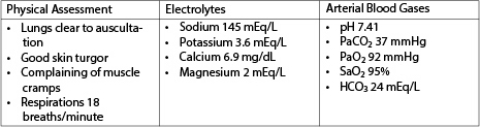
(Multiple Choice)
4.8/5 (83)
(83) A patient receives 3% NaCl solution for correction of hyponatremia.Which assessment is most important for the nurse to monitor for while the patient is receiving this infusion?
(Multiple Choice)
4.8/5 (69)
(69) An older adult patient who is malnourished presents to the emergency department with a serum protein level of 5.2 g/dL.The nurse would expect which clinical manifestation?
(Multiple Choice)
5.0/5 (75)
(75) A patient is admitted for hypovolemia associated with multiple draining wounds.Which assessment would be the most accurate way for the nurse to evaluate fluid balance?
(Multiple Choice)
4.9/5 (69)
(69) 
Filters
- Essay(0)
- Multiple Choice(0)
- Short Answer(0)
- True False(0)
- Matching(0)