



 Chat with AI
Exam 8: A Violent Pulse: Earthquakes

Exam 1: The Earth in Context71 Questions
Exam 2: The Way the Earth Works: Plate Tectonics125 Questions
Exam 3: Patterns in Nature: Minerals60 Questions
Exam 4: Up From the Inferno: Magma and Igneous Rocks64 Questions
Exam 5: The Wrath of Vulcan: Volcanic Eruptions60 Questions
Exam 6: Pages of Earths Past: Sedimentary Rocks66 Questions
Exam 7: Metamorphism: a Process of Change61 Questions
Exam 8: A Violent Pulse: Earthquakes60 Questions
Exam 9: Crags, cracks, and Crumples: Crustal Deformation and Mountain Building60 Questions
Exam 10: Deep Time: How Old Is Old60 Questions
Exam 11: A Biography of Earth66 Questions
Exam 12: Riches in Rock: Energy and Mineral Resources70 Questions
Exam 13: Unsafe Ground: Landslides and Other Mass Movements60 Questions
Exam 14: Streams and Floods: the Geology of Running Water56 Questions
Exam 15: Restless Realm: Oceans and Coasts57 Questions
Exam 16: A Hidden Reserve: Groundwater54 Questions
Exam 17: Dry Regions: the Geology of Deserts60 Questions
Exam 18: Amazing Ice: Glaciers and Ice Ages60 Questions
Exam 19: Global Change in the Earth System60 Questions
Exam 20: Rock Groups25 Questions
Exam 21: A Surface Veneer: Sediments and Soils25 Questions
Exam 22: The Rock Cycle25 Questions
Exam 23: The Earths Interior Revisited: Insights From Geophysics25 Questions
Exam 24: Memories of Past Life: Fossils and Evolution25 Questions
Exam 25: An Introduction to Landscapes and the Hydrologic Cycle25 Questions
Select questions type


If,during an earthquake,a hanging wall slides upward relative to a footwall,the fault is termed ____________ if the fault is shallow (much closer to horizontal than vertical). 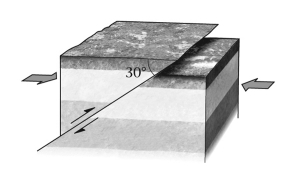
(Multiple Choice)
5.0/5  (85)
(85) Which earthquake severity scale varies from locality to locality for a single earthquake?
(Multiple Choice)
4.8/5 (87)
(87) If a fault is nearly vertical in orientation and the two walls of rock on opposite sides slide past one another horizontally,the fault is termed ____________. 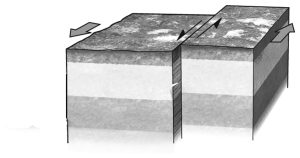
(Multiple Choice)
4.8/5 (74)
(74) Seismometers,being able to detect ground movements of a millionth of a millimeter,are useful to governments worldwide for detecting not only earthquakes,but _______________.
(Multiple Choice)
4.8/5 (82)
(82) The intersection between a fault plane and the ground surface is called the ____________.
(Multiple Choice)
4.8/5 (85)
(85) According to the moment magnitude scale (Mw)-a magnitude 8 earthquake results in 1,000 times greater amplitude than a magnitude ____________ earthquake.
(Multiple Choice)
4.9/5 (63)
(63) All else being equal,an earthquake that strikes in the eastern United States would produce shaking that would be felt ____________ than one that occurred in the western United States.
(Multiple Choice)
4.7/5 (76)
(76) All discovered faults are likely to experience earthquakes in the next few hundred years.
(True/False)
4.9/5 (87)
(87) Which earthquake severity scale takes into account the type of rock that has been fractured?
(Multiple Choice)
4.9/5 (78)
(78) If,during an earthquake,a hanging wall slides upward relative to a footwall,the fault is termed ____________ if the fault is steep (closer to vertical than horizontal). 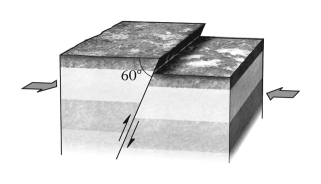
(Multiple Choice)
4.7/5 (86)
(86) Which type of fault does NOT,by definition,have a fault trace?
(Multiple Choice)
4.7/5 (69)
(69) Faults that have moved recently or are likely to move in the future are referred to as ____________.
(Multiple Choice)
4.8/5 (81)
(81) The point on Earth's surface directly above the point where an earthquake occurs is termed the ____________.
(Multiple Choice)
4.8/5 (77)
(77) Earthquake waves that pass through the interior of Earth are termed ____________.
(Multiple Choice)
4.9/5 (77)
(77) Periods of intermittent sliding on a fault as a result of the release of stress during episodes of displacement,followed by stress buildup to the point that the fault is reactivated,is termed ____________.
(Multiple Choice)
4.9/5 (79)
(79) 
Filters
- Essay(0)
- Multiple Choice(0)
- Short Answer(0)
- True False(0)
- Matching(0)