



 Chat with AI
Exam 19: Global Change in the Earth System

Exam 1: The Earth in Context71 Questions
Exam 2: The Way the Earth Works: Plate Tectonics125 Questions
Exam 3: Patterns in Nature: Minerals60 Questions
Exam 4: Up From the Inferno: Magma and Igneous Rocks64 Questions
Exam 5: The Wrath of Vulcan: Volcanic Eruptions60 Questions
Exam 6: Pages of Earths Past: Sedimentary Rocks66 Questions
Exam 7: Metamorphism: a Process of Change61 Questions
Exam 8: A Violent Pulse: Earthquakes60 Questions
Exam 9: Crags, cracks, and Crumples: Crustal Deformation and Mountain Building60 Questions
Exam 10: Deep Time: How Old Is Old60 Questions
Exam 11: A Biography of Earth66 Questions
Exam 12: Riches in Rock: Energy and Mineral Resources70 Questions
Exam 13: Unsafe Ground: Landslides and Other Mass Movements60 Questions
Exam 14: Streams and Floods: the Geology of Running Water56 Questions
Exam 15: Restless Realm: Oceans and Coasts57 Questions
Exam 16: A Hidden Reserve: Groundwater54 Questions
Exam 17: Dry Regions: the Geology of Deserts60 Questions
Exam 18: Amazing Ice: Glaciers and Ice Ages60 Questions
Exam 19: Global Change in the Earth System60 Questions
Exam 20: Rock Groups25 Questions
Exam 21: A Surface Veneer: Sediments and Soils25 Questions
Exam 22: The Rock Cycle25 Questions
Exam 23: The Earths Interior Revisited: Insights From Geophysics25 Questions
Exam 24: Memories of Past Life: Fossils and Evolution25 Questions
Exam 25: An Introduction to Landscapes and the Hydrologic Cycle25 Questions
Select questions type


The formation of oil shale deposits,coals,and limestones has what overall effect on CO₂ in the Earth's atmosphere?

Free
(Multiple Choice)
4.8/5  (81)
(81) Correct Answer: Verified
B
Which of the following is NOT a greenhouse gas or does not act like one?
Free
(Multiple Choice)
4.9/5 (72)
(72) Correct Answer:Verified
VerifiedA
Assume that a new family of bacteria species evolves and becomes widespread,and that it rapidly and easily combines atmospheric oxygen with previously stable minerals.What would you reconsider about the oxygenation of the atmosphere several billion years ago?
Free
(Multiple Choice)
4.8/5 (79)
(79) Correct Answer:Verified
VerifiedB
Which of the following is an important long-term (acting over spans of tens of millions of years)factor in global climate change?
(Multiple Choice)
4.9/5 (73)
(73) Looking at the figure below,how much has sea level risen since the end of the last ice age,if we assume that was 16,000 years ago? 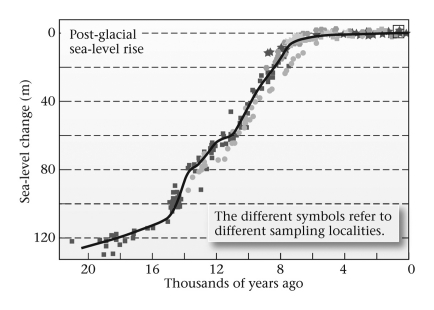
(Multiple Choice)
4.9/5 (82)
(82) Based on information in this chapter and the chapter on energy,what effect do you think the discovery of several more centuries of oil reserves would probably end up having on global climate?
(Multiple Choice)
4.7/5 (85)
(85) Why is the Atlantic Ocean likely to develop a subduction zone along one or more margins,in the future?
(Multiple Choice)
4.9/5 (79)
(79) A blogger writes that global warming is a myth,noting that his or her city had its coldest ever-recorded temperature last winter.Which statement(s)about his or her statement is/are correct?
(Multiple Choice)
4.9/5 (82)
(82) The discovery that the amount of solar radiation received at any latitude on the Earth's surface varies over scales of several thousand years or more and can be accurately predicted was made by ____________.
(Multiple Choice)
5.0/5 (87)
(87) Global warming has caused Earth to become warmer in the last few decades than it has ever been in geologic history.
(True/False)
4.8/5 (73)
(73) In an earlier chapter you learned that geologists are taught that "The Present is the Key to the Past." In studying paleoclimate,why would this idea probably be wrong?
(Multiple Choice)
4.8/5 (92)
(92) It is generally believed that humans began to significantly modify the environment about how long ago?
(Multiple Choice)
4.9/5 (71)
(71) Some plankton make shells of calcite/aragonite,that is,CaCO₃.They do this metabolically by combining calcium (Ca²⁺)ions and bicarbonate (HCO₃-)ions that are both dissolved in water around them.When such plankton dies,their shells sink downward to become sediment on the ocean floor.Under some conditions in the ocean or sediment,the CaCO₃ shells may dissolve,locally enriching the pore waters or deep-ocean waters in HCO₃-.Portions of this total process could be considered belonging to each of the following cycles,EXCEPT for the ____________.
(Multiple Choice)
4.7/5 (80)
(80) Which of the following inputs from outside the Earth system probably does NOT affect Earth's climate?
(Multiple Choice)
4.9/5 (79)
(79) With the increased amount of information that has been discovered in recent years,the Intergovernmental Panel on Climate Change has concluded that __________.
(Multiple Choice)
4.8/5 (76)
(76) Which two features on the figure below are sources of CO₂ and hence probable contributors to global warming? 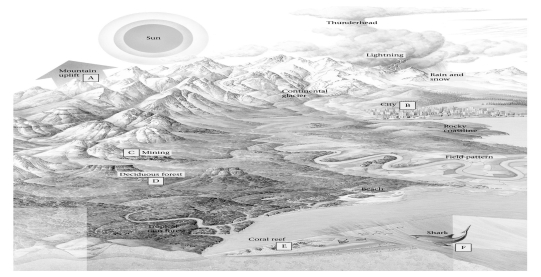
(Multiple Choice)
4.9/5 (82)
(82) How are bicarbonate and carbon dioxide related to one another?
(Multiple Choice)
4.8/5 (84)
(84) 
Filters
- Essay(0)
- Multiple Choice(0)
- Short Answer(0)
- True False(0)
- Matching(0)