



 Chat with AI
Exam 54: Community Ecology

Exam 1: Introduction: Evolution and Themes of Biology70 Questions
Exam 2: The Chemical Context of Life90 Questions
Exam 3: Water and Life80 Questions
Exam 4: Carbon and the Molecular Diversity of Life78 Questions
Exam 5: The Structure and Function of Large Biological Molecules117 Questions
Exam 6: A Tour of the Cell96 Questions
Exam 7: Membrane Structure and Function78 Questions
Exam 8: An Introduction to Metabolism88 Questions
Exam 9: Cellular Respiration and Fermentation117 Questions
Exam 10: Photosynthesis89 Questions
Exam 11: Cell Communication77 Questions
Exam 12: The Cell Cycle83 Questions
Exam 13: Meiosis and Sexual Life Cycles74 Questions
Exam 14: Mendel and the Gene Idea82 Questions
Exam 15: The Chromosomal Basis of Inheritance66 Questions
Exam 16: The Molecular Basis of Inheritance67 Questions
Exam 17: From Gene to Protein91 Questions
Exam 18: Regulation of Gene Expression107 Questions
Exam 19: Viruses53 Questions
Exam 20: Dna Tools and Biotechnology72 Questions
Exam 21: Genomes and Their Evolution52 Questions
Exam 22: Descent With Modification: a Darwinian View of Life63 Questions
Exam 23: The Evolution of Populations86 Questions
Exam 24: The Origin of Species71 Questions
Exam 25: The History of Life on Earth83 Questions
Exam 26: Phylogeny and the Tree of Life81 Questions
Exam 27: Bacteria and Archaea86 Questions
Exam 28: Protists84 Questions
Exam 29: Plant Diversity I: How Plants Colonized Land82 Questions
Exam 30: Plant Diversity Ii: the Evolution of Seed Plants110 Questions
Exam 31: Fungi97 Questions
Exam 32: An Overview of Animal Diversity82 Questions
Exam 33: An Introduction to Invertebrates101 Questions
Exam 34: The Origin and Evolution of Vertebrates117 Questions
Exam 35: Plant Structure, Growth, and Development75 Questions
Exam 36: Resource Acquisition and Transport in Vascular Plants89 Questions
Exam 37: Soil and Plant Nutrition91 Questions
Exam 38: Angiosperm Reproduction and Biotechnology94 Questions
Exam 39: Plant Responses to Internal and External Signals116 Questions
Exam 40: Basic Principles of Animal Form and Function86 Questions
Exam 41: Animal Nutrition73 Questions
Exam 42: Circulation and Gas Exchange100 Questions
Exam 43: The Immune System110 Questions
Exam 44: Osmoregulation and Excretion79 Questions
Exam 45: Hormones and the Endocrine System82 Questions
Exam 46: Animal Reproduction104 Questions
Exam 47: Animal Development98 Questions
Exam 48: Neurons, Synapses, and Signalling81 Questions
Exam 49: Nervous Systems73 Questions
Exam 50: Sensory and Motor Mechanisms91 Questions
Exam 51: Animal Behaviour79 Questions
Exam 52: An Introduction to Ecology and the Biosphere81 Questions
Exam 53: Population Ecology87 Questions
Exam 54: Community Ecology85 Questions
Exam 55: Ecosystems and Restoration Ecology89 Questions
Exam 56: Conservation Biology and Global Change75 Questions
Select questions type


As you are watching dairy cattle grazing in a field you notice a flock of starlings following them and eating insects that were disturbed by the cattles' hooves. Name the kind of species interaction you have observed and the benefit, if any.
(Multiple Choice)
4.8/5  (91)
(91) Which of the following studies would a community ecologist undertake to learn about competitive interactions?
(Multiple Choice)
4.9/5 (85)
(85) Prairie dogs once covered the expanses of the Great Plains. Their grazing made the grass more nutritious for the huge herds of bison, and they were preyed upon by a variety of snakes, raptors, and mammals. In fact, the black-footed ferret (now endangered)specialized in prairie dog predation. Today, increases in housing and agricultural developments have eradicated many prairie dog towns. Which of the following statements about prairie dogs is true?
(Multiple Choice)
4.8/5 (75)
(75) How might an ecologist test whether a species is occupying its realized or its fundamental niche?
(Multiple Choice)
4.8/5 (90)
(90) Which of the following would be most significant in understanding the structure of an ecological community?
(Multiple Choice)
4.9/5 (89)
(89) Which of the following statements is consistent with the principle of competitive exclusion?
(Multiple Choice)
4.9/5 (91)
(91) Use the following diagram of five islands formed at around the same time near a particular mainland, as well as MacArthur and Wilson's island biogeography principles, to answer the following questions.
 -Which island would likely exhibit the most impoverished species diversity?
 (Multiple Choice)
4.9/5 (79)
(79) Why do tropical communities tend to have greater species diversity than temperate or polar communities?
(Multiple Choice)
4.8/5 (82)
(82) The symbols +, -, and o are to be used to show the results of interactions between individuals and groups of individuals in the examples that follow. The symbol + denotes a positive interaction, - denotes a negative interaction, and o denotes where individuals are not affected by interacting. The first symbol refers to the first organism mentioned.
-What interactions exist between mycorrhizae and evergreen tree roots?
(Multiple Choice)
4.8/5 (83)
(83) The Ebola virus is a very virulent zootonic pathogen that causes high mortality rates among people. In humans, this virus causes Ebola hemorrhagic fever (severe internal bleeding)and, in some years, mortality can reach 100%. The virus is likely transmitted from wild animals to people and spreads via human to human transmission. There is no vaccine or cure for people. If the virus is so deadly and kills its human hosts, speculate on a possible reason why the virus continues to survive and has not died off with the human hosts it kills in such large numbers.
(Multiple Choice)
4.8/5 (82)
(82) Why is a pathogen generally more virulent in a new habitat?
(Multiple Choice)
4.8/5 (67)
(67) White-breasted nuthatches and Downy woodpeckers both eat insects that hide in the furrows of bark in hardwood trees. The Downy woodpecker searches for insects by hunting from the bottom of the tree trunk to the top, whereas the white-breasted nuthatch searches from the top of the trunk down. These hunting behaviours best illustrate which of the following ecological concepts?
(Multiple Choice)
4.9/5 (73)
(73) Please refer to the art below to answer the following question.
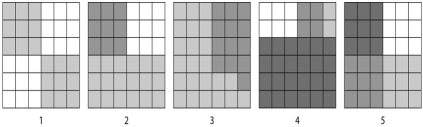 -According to the Shannon Diversity Index, which block would show the greatest diversity?
 (Multiple Choice)
4.8/5 (65)
(65) In terms of community ecology, why are pathogens more virulent now than ever before?
(Multiple Choice)
4.7/5 (76)
(76) 
Filters
- Essay(0)
- Multiple Choice(0)
- Short Answer(0)
- True False(0)
- Matching(0)