



 Chat with AI
Exam 51: Animal Behaviour

Exam 1: Introduction: Evolution and Themes of Biology70 Questions
Exam 2: The Chemical Context of Life90 Questions
Exam 3: Water and Life80 Questions
Exam 4: Carbon and the Molecular Diversity of Life78 Questions
Exam 5: The Structure and Function of Large Biological Molecules117 Questions
Exam 6: A Tour of the Cell96 Questions
Exam 7: Membrane Structure and Function78 Questions
Exam 8: An Introduction to Metabolism88 Questions
Exam 9: Cellular Respiration and Fermentation117 Questions
Exam 10: Photosynthesis89 Questions
Exam 11: Cell Communication77 Questions
Exam 12: The Cell Cycle83 Questions
Exam 13: Meiosis and Sexual Life Cycles74 Questions
Exam 14: Mendel and the Gene Idea82 Questions
Exam 15: The Chromosomal Basis of Inheritance66 Questions
Exam 16: The Molecular Basis of Inheritance67 Questions
Exam 17: From Gene to Protein91 Questions
Exam 18: Regulation of Gene Expression107 Questions
Exam 19: Viruses53 Questions
Exam 20: Dna Tools and Biotechnology72 Questions
Exam 21: Genomes and Their Evolution52 Questions
Exam 22: Descent With Modification: a Darwinian View of Life63 Questions
Exam 23: The Evolution of Populations86 Questions
Exam 24: The Origin of Species71 Questions
Exam 25: The History of Life on Earth83 Questions
Exam 26: Phylogeny and the Tree of Life81 Questions
Exam 27: Bacteria and Archaea86 Questions
Exam 28: Protists84 Questions
Exam 29: Plant Diversity I: How Plants Colonized Land82 Questions
Exam 30: Plant Diversity Ii: the Evolution of Seed Plants110 Questions
Exam 31: Fungi97 Questions
Exam 32: An Overview of Animal Diversity82 Questions
Exam 33: An Introduction to Invertebrates101 Questions
Exam 34: The Origin and Evolution of Vertebrates117 Questions
Exam 35: Plant Structure, Growth, and Development75 Questions
Exam 36: Resource Acquisition and Transport in Vascular Plants89 Questions
Exam 37: Soil and Plant Nutrition91 Questions
Exam 38: Angiosperm Reproduction and Biotechnology94 Questions
Exam 39: Plant Responses to Internal and External Signals116 Questions
Exam 40: Basic Principles of Animal Form and Function86 Questions
Exam 41: Animal Nutrition73 Questions
Exam 42: Circulation and Gas Exchange100 Questions
Exam 43: The Immune System110 Questions
Exam 44: Osmoregulation and Excretion79 Questions
Exam 45: Hormones and the Endocrine System82 Questions
Exam 46: Animal Reproduction104 Questions
Exam 47: Animal Development98 Questions
Exam 48: Neurons, Synapses, and Signalling81 Questions
Exam 49: Nervous Systems73 Questions
Exam 50: Sensory and Motor Mechanisms91 Questions
Exam 51: Animal Behaviour79 Questions
Exam 52: An Introduction to Ecology and the Biosphere81 Questions
Exam 53: Population Ecology87 Questions
Exam 54: Community Ecology85 Questions
Exam 55: Ecosystems and Restoration Ecology89 Questions
Exam 56: Conservation Biology and Global Change75 Questions
Select questions type


Which of the following is not a display of altrustic behaviour?
(Multiple Choice)
4.9/5  (77)
(77) What is the normal imprinting stimulus to a hatchling graylag goose?
(Multiple Choice)
4.8/5 (88)
(88) Karl von Frisch demonstrated that European honeybees communicate the location of a distant food source by
(Multiple Choice)
4.9/5 (67)
(67) Scientists have tried raising endangered whooping cranes in captivity by using sandhill cranes as foster parents. This strategy is no longer used because
(Multiple Choice)
4.9/5 (74)
(74) Use the following information to answer the next few questions.
Two populations of the highly ornamented white-crested sparrow species are spatially separated by a mountain range. Males from the two populations exhibit differing elaborate courtship displays. When a female appears, the males from the eastern population approach the female while bobbing their heads and spreading their wings, while the western population approaches a female by hopping and flapping their wings. Individuals from each population reared in isolation exhibited the same courtship displays as those in the wild.
-When presented with a model of a female, a male from the eastern population will perform the courtship display to completion, regardless of a eliciting a response from the "female." This is an example of
(Multiple Choice)
4.8/5 (85)
(85) Listed below are several examples of types of animal behaviour. Match the letter of the correct term (A-E) to each example in the following questions.
A. operant conditioning
B. agonistic behaviour
C innate behaviour
D. imprinting
E. altruistic behaviour
-Upon observing a golden eagle flying overhead, a sentry prairie dog gives a warning call to other foraging members of the prairie dog community.
(Multiple Choice)
4.8/5 (78)
(78) Use the following information to answer the next few questions.
Two populations of the highly ornamented white-crested sparrow species are spatially separated by a mountain range. Males from the two populations exhibit differing elaborate courtship displays. When a female appears, the males from the eastern population approach the female while bobbing their heads and spreading their wings, while the western population approaches a female by hopping and flapping their wings. Individuals from each population reared in isolation exhibited the same courtship displays as those in the wild.
-Which of the following is true of innate behaviours?
(Multiple Choice)
4.9/5 (81)
(81) 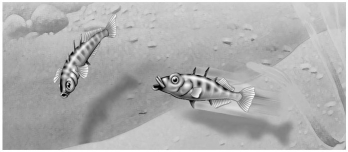 -In the territorial behaviour of the stickleback fish, the red belly of one male that elicits attack from another male is functioning as
 (Multiple Choice)
4.8/5 (82)
(82) White-crowned sparrows can only learn the "crystallized" song for their species by
(Multiple Choice)
5.0/5 (80)
(80) A stickleback fish will attack a fish model as long as the model has red colouring. What animal behaviour idea is manifested by this observation?
(Multiple Choice)
4.9/5 (81)
(81) A female cat in heat urinates more often and in many places. Male cats congregate near the urine deposits and fight with each other. Which of the following would be an ultimate cause of the male cats' response to the female's urinating behaviour?
(Multiple Choice)
4.9/5 (77)
(77) During a field trip, an instructor touched a moth resting on a tree trunk. The moth raised its forewings to reveal large eyespots on its hind wings. The instructor asked why the moth lifted its wings. One student answered that sensory receptors had fired and triggered a neuronal reflex culminating in the contraction of certain muscles. A second student responded that the behaviour might frighten predators. Which statement best describes these explanations?
(Multiple Choice)
4.7/5 (81)
(81) The colour of throats of males in a population of side-blotched lizards is determined by
(Multiple Choice)
4.7/5 (83)
(83) A chemical produced by an animal that serves as a communication to another animal of the same species is called
(Multiple Choice)
4.8/5 (80)
(80) Every morning at the same time, John went into the den to feed his new tropical fish. After a few weeks, he noticed that the fish swam to the top of the tank when he entered the room. This is an example of
(Multiple Choice)
4.8/5 (79)
(79) 
Filters
- Essay(0)
- Multiple Choice(0)
- Short Answer(0)
- True False(0)
- Matching(0)