



 Chat with AI
Exam 49: Nervous Systems

Exam 1: Introduction: Evolution and Themes of Biology70 Questions
Exam 2: The Chemical Context of Life90 Questions
Exam 3: Water and Life80 Questions
Exam 4: Carbon and the Molecular Diversity of Life78 Questions
Exam 5: The Structure and Function of Large Biological Molecules117 Questions
Exam 6: A Tour of the Cell96 Questions
Exam 7: Membrane Structure and Function78 Questions
Exam 8: An Introduction to Metabolism88 Questions
Exam 9: Cellular Respiration and Fermentation117 Questions
Exam 10: Photosynthesis89 Questions
Exam 11: Cell Communication77 Questions
Exam 12: The Cell Cycle83 Questions
Exam 13: Meiosis and Sexual Life Cycles74 Questions
Exam 14: Mendel and the Gene Idea82 Questions
Exam 15: The Chromosomal Basis of Inheritance66 Questions
Exam 16: The Molecular Basis of Inheritance67 Questions
Exam 17: From Gene to Protein91 Questions
Exam 18: Regulation of Gene Expression107 Questions
Exam 19: Viruses53 Questions
Exam 20: Dna Tools and Biotechnology72 Questions
Exam 21: Genomes and Their Evolution52 Questions
Exam 22: Descent With Modification: a Darwinian View of Life63 Questions
Exam 23: The Evolution of Populations86 Questions
Exam 24: The Origin of Species71 Questions
Exam 25: The History of Life on Earth83 Questions
Exam 26: Phylogeny and the Tree of Life81 Questions
Exam 27: Bacteria and Archaea86 Questions
Exam 28: Protists84 Questions
Exam 29: Plant Diversity I: How Plants Colonized Land82 Questions
Exam 30: Plant Diversity Ii: the Evolution of Seed Plants110 Questions
Exam 31: Fungi97 Questions
Exam 32: An Overview of Animal Diversity82 Questions
Exam 33: An Introduction to Invertebrates101 Questions
Exam 34: The Origin and Evolution of Vertebrates117 Questions
Exam 35: Plant Structure, Growth, and Development75 Questions
Exam 36: Resource Acquisition and Transport in Vascular Plants89 Questions
Exam 37: Soil and Plant Nutrition91 Questions
Exam 38: Angiosperm Reproduction and Biotechnology94 Questions
Exam 39: Plant Responses to Internal and External Signals116 Questions
Exam 40: Basic Principles of Animal Form and Function86 Questions
Exam 41: Animal Nutrition73 Questions
Exam 42: Circulation and Gas Exchange100 Questions
Exam 43: The Immune System110 Questions
Exam 44: Osmoregulation and Excretion79 Questions
Exam 45: Hormones and the Endocrine System82 Questions
Exam 46: Animal Reproduction104 Questions
Exam 47: Animal Development98 Questions
Exam 48: Neurons, Synapses, and Signalling81 Questions
Exam 49: Nervous Systems73 Questions
Exam 50: Sensory and Motor Mechanisms91 Questions
Exam 51: Animal Behaviour79 Questions
Exam 52: An Introduction to Ecology and the Biosphere81 Questions
Exam 53: Population Ecology87 Questions
Exam 54: Community Ecology85 Questions
Exam 55: Ecosystems and Restoration Ecology89 Questions
Exam 56: Conservation Biology and Global Change75 Questions
Select questions type


If an individual did not possess the NMDA or AMPA receptors, this would inhibit
(Multiple Choice)
4.9/5  (74)
(74) Imagine you are resting comfortably on a sofa after dinner. This could be described as a state with
(Multiple Choice)
4.9/5 (69)
(69) Refer to the following illustration of the limbic system to help answer the next few questions.
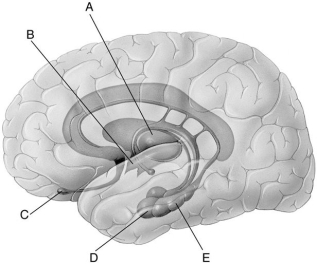 -In the figure, which letter points to the hippocampus?
 (Multiple Choice)
5.0/5 (80)
(80) Cranial nerves originate in the brain and are thus part of the
(Multiple Choice)
5.0/5 (89)
(89) The limbic system in the central nervous system sustains many vegetative functions in mammals and is closely associated with structures that process cues about
(Multiple Choice)
4.8/5 (80)
(80) Early onset Alzheimer's is similar to early-onset Parkinson's in that both
(Multiple Choice)
4.7/5 (77)
(77) Preparation for the fight-or-flight response includes activation of the ________ nervous system.
(Multiple Choice)
4.8/5 (85)
(85) The telencephalon region of the developing brain of a mammal
(Multiple Choice)
4.8/5 (80)
(80) In a cephalized invertebrate, the system that transmits "efferent" impulses from the anterior ganglion to distal segments is the
(Multiple Choice)
4.8/5 (61)
(61) Cephalization, the clustering of neurons and interneurons in the anterior part of the animal, is apparent in
(Multiple Choice)
4.9/5 (75)
(75) The unconscious control of respiration and circulation are associated with the
(Multiple Choice)
4.8/5 (67)
(67) Which brain region would be involved in information retention if you were to take a nap after studying?
(Multiple Choice)
4.9/5 (83)
(83) The divisions of the nervous system that have antagonistic, or opposing, actions are
(Multiple Choice)
4.8/5 (79)
(79) Use the following information to answer the next few questions.
While walking your dog one night, you notice that there are few animals making noise compared to the day. This piques your interest and you decide to perform a literature search. You discover that the 24-hour biological clock is a conserved evolutionary adaptation across many taxa, and is typically synchronized with periods of light and dark, where the animals are alert in the light periods and sleeping during the dark periods. The group of neurons that links the biological clock to environmental cues of light and dark is called the suprachiasmatic nucleus (SCN).
-In birds and mammals, the hormone that affects the sleep/wake cycle is
(Multiple Choice)
4.7/5 (87)
(87) Wakefulness is regulated by the reticular formation, which is present in the
(Multiple Choice)
4.8/5 (85)
(85) 
Filters
- Essay(0)
- Multiple Choice(0)
- Short Answer(0)
- True False(0)
- Matching(0)