



 Chat with AI
Exam 28: Protists

Exam 1: Introduction: Evolution and Themes of Biology70 Questions
Exam 2: The Chemical Context of Life90 Questions
Exam 3: Water and Life80 Questions
Exam 4: Carbon and the Molecular Diversity of Life78 Questions
Exam 5: The Structure and Function of Large Biological Molecules117 Questions
Exam 6: A Tour of the Cell96 Questions
Exam 7: Membrane Structure and Function78 Questions
Exam 8: An Introduction to Metabolism88 Questions
Exam 9: Cellular Respiration and Fermentation117 Questions
Exam 10: Photosynthesis89 Questions
Exam 11: Cell Communication77 Questions
Exam 12: The Cell Cycle83 Questions
Exam 13: Meiosis and Sexual Life Cycles74 Questions
Exam 14: Mendel and the Gene Idea82 Questions
Exam 15: The Chromosomal Basis of Inheritance66 Questions
Exam 16: The Molecular Basis of Inheritance67 Questions
Exam 17: From Gene to Protein91 Questions
Exam 18: Regulation of Gene Expression107 Questions
Exam 19: Viruses53 Questions
Exam 20: Dna Tools and Biotechnology72 Questions
Exam 21: Genomes and Their Evolution52 Questions
Exam 22: Descent With Modification: a Darwinian View of Life63 Questions
Exam 23: The Evolution of Populations86 Questions
Exam 24: The Origin of Species71 Questions
Exam 25: The History of Life on Earth83 Questions
Exam 26: Phylogeny and the Tree of Life81 Questions
Exam 27: Bacteria and Archaea86 Questions
Exam 28: Protists84 Questions
Exam 29: Plant Diversity I: How Plants Colonized Land82 Questions
Exam 30: Plant Diversity Ii: the Evolution of Seed Plants110 Questions
Exam 31: Fungi97 Questions
Exam 32: An Overview of Animal Diversity82 Questions
Exam 33: An Introduction to Invertebrates101 Questions
Exam 34: The Origin and Evolution of Vertebrates117 Questions
Exam 35: Plant Structure, Growth, and Development75 Questions
Exam 36: Resource Acquisition and Transport in Vascular Plants89 Questions
Exam 37: Soil and Plant Nutrition91 Questions
Exam 38: Angiosperm Reproduction and Biotechnology94 Questions
Exam 39: Plant Responses to Internal and External Signals116 Questions
Exam 40: Basic Principles of Animal Form and Function86 Questions
Exam 41: Animal Nutrition73 Questions
Exam 42: Circulation and Gas Exchange100 Questions
Exam 43: The Immune System110 Questions
Exam 44: Osmoregulation and Excretion79 Questions
Exam 45: Hormones and the Endocrine System82 Questions
Exam 46: Animal Reproduction104 Questions
Exam 47: Animal Development98 Questions
Exam 48: Neurons, Synapses, and Signalling81 Questions
Exam 49: Nervous Systems73 Questions
Exam 50: Sensory and Motor Mechanisms91 Questions
Exam 51: Animal Behaviour79 Questions
Exam 52: An Introduction to Ecology and the Biosphere81 Questions
Exam 53: Population Ecology87 Questions
Exam 54: Community Ecology85 Questions
Exam 55: Ecosystems and Restoration Ecology89 Questions
Exam 56: Conservation Biology and Global Change75 Questions
Select questions type


P. chromatophora secretes around itself a test, or case, of plates made of silica. Which of the following is another rhizarian that would be in competition with P. chromatophora for the silica needed to make these plates, assuming limited quantities of silica in the environment?
(Multiple Choice)
4.9/5  (62)
(62) You are given the task of designing an aerobic, mixotrophic protist that can perform photosynthesis in fairly deep water (for example, 250 m deep), and can also crawl about and engulf small particles. With which two of the following structures would you provide your protist? 1. hydrogenosome
2. apicoplast
3. pseudopods
4. chloroplast from red alga
5. chloroplast from green alga
(Multiple Choice)
4.8/5 (93)
(93) Which of the following is a characteristic of the water moulds (oomycetes)?
(Multiple Choice)
4.9/5 (84)
(84) Use the following information to answer the questions below.
Giardia lamblia is an intestinal parasite of humans and other mammals that causes intestinal ailments in most people who ingest the cysts. Upon ingestion, each cyst releases two motile cells, called trophozoites. These attach to the small intestine's lining via a ventral adhesive disk. The trophozoites anaerobically metabolize glucose from the host's intestinal contents to produce ATP. Reproduction is completely asexual, occurring by longitudinal binary fission of trophozoites, with each daughter cell receiving two haploid nuclei (n = 5). A trophozoite will often encyst as it passes into the large intestine by secreting around itself a case that is resistant to cold, heat, and dehydration. Infection usually occurs by drinking untreated water that contains cysts.
-The cysts of Giardia are most analogous to the
(Multiple Choice)
5.0/5 (90)
(90) According to the endosymbiotic theory of the origin of eukaryotic cells, how did mitochondria originate?
(Multiple Choice)
4.9/5 (78)
(78) Use the following information to answer the questions below.
Paulinella chromatophora is one of the few cercozoans that is autotrophic, carrying out aerobic photosynthesis with its two elongated "cyanelles." The cyanelles are contained within vesicles of the host cell, and each is derived from a cyanobacterium, though not the same type of cyanobacterium that gave rise to the chloroplasts of algae and plants.
-The closest living relative of P. chromatophora is the heterotroph, P. ovalis. What type of evidence permits biologists to make this claim about relatedness?
(Multiple Choice)
4.7/5 (77)
(77) The chloroplasts of land plants are thought to have been derived according to which evolutionary sequence?
(Multiple Choice)
4.8/5 (84)
(84) Use the following information to answer the questions below.
Giardia lamblia is an intestinal parasite of humans and other mammals that causes intestinal ailments in most people who ingest the cysts. Upon ingestion, each cyst releases two motile cells, called trophozoites. These attach to the small intestine's lining via a ventral adhesive disk. The trophozoites anaerobically metabolize glucose from the host's intestinal contents to produce ATP. Reproduction is completely asexual, occurring by longitudinal binary fission of trophozoites, with each daughter cell receiving two haploid nuclei (n = 5). A trophozoite will often encyst as it passes into the large intestine by secreting around itself a case that is resistant to cold, heat, and dehydration. Infection usually occurs by drinking untreated water that contains cysts.
-If the mitosomes of Giardia contain no DNA, yet are descendants of what were once? free-living organisms, then where are we likely to find the genes that encode their structures, and what accounts for their current location there?
(Multiple Choice)
4.8/5 (70)
(70) You are given an unknown organism to identify. It is unicellular and heterotrophic. It is motile, using many short extensions of the cytoplasm, each featuring the 9 + 2 filament pattern. It has well-developed organelles and three nuclei, one large and two small. This organism is most likely to be a member of which group?
(Multiple Choice)
4.8/5 (69)
(69) Theoretically, P.bursaria can obtain zoochlorella either vertically (via the asexual reproduction of its mother cell)or horizontally (by ingesting free-living Chlorella from its habitat). Consider a P. bursaria cell containing zoochlorellae, but whose habitat lacks free-living Chlorella. If this cell subsequently undergoes many generations of asexual reproduction, if all of its daughter cells contain roughly the same number of zoochlorellae as it had originally contained, and if the zoochlorellae are all haploid and identical in appearance, then what is true?
(Multiple Choice)
4.9/5 (91)
(91) The next few questions refer to the following description.
Healthy individuals of Paramecium bursaria contain photosynthetic algal endosymbionts of the genus Chlorella. When within their hosts, the algae are referred to as zoochlorellae. In aquaria with light coming from only one side, P. bursaria gathers at the well-lit side, whereas other species of Paramecium gather at the opposite side. The zoochlorellae provide their hosts with glucose and oxygen, and P. bursaria provides its zoochlorellae with protection and motility.? P. bursaria can lose its zoochlorellae in two ways: (1) if kept in darkness, the algae will die; and (2) if prey items (mostly bacteria) are absent from its habitat, P. bursaria will digest its zoochlorellae.
-Which term most accurately describes the nutritional mode of healthy P. bursaria?
(Multiple Choice)
4.9/5 (72)
(72) Use the following information to answer the questions below.
Giardia lamblia is an intestinal parasite of humans and other mammals that causes intestinal ailments in most people who ingest the cysts. Upon ingestion, each cyst releases two motile cells, called trophozoites. These attach to the small intestine's lining via a ventral adhesive disk. The trophozoites anaerobically metabolize glucose from the host's intestinal contents to produce ATP. Reproduction is completely asexual, occurring by longitudinal binary fission of trophozoites, with each daughter cell receiving two haploid nuclei (n = 5). A trophozoite will often encyst as it passes into the large intestine by secreting around itself a case that is resistant to cold, heat, and dehydration. Infection usually occurs by drinking untreated water that contains cysts.
-Given the putative ancestry of Giardia's mitosome, what should we predict is true of the mitosome?
(Multiple Choice)
4.9/5 (75)
(75) A gelatinous seaweed that grows in shallow, cold water and undergoes heteromorphic alternation of generations is most probably what type of alga?
(Multiple Choice)
4.8/5 (77)
(77) Use the following information to answer the questions below.
Giardia lamblia is an intestinal parasite of humans and other mammals that causes intestinal ailments in most people who ingest the cysts. Upon ingestion, each cyst releases two motile cells, called trophozoites. These attach to the small intestine's lining via a ventral adhesive disk. The trophozoites anaerobically metabolize glucose from the host's intestinal contents to produce ATP. Reproduction is completely asexual, occurring by longitudinal binary fission of trophozoites, with each daughter cell receiving two haploid nuclei (n = 5). A trophozoite will often encyst as it passes into the large intestine by secreting around itself a case that is resistant to cold, heat, and dehydration. Infection usually occurs by drinking untreated water that contains cysts.
-The mitosome of Giardia has no DNA within it. If it did contain DNA, then what predictions should we be able to make about its DNA? 1. It is linear.
2. It is circular.
3. It has many introns.
4. It has few introns.
5. It is not associated with histone proteins.
6. It is complexed with histone proteins.
(Multiple Choice)
4.9/5 (89)
(89) The following questions refer to the description below.
You and a friend were walking through a pet store looking at the different aquaria with fish. Most of the aquaria had fish that were healthy and colourful, but two tanks with many fish in them had fish with "fin and tail rot" caused by a pathogenic bacteria. You and your friend read that bacteria are found in most environments and that healthy fish are quite resistant to bacterial infections.
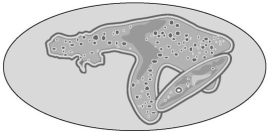 -Test tube 4 contains
 (Multiple Choice)
4.8/5 (80)
(80) Use the following information to answer the questions below.
Giardia lamblia is an intestinal parasite of humans and other mammals that causes intestinal ailments in most people who ingest the cysts. Upon ingestion, each cyst releases two motile cells, called trophozoites. These attach to the small intestine's lining via a ventral adhesive disk. The trophozoites anaerobically metabolize glucose from the host's intestinal contents to produce ATP. Reproduction is completely asexual, occurring by longitudinal binary fission of trophozoites, with each daughter cell receiving two haploid nuclei (n = 5). A trophozoite will often encyst as it passes into the large intestine by secreting around itself a case that is resistant to cold, heat, and dehydration. Infection usually occurs by drinking untreated water that contains cysts.
-The trophozoites of Giardia were first observed in 1681 in the diarrhea stools of the first known person to view protists with a microscope, a person named
(Multiple Choice)
4.8/5 (81)
(81) Which protists are in the same eukaryotic supergroup as land plants?
(Multiple Choice)
5.0/5 (86)
(86) A biologist discovers an alga that is marine, multicellular, and lives at a depth reached only by blue light. This alga probably belongs to which group?
(Multiple Choice)
4.9/5 (71)
(71) 
Filters
- Essay(0)
- Multiple Choice(0)
- Short Answer(0)
- True False(0)
- Matching(0)