



 Chat with AI
Exam 28: Protists

Exam 1: Introduction: Evolution and Themes of Biology70 Questions
Exam 2: The Chemical Context of Life90 Questions
Exam 3: Water and Life80 Questions
Exam 4: Carbon and the Molecular Diversity of Life78 Questions
Exam 5: The Structure and Function of Large Biological Molecules117 Questions
Exam 6: A Tour of the Cell96 Questions
Exam 7: Membrane Structure and Function78 Questions
Exam 8: An Introduction to Metabolism88 Questions
Exam 9: Cellular Respiration and Fermentation117 Questions
Exam 10: Photosynthesis89 Questions
Exam 11: Cell Communication77 Questions
Exam 12: The Cell Cycle83 Questions
Exam 13: Meiosis and Sexual Life Cycles74 Questions
Exam 14: Mendel and the Gene Idea82 Questions
Exam 15: The Chromosomal Basis of Inheritance66 Questions
Exam 16: The Molecular Basis of Inheritance67 Questions
Exam 17: From Gene to Protein91 Questions
Exam 18: Regulation of Gene Expression107 Questions
Exam 19: Viruses53 Questions
Exam 20: Dna Tools and Biotechnology72 Questions
Exam 21: Genomes and Their Evolution52 Questions
Exam 22: Descent With Modification: a Darwinian View of Life63 Questions
Exam 23: The Evolution of Populations86 Questions
Exam 24: The Origin of Species71 Questions
Exam 25: The History of Life on Earth83 Questions
Exam 26: Phylogeny and the Tree of Life81 Questions
Exam 27: Bacteria and Archaea86 Questions
Exam 28: Protists84 Questions
Exam 29: Plant Diversity I: How Plants Colonized Land82 Questions
Exam 30: Plant Diversity Ii: the Evolution of Seed Plants110 Questions
Exam 31: Fungi97 Questions
Exam 32: An Overview of Animal Diversity82 Questions
Exam 33: An Introduction to Invertebrates101 Questions
Exam 34: The Origin and Evolution of Vertebrates117 Questions
Exam 35: Plant Structure, Growth, and Development75 Questions
Exam 36: Resource Acquisition and Transport in Vascular Plants89 Questions
Exam 37: Soil and Plant Nutrition91 Questions
Exam 38: Angiosperm Reproduction and Biotechnology94 Questions
Exam 39: Plant Responses to Internal and External Signals116 Questions
Exam 40: Basic Principles of Animal Form and Function86 Questions
Exam 41: Animal Nutrition73 Questions
Exam 42: Circulation and Gas Exchange100 Questions
Exam 43: The Immune System110 Questions
Exam 44: Osmoregulation and Excretion79 Questions
Exam 45: Hormones and the Endocrine System82 Questions
Exam 46: Animal Reproduction104 Questions
Exam 47: Animal Development98 Questions
Exam 48: Neurons, Synapses, and Signalling81 Questions
Exam 49: Nervous Systems73 Questions
Exam 50: Sensory and Motor Mechanisms91 Questions
Exam 51: Animal Behaviour79 Questions
Exam 52: An Introduction to Ecology and the Biosphere81 Questions
Exam 53: Population Ecology87 Questions
Exam 54: Community Ecology85 Questions
Exam 55: Ecosystems and Restoration Ecology89 Questions
Exam 56: Conservation Biology and Global Change75 Questions
Select questions type


The following questions refer to the description below.
You and a friend were walking through a pet store looking at the different aquaria with fish. Most of the aquaria had fish that were healthy and colourful, but two tanks with many fish in them had fish with "fin and tail rot" caused by a pathogenic bacteria. You and your friend read that bacteria are found in most environments and that healthy fish are quite resistant to bacterial infections.
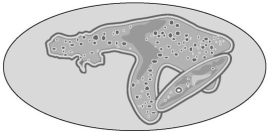 -Test tube 5 contains
 (Multiple Choice)
4.8/5  (79)
(79) Which process results in genetic recombination, but is separate from the process by which the population size of Paramecium increases?
(Multiple Choice)
4.9/5 (86)
(86) An individual mixotroph loses its plastids, yet continues to survive. Which of the following most likely accounts for its continued survival?
(Multiple Choice)
4.8/5 (77)
(77) If the Archaeplastidae are eventually designated a kingdom, and if land plants are excluded from this kingdom, then what will be true of this new kingdom?
(Multiple Choice)
4.9/5 (85)
(85) Green algae differ from land plants in that many green algae
(Multiple Choice)
5.0/5 (63)
(63) Diatoms are mostly asexual members of the phytoplankton. Diatoms lack any organelles that might have the 9 + 2 pattern. They obtain their nutrition from functional chloroplasts, and each diatom is encased within two porous, glasslike valves. Which question would be most important for one interested in the day-to-day survival of individual diatoms?
(Multiple Choice)
5.0/5 (77)
(77) You are given the task of designing an aquatic protist that is a primary producer. It cannot swim on its own, yet must stay in well-lit surface waters. It must be resistant to physical damage from wave action. It should be most similar to a(n)
(Multiple Choice)
5.0/5 (74)
(74) Plastids that are surrounded by more than two membranes are evidence of
(Multiple Choice)
4.8/5 (96)
(96) A large seaweed that floats freely on the surface of deep bodies of water would be expected to lack which of the following?
(Multiple Choice)
4.8/5 (79)
(79) A crucial photosynthetic gene of the cyanobacterium that gave rise to the cyanelle is called psaE. This gene is present in the nuclear genome of the cercozoan, but is not in the genome of the cyanelle. This is evidence of
(Multiple Choice)
4.8/5 (72)
(72) Which two genera have members that can evade the human immune system by frequently changing their surface proteins? 1. Plasmodium
2. Trichomonas
3. Paramecium
4. Trypanosoma
5. Entamoeba
(Multiple Choice)
4.8/5 (87)
(87) Biologists suspect that endosymbiosis gave rise to mitochondria before plastids partly because
(Multiple Choice)
4.9/5 (85)
(85) In alternation of generation in brown algae, which pair is incorrectly matched?
(Multiple Choice)
4.8/5 (85)
(85) The chloroplasts of all of the following are thought to be derived from ancestral red algae, except those of
(Multiple Choice)
4.8/5 (73)
(73) Which of the following is correctly described as a primary producer?
(Multiple Choice)
4.7/5 (77)
(77) Reinforced, threadlike pseudopods that can perform phagocytosis are generally characteristic of which group?
(Multiple Choice)
4.9/5 (84)
(84) In life cycles with an alternation of generations, multicellular haploid forms alternate with
(Multiple Choice)
4.9/5 (86)
(86) 
Filters
- Essay(0)
- Multiple Choice(0)
- Short Answer(0)
- True False(0)
- Matching(0)