



 Chat with AI
Exam 21: Genomes and Their Evolution

Exam 1: Introduction: Evolution and Themes of Biology70 Questions
Exam 2: The Chemical Context of Life90 Questions
Exam 3: Water and Life80 Questions
Exam 4: Carbon and the Molecular Diversity of Life78 Questions
Exam 5: The Structure and Function of Large Biological Molecules117 Questions
Exam 6: A Tour of the Cell96 Questions
Exam 7: Membrane Structure and Function78 Questions
Exam 8: An Introduction to Metabolism88 Questions
Exam 9: Cellular Respiration and Fermentation117 Questions
Exam 10: Photosynthesis89 Questions
Exam 11: Cell Communication77 Questions
Exam 12: The Cell Cycle83 Questions
Exam 13: Meiosis and Sexual Life Cycles74 Questions
Exam 14: Mendel and the Gene Idea82 Questions
Exam 15: The Chromosomal Basis of Inheritance66 Questions
Exam 16: The Molecular Basis of Inheritance67 Questions
Exam 17: From Gene to Protein91 Questions
Exam 18: Regulation of Gene Expression107 Questions
Exam 19: Viruses53 Questions
Exam 20: Dna Tools and Biotechnology72 Questions
Exam 21: Genomes and Their Evolution52 Questions
Exam 22: Descent With Modification: a Darwinian View of Life63 Questions
Exam 23: The Evolution of Populations86 Questions
Exam 24: The Origin of Species71 Questions
Exam 25: The History of Life on Earth83 Questions
Exam 26: Phylogeny and the Tree of Life81 Questions
Exam 27: Bacteria and Archaea86 Questions
Exam 28: Protists84 Questions
Exam 29: Plant Diversity I: How Plants Colonized Land82 Questions
Exam 30: Plant Diversity Ii: the Evolution of Seed Plants110 Questions
Exam 31: Fungi97 Questions
Exam 32: An Overview of Animal Diversity82 Questions
Exam 33: An Introduction to Invertebrates101 Questions
Exam 34: The Origin and Evolution of Vertebrates117 Questions
Exam 35: Plant Structure, Growth, and Development75 Questions
Exam 36: Resource Acquisition and Transport in Vascular Plants89 Questions
Exam 37: Soil and Plant Nutrition91 Questions
Exam 38: Angiosperm Reproduction and Biotechnology94 Questions
Exam 39: Plant Responses to Internal and External Signals116 Questions
Exam 40: Basic Principles of Animal Form and Function86 Questions
Exam 41: Animal Nutrition73 Questions
Exam 42: Circulation and Gas Exchange100 Questions
Exam 43: The Immune System110 Questions
Exam 44: Osmoregulation and Excretion79 Questions
Exam 45: Hormones and the Endocrine System82 Questions
Exam 46: Animal Reproduction104 Questions
Exam 47: Animal Development98 Questions
Exam 48: Neurons, Synapses, and Signalling81 Questions
Exam 49: Nervous Systems73 Questions
Exam 50: Sensory and Motor Mechanisms91 Questions
Exam 51: Animal Behaviour79 Questions
Exam 52: An Introduction to Ecology and the Biosphere81 Questions
Exam 53: Population Ecology87 Questions
Exam 54: Community Ecology85 Questions
Exam 55: Ecosystems and Restoration Ecology89 Questions
Exam 56: Conservation Biology and Global Change75 Questions
Select questions type


Use the following information to answer the questions below.
You have isolated a gene sequence from the mustard plant Arabidopsis and have BLAST searched the NCBI database. Your sequence hit several EST sequences that were identified as transcription factors. These sequences were found in E.coli, Chlamydomonas (a green algae), yeast, mice, and humans and only had a few base pair differences.
-When you compared your sequence to the database, what were you practising?
(Multiple Choice)
4.9/5  (73)
(73) Barbara McClintock, who achieved fame for discovering that genes could move within genomes, had her meticulous work ignored for nearly four decades, but eventually won the Nobel Prize. Why was her work so distrusted?
(Multiple Choice)
4.8/5 (76)
(76) A consortium of 25 Canadian scientists, led by Dr. Rudnicki at the University of Ottawa, is looking at gene expression in both ________ cells. This is important in understanding regenerative medicine.
(Multiple Choice)
4.9/5 (91)
(91) Use the following figure to answer the next few questions.
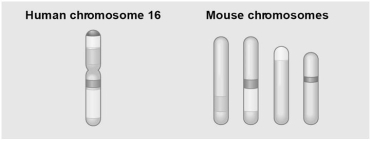 This figure shows a diagram of blocks of genes on human chromosome 16 and the locations of blocks of similar genes on four chromosomes of the mouse.
-The movement of these blocks suggests that
This figure shows a diagram of blocks of genes on human chromosome 16 and the locations of blocks of similar genes on four chromosomes of the mouse.
-The movement of these blocks suggests that (Multiple Choice)
4.7/5 (75)
(75) A recent report has indicated several conclusions about comparisons of our genome with that of Neanderthals. This report concludes, in part, that, at some period in evolutionary history, there was an admixture of the two genomes. This is evidenced by
(Multiple Choice)
4.8/5 (76)
(76) Use the following information to help you answer the next few questions.
Multigene families include two or more nearly identical genes or genes sharing nearly identical sequences. A classical example is the set of genes for globin molecules, including genes on human chromosomes 11 and 16.
-Several of the different globin genes are expressed in humans, but at different times in development. What mechanism could allow for this?
(Multiple Choice)
4.8/5 (86)
(86) Why might the cricket genome have 11 times as many base pairs as that of Drosophila melanogaster?
(Multiple Choice)
4.7/5 (65)
(65) 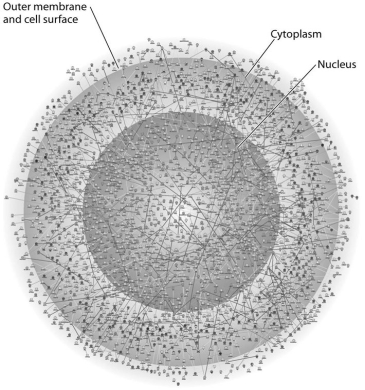 -The illustration above most probably represents
The comparison between the number of human genes and those of other animal species has led to many conclusions, including
(Multiple Choice)
4.9/5 (74)
(74) 
Filters
- Essay(0)
- Multiple Choice(0)
- Short Answer(0)
- True False(0)
- Matching(0)