



 Chat with AI
Exam 21: Genomes and Their Evolution

Exam 1: Introduction: Evolution and Themes of Biology70 Questions
Exam 2: The Chemical Context of Life90 Questions
Exam 3: Water and Life80 Questions
Exam 4: Carbon and the Molecular Diversity of Life78 Questions
Exam 5: The Structure and Function of Large Biological Molecules117 Questions
Exam 6: A Tour of the Cell96 Questions
Exam 7: Membrane Structure and Function78 Questions
Exam 8: An Introduction to Metabolism88 Questions
Exam 9: Cellular Respiration and Fermentation117 Questions
Exam 10: Photosynthesis89 Questions
Exam 11: Cell Communication77 Questions
Exam 12: The Cell Cycle83 Questions
Exam 13: Meiosis and Sexual Life Cycles74 Questions
Exam 14: Mendel and the Gene Idea82 Questions
Exam 15: The Chromosomal Basis of Inheritance66 Questions
Exam 16: The Molecular Basis of Inheritance67 Questions
Exam 17: From Gene to Protein91 Questions
Exam 18: Regulation of Gene Expression107 Questions
Exam 19: Viruses53 Questions
Exam 20: Dna Tools and Biotechnology72 Questions
Exam 21: Genomes and Their Evolution52 Questions
Exam 22: Descent With Modification: a Darwinian View of Life63 Questions
Exam 23: The Evolution of Populations86 Questions
Exam 24: The Origin of Species71 Questions
Exam 25: The History of Life on Earth83 Questions
Exam 26: Phylogeny and the Tree of Life81 Questions
Exam 27: Bacteria and Archaea86 Questions
Exam 28: Protists84 Questions
Exam 29: Plant Diversity I: How Plants Colonized Land82 Questions
Exam 30: Plant Diversity Ii: the Evolution of Seed Plants110 Questions
Exam 31: Fungi97 Questions
Exam 32: An Overview of Animal Diversity82 Questions
Exam 33: An Introduction to Invertebrates101 Questions
Exam 34: The Origin and Evolution of Vertebrates117 Questions
Exam 35: Plant Structure, Growth, and Development75 Questions
Exam 36: Resource Acquisition and Transport in Vascular Plants89 Questions
Exam 37: Soil and Plant Nutrition91 Questions
Exam 38: Angiosperm Reproduction and Biotechnology94 Questions
Exam 39: Plant Responses to Internal and External Signals116 Questions
Exam 40: Basic Principles of Animal Form and Function86 Questions
Exam 41: Animal Nutrition73 Questions
Exam 42: Circulation and Gas Exchange100 Questions
Exam 43: The Immune System110 Questions
Exam 44: Osmoregulation and Excretion79 Questions
Exam 45: Hormones and the Endocrine System82 Questions
Exam 46: Animal Reproduction104 Questions
Exam 47: Animal Development98 Questions
Exam 48: Neurons, Synapses, and Signalling81 Questions
Exam 49: Nervous Systems73 Questions
Exam 50: Sensory and Motor Mechanisms91 Questions
Exam 51: Animal Behaviour79 Questions
Exam 52: An Introduction to Ecology and the Biosphere81 Questions
Exam 53: Population Ecology87 Questions
Exam 54: Community Ecology85 Questions
Exam 55: Ecosystems and Restoration Ecology89 Questions
Exam 56: Conservation Biology and Global Change75 Questions
Select questions type


In comparing the genomes of humans and those of other higher primates, it is seen that humans have a large metacentric pair we call chromosome 2 among our 46 chromosomes, whereas the other primates of this group have 48 chromosomes and any pair like the human chromosome 2 pair is not present; instead, the primate groups each have two pairs of midsize acrocentric chromosomes. What is the most likely explanation?
(Multiple Choice)
4.9/5  (76)
(76) Fragments of DNA have been extracted from the remnants of extinct woolly mammoths, amplified, and sequenced. These can now be used to
(Multiple Choice)
4.8/5 (75)
(75) The biggest problem with the shotgun technique is its tendency to underestimate the size of the genome. Which of the following might best account for this?
(Multiple Choice)
4.7/5 (70)
(70) Homeotic genes contain a homeobox sequence that is highly conserved among very diverse species. The homeobox is the code for that domain of a protein that binds to DNA in a regulatory developmental process. Which of the following would you then expect?
(Multiple Choice)
4.9/5 (76)
(76) Use the following information to answer the questions below.
You have isolated a gene sequence from the mustard plant Arabidopsis and have BLAST searched the NCBI database. Your sequence hit several EST sequences that were identified as transcription factors. These sequences were found in E.coli, Chlamydomonas (a green algae), yeast, mice, and humans and only had a few base pair differences.
-What can be surmised about your transcription factor?
(Multiple Choice)
4.7/5 (87)
(87) The large common repository for genetic sequences hosted by NCBI is called
(Multiple Choice)
4.9/5 (79)
(79) A project initiated at the University of Guelph is attempting to catalogue the differences of a short sequence within the mitochondrial DNA in all animal species. This ________ should allow the quick identification of a species.
(Multiple Choice)
4.8/5 (74)
(74) Use the following figure to answer the next few questions.
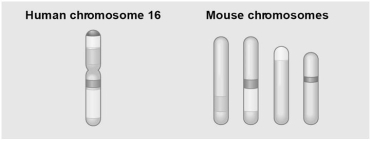 This figure shows a diagram of blocks of genes on human chromosome 16 and the locations of blocks of similar genes on four chromosomes of the mouse.
-Which of the following represents another example of the same phenomenon as that shown in the above figure?
This figure shows a diagram of blocks of genes on human chromosome 16 and the locations of blocks of similar genes on four chromosomes of the mouse.
-Which of the following represents another example of the same phenomenon as that shown in the above figure? (Multiple Choice)
4.8/5 (71)
(71) Which of the following most correctly describes a shotgun technique for sequencing a genome?
(Multiple Choice)
4.9/5 (70)
(70) If humans have 2900 Mb, a specific member of the lily family has 120 000 Mb, and a yeast has ~13 Mb, why can't this data allow us to order their evolutionary significance?
(Multiple Choice)
4.8/5 (91)
(91) What characteristic of short tandem repeat DNA makes it useful for studying evolution?
(Multiple Choice)
4.8/5 (76)
(76) Alu elements account for about 10% of the human genome. What are Alu elements?
(Multiple Choice)
5.0/5 (75)
(75) Bioinformatics can be used to scan sequences for probable genes looking for start and stop sites for transcription and for translation, for probable splice sites, and for sequences that specify known mRNAs. Such sequences containing these elements are called
(Multiple Choice)
4.7/5 (88)
(88) Researchers at the University of British Columbia are working on a way to analyze gene expression within a single cell as it differentiates. This is significant because
(Multiple Choice)
4.9/5 (83)
(83) By the year 2012, ________ genomes had been completely sequenced.
(Multiple Choice)
4.7/5 (73)
(73) Use the following information to answer the questions below.
You have isolated a gene sequence from the mustard plant Arabidopsis and have BLAST searched the NCBI database. Your sequence hit several EST sequences that were identified as transcription factors. These sequences were found in E.coli, Chlamydomonas (a green algae), yeast, mice, and humans and only had a few base pair differences.
-What can be said about this sequence?
(Multiple Choice)
4.8/5 (86)
(86) 
Filters
- Essay(0)
- Multiple Choice(0)
- Short Answer(0)
- True False(0)
- Matching(0)