



 Chat with AI
Exam 18: Regulation of Gene Expression

Exam 1: Introduction: Evolution and Themes of Biology70 Questions
Exam 2: The Chemical Context of Life90 Questions
Exam 3: Water and Life80 Questions
Exam 4: Carbon and the Molecular Diversity of Life78 Questions
Exam 5: The Structure and Function of Large Biological Molecules117 Questions
Exam 6: A Tour of the Cell96 Questions
Exam 7: Membrane Structure and Function78 Questions
Exam 8: An Introduction to Metabolism88 Questions
Exam 9: Cellular Respiration and Fermentation117 Questions
Exam 10: Photosynthesis89 Questions
Exam 11: Cell Communication77 Questions
Exam 12: The Cell Cycle83 Questions
Exam 13: Meiosis and Sexual Life Cycles74 Questions
Exam 14: Mendel and the Gene Idea82 Questions
Exam 15: The Chromosomal Basis of Inheritance66 Questions
Exam 16: The Molecular Basis of Inheritance67 Questions
Exam 17: From Gene to Protein91 Questions
Exam 18: Regulation of Gene Expression107 Questions
Exam 19: Viruses53 Questions
Exam 20: Dna Tools and Biotechnology72 Questions
Exam 21: Genomes and Their Evolution52 Questions
Exam 22: Descent With Modification: a Darwinian View of Life63 Questions
Exam 23: The Evolution of Populations86 Questions
Exam 24: The Origin of Species71 Questions
Exam 25: The History of Life on Earth83 Questions
Exam 26: Phylogeny and the Tree of Life81 Questions
Exam 27: Bacteria and Archaea86 Questions
Exam 28: Protists84 Questions
Exam 29: Plant Diversity I: How Plants Colonized Land82 Questions
Exam 30: Plant Diversity Ii: the Evolution of Seed Plants110 Questions
Exam 31: Fungi97 Questions
Exam 32: An Overview of Animal Diversity82 Questions
Exam 33: An Introduction to Invertebrates101 Questions
Exam 34: The Origin and Evolution of Vertebrates117 Questions
Exam 35: Plant Structure, Growth, and Development75 Questions
Exam 36: Resource Acquisition and Transport in Vascular Plants89 Questions
Exam 37: Soil and Plant Nutrition91 Questions
Exam 38: Angiosperm Reproduction and Biotechnology94 Questions
Exam 39: Plant Responses to Internal and External Signals116 Questions
Exam 40: Basic Principles of Animal Form and Function86 Questions
Exam 41: Animal Nutrition73 Questions
Exam 42: Circulation and Gas Exchange100 Questions
Exam 43: The Immune System110 Questions
Exam 44: Osmoregulation and Excretion79 Questions
Exam 45: Hormones and the Endocrine System82 Questions
Exam 46: Animal Reproduction104 Questions
Exam 47: Animal Development98 Questions
Exam 48: Neurons, Synapses, and Signalling81 Questions
Exam 49: Nervous Systems73 Questions
Exam 50: Sensory and Motor Mechanisms91 Questions
Exam 51: Animal Behaviour79 Questions
Exam 52: An Introduction to Ecology and the Biosphere81 Questions
Exam 53: Population Ecology87 Questions
Exam 54: Community Ecology85 Questions
Exam 55: Ecosystems and Restoration Ecology89 Questions
Exam 56: Conservation Biology and Global Change75 Questions
Select questions type


Most repressor proteins are allosteric. Which of the following binds with the repressor to alter its conformation?
(Multiple Choice)
5.0/5  (93)
(93) Which of the following statements about the DNA in one of your brain cells is true?
(Multiple Choice)
5.0/5 (83)
(83) Use the following information to answer the questions below.
Epstein Bar Virus (EBV) causes most of us to have an episode of sore throat and swollen glands during early childhood. If we first become exposed to the virus during our teen years, however, EBV causes the syndrome we know as mononucleosis. However, in special circumstances, the same virus can be carcinogenic.
-A very rare human allele of a gene called XLP, or X-linked lymphoproliferative syndrome, causes a small number of people from many different parts of the world to get cancer following even childhood exposure to EBV. Given the previous information, what might be going on?
(Multiple Choice)
4.8/5 (80)
(80) The researcher measures the concentration of the polypeptides from different regions in the early embryo and finds the following pattern (darker shading = greater concentration): 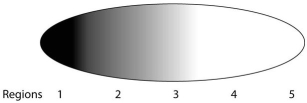 Which of the following would be his most logical assumption?
 (Multiple Choice)
4.7/5 (99)
(99) The transformation from a zygote to a full-formed organism involves three interrelated processes. In order of occurrence, they are
(Multiple Choice)
5.0/5 (80)
(80) Use the following information to answer the questions below.
A geneticist introduces a transgene into yeast cells and isolates five independent cell lines in which the transgene has integrated into the yeast genome. In four of the lines, the transgene is expressed strongly, but in the fifth there is no expression at all.
-Of the lines that express the transgene, one is transcribed but not translated. Which of the following is a likely explanation?
(Multiple Choice)
4.8/5 (69)
(69) Which of the following mechanisms is (are)used to coordinate the expression of multiple, related genes in eukaryotic cells?
(Multiple Choice)
4.8/5 (66)
(66) Use the following information to answer the questions below.
Epstein Bar Virus (EBV) causes most of us to have an episode of sore throat and swollen glands during early childhood. If we first become exposed to the virus during our teen years, however, EBV causes the syndrome we know as mononucleosis. However, in special circumstances, the same virus can be carcinogenic.
-If a particular operon encodes enzymes for making an essential amino acid and is regulated like the trp operon, then
(Multiple Choice)
4.8/5 (93)
(93) Use the following information to answer the questions below.
A geneticist introduces a transgene into yeast cells and isolates five independent cell lines in which the transgene has integrated into the yeast genome. In four of the lines, the transgene is expressed strongly, but in the fifth there is no expression at all.
-Which of the following is a likely explanation for the lack of transgene expression in the fifth cell line?
(Multiple Choice)
4.9/5 (80)
(80) Use the following information to answer the questions below.
A few decades ago, Knudsen and colleagues proposed a theory that, for a normal cell to become a cancer cell, a minimum of two genetic changes had to occur in that cell. Knudsen was studying retinoblastoma, a childhood cancer of the eye.
-One of the human leukemias, called CML (chronic myelogenous leukemia), is associated with a chromosomal translocation between chromosomes 9 and 22 in somatic cells of bone marrow. Which of the following allows CML to provide further evidence of this multistep nature of cancer?
(Multiple Choice)
4.9/5 (70)
(70) Use the following information to answer the questions below.
A few decades ago, Knudsen and colleagues proposed a theory that, for a normal cell to become a cancer cell, a minimum of two genetic changes had to occur in that cell. Knudsen was studying retinoblastoma, a childhood cancer of the eye.
-In colorectal cancer, several genes must be mutated in order to make a cell a cancer cell, supporting Knudsen's hypothesis. Which of the following kinds of genes would you expect to be mutated?
(Multiple Choice)
5.0/5 (73)
(73)  Drosophila larvae (wt) showing segmentation and anterior-posterior axis.
Refer to the image above to answer the following questions.
-Which gene is definitely functioning in the mother of this larva?
Drosophila larvae (wt) showing segmentation and anterior-posterior axis.
Refer to the image above to answer the following questions.
-Which gene is definitely functioning in the mother of this larva? (Multiple Choice)
5.0/5 (83)
(83) Use the following information to answer the questions below.
A researcher introduces double-stranded RNA into a culture of mammalian cells, and can identify its location or that of its smaller subsections experimentally, using a fluorescent probe.
-Within the first quarter hour, the researcher sees that the intact RNA is found in the cells. After 3 hours, she is not surprised to find that
(Multiple Choice)
4.9/5 (68)
(68) Use the following figure to answer the questions below.
 -What is the significance of the configuration between A and B?
 (Multiple Choice)
4.9/5 (75)
(75) When DNA is compacted by histones into 10-nm and 30-nm fibres, the DNA is unable to interact with proteins required for gene expression. Therefore, to allow for these proteins to act, the chromatin must constantly alter its structure. Which processes contribute to this dynamic activity?
(Multiple Choice)
4.7/5 (82)
(82) Two potential devices that eukaryotic cells use to regulate transcription are
(Multiple Choice)
4.9/5 (85)
(85) The product of the bicoid gene in Drosophila provides essential information about
(Multiple Choice)
4.8/5 (71)
(71) Use the following information to answer the questions below.
A researcher found a method she could use to manipulate and quantify phosphorylation and methylation in embryonic cells in culture.
-In one set of experiments she succeeded in decreasing methylation of histone tails. Which of the following results would she most likely see?
(Multiple Choice)
4.8/5 (92)
(92) If a Drosophila female has a homozygous mutation for a maternal effect gene
(Multiple Choice)
4.8/5 (80)
(80) 
Filters
- Essay(0)
- Multiple Choice(0)
- Short Answer(0)
- True False(0)
- Matching(0)