



 Chat with AI
Exam 18: Regulation of Gene Expression

Exam 1: Introduction: Evolution and Themes of Biology70 Questions
Exam 2: The Chemical Context of Life90 Questions
Exam 3: Water and Life80 Questions
Exam 4: Carbon and the Molecular Diversity of Life78 Questions
Exam 5: The Structure and Function of Large Biological Molecules117 Questions
Exam 6: A Tour of the Cell96 Questions
Exam 7: Membrane Structure and Function78 Questions
Exam 8: An Introduction to Metabolism88 Questions
Exam 9: Cellular Respiration and Fermentation117 Questions
Exam 10: Photosynthesis89 Questions
Exam 11: Cell Communication77 Questions
Exam 12: The Cell Cycle83 Questions
Exam 13: Meiosis and Sexual Life Cycles74 Questions
Exam 14: Mendel and the Gene Idea82 Questions
Exam 15: The Chromosomal Basis of Inheritance66 Questions
Exam 16: The Molecular Basis of Inheritance67 Questions
Exam 17: From Gene to Protein91 Questions
Exam 18: Regulation of Gene Expression107 Questions
Exam 19: Viruses53 Questions
Exam 20: Dna Tools and Biotechnology72 Questions
Exam 21: Genomes and Their Evolution52 Questions
Exam 22: Descent With Modification: a Darwinian View of Life63 Questions
Exam 23: The Evolution of Populations86 Questions
Exam 24: The Origin of Species71 Questions
Exam 25: The History of Life on Earth83 Questions
Exam 26: Phylogeny and the Tree of Life81 Questions
Exam 27: Bacteria and Archaea86 Questions
Exam 28: Protists84 Questions
Exam 29: Plant Diversity I: How Plants Colonized Land82 Questions
Exam 30: Plant Diversity Ii: the Evolution of Seed Plants110 Questions
Exam 31: Fungi97 Questions
Exam 32: An Overview of Animal Diversity82 Questions
Exam 33: An Introduction to Invertebrates101 Questions
Exam 34: The Origin and Evolution of Vertebrates117 Questions
Exam 35: Plant Structure, Growth, and Development75 Questions
Exam 36: Resource Acquisition and Transport in Vascular Plants89 Questions
Exam 37: Soil and Plant Nutrition91 Questions
Exam 38: Angiosperm Reproduction and Biotechnology94 Questions
Exam 39: Plant Responses to Internal and External Signals116 Questions
Exam 40: Basic Principles of Animal Form and Function86 Questions
Exam 41: Animal Nutrition73 Questions
Exam 42: Circulation and Gas Exchange100 Questions
Exam 43: The Immune System110 Questions
Exam 44: Osmoregulation and Excretion79 Questions
Exam 45: Hormones and the Endocrine System82 Questions
Exam 46: Animal Reproduction104 Questions
Exam 47: Animal Development98 Questions
Exam 48: Neurons, Synapses, and Signalling81 Questions
Exam 49: Nervous Systems73 Questions
Exam 50: Sensory and Motor Mechanisms91 Questions
Exam 51: Animal Behaviour79 Questions
Exam 52: An Introduction to Ecology and the Biosphere81 Questions
Exam 53: Population Ecology87 Questions
Exam 54: Community Ecology85 Questions
Exam 55: Ecosystems and Restoration Ecology89 Questions
Exam 56: Conservation Biology and Global Change75 Questions
Select questions type


Use the following information to answer the questions below.
A researcher found a method she could use to manipulate and quantify phosphorylation and methylation in embryonic cells in culture.
-She tried decreasing the amount of methylation enzymes in the embryonic stem cells and then allowed the cells to further differentiate. Which of the following results would she most likely see?
(Multiple Choice)
4.9/5  (84)
(84) Absence of bicoid mRNA from a Drosophila egg leads to the absence of anterior larval body parts and mirror-image duplication of posterior parts. This is evidence that the product of the bicoid gene
(Multiple Choice)
4.9/5 (79)
(79) You are given an experimental problem involving control of a gene's expression in the embryo of a particular species. One of your first questions is whether the gene's expression is controlled at the level of transcription or translation. Which of the following might best give you an answer?
(Multiple Choice)
4.8/5 (80)
(80) In response to chemical signals, prokaryotes can do which of the following?
(Multiple Choice)
4.9/5 (72)
(72) Use the following figure to answer the questions below.
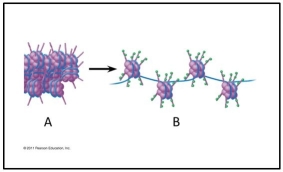 -What is chemically different between A and B in the above image?
 (Multiple Choice)
4.9/5 (100)
(100) The fact that plants can be cloned from somatic cells demonstrates that
(Multiple Choice)
4.9/5 (77)
(77) A lack of which molecule would result in the cell's inability to "turn off" genes?
(Multiple Choice)
4.8/5 (80)
(80) Use the following information to answer the questions below.
A few decades ago, Knudsen and colleagues proposed a theory that, for a normal cell to become a cancer cell, a minimum of two genetic changes had to occur in that cell. Knudsen was studying retinoblastoma, a childhood cancer of the eye.
-Knudsen and colleagues also noted that persons with hereditary retinoblastoma that had been treated successfully lived on but then had a higher frequency of developing osteosarcomas (bone cancers)later in life. This provided further evidence of their theory because
(Multiple Choice)
4.8/5 (84)
(84) Use the following information to answer the questions below.
One hereditary disease in humans, called xeroderma pigmentosum (XP), makes homozygous individuals exceptionally susceptible to UV-induced mutation damage in the cells of exposed tissue, especially skin. Without extraordinary avoidance of sunlight exposure, patients soon succumb to numerous skin cancers.
-Given the damage caused by UV, the kind of gene affected in those with XP is one whose product is involved with
(Multiple Choice)
4.9/5 (77)
(77) Allolactose, an isomer of lactose, is formed in small amounts from lactose. An E. coli cell is presented for the first time with the sugar lactose (containing allolactose)as a potential food source. Which of the following occurs when the lactose enters the cell?
(Multiple Choice)
4.8/5 (80)
(80) Use the following information to answer the questions below.
One hereditary disease in humans, called xeroderma pigmentosum (XP), makes homozygous individuals exceptionally susceptible to UV-induced mutation damage in the cells of exposed tissue, especially skin. Without extraordinary avoidance of sunlight exposure, patients soon succumb to numerous skin cancers.
-Which of the following best describes this phenomenon?
(Multiple Choice)
4.9/5 (91)
(91) The phenomenon in which RNA molecules in a cell are destroyed if they have a sequence complementary to an introduced double-stranded RNA is called
(Multiple Choice)
4.8/5 (81)
(81) 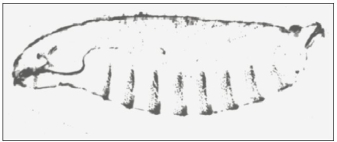 Drosophila larvae (wt) showing segmentation and anterior-posterior axis.
Refer to the image above to answer the following questions.
-The product of the gene responsible for anterior-posterior axis is concentrated more in the anterior end. This supports the
Drosophila larvae (wt) showing segmentation and anterior-posterior axis.
Refer to the image above to answer the following questions.
-The product of the gene responsible for anterior-posterior axis is concentrated more in the anterior end. This supports the (Multiple Choice)
4.8/5 (67)
(67) Use the following information to answer the questions below.
A researcher introduces double-stranded RNA into a culture of mammalian cells, and can identify its location or that of its smaller subsections experimentally, using a fluorescent probe.
-In addition, she finds what other evidence of this single-stranded RNA piece's activity?
(Multiple Choice)
4.8/5 (79)
(79) Use the following figure to answer the questions below.
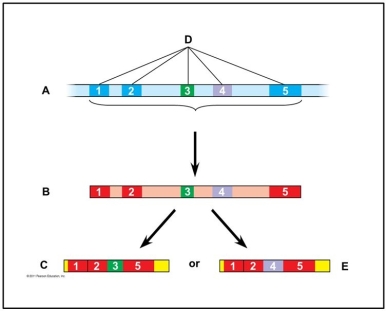 -What does D represent?
 (Multiple Choice)
4.8/5 (84)
(84) Which of the following is an example of post-transcriptional control of gene expression?
(Multiple Choice)
4.9/5 (84)
(84) 
Filters
- Essay(0)
- Multiple Choice(0)
- Short Answer(0)
- True False(0)
- Matching(0)