



 Chat with AI
Exam 9: Cellular Respiration and Fermentation

Exam 1: Introduction: Evolution and Themes of Biology70 Questions
Exam 2: The Chemical Context of Life90 Questions
Exam 3: Water and Life80 Questions
Exam 4: Carbon and the Molecular Diversity of Life78 Questions
Exam 5: The Structure and Function of Large Biological Molecules117 Questions
Exam 6: A Tour of the Cell96 Questions
Exam 7: Membrane Structure and Function78 Questions
Exam 8: An Introduction to Metabolism88 Questions
Exam 9: Cellular Respiration and Fermentation117 Questions
Exam 10: Photosynthesis89 Questions
Exam 11: Cell Communication77 Questions
Exam 12: The Cell Cycle83 Questions
Exam 13: Meiosis and Sexual Life Cycles74 Questions
Exam 14: Mendel and the Gene Idea82 Questions
Exam 15: The Chromosomal Basis of Inheritance66 Questions
Exam 16: The Molecular Basis of Inheritance67 Questions
Exam 17: From Gene to Protein91 Questions
Exam 18: Regulation of Gene Expression107 Questions
Exam 19: Viruses53 Questions
Exam 20: Dna Tools and Biotechnology72 Questions
Exam 21: Genomes and Their Evolution52 Questions
Exam 22: Descent With Modification: a Darwinian View of Life63 Questions
Exam 23: The Evolution of Populations86 Questions
Exam 24: The Origin of Species71 Questions
Exam 25: The History of Life on Earth83 Questions
Exam 26: Phylogeny and the Tree of Life81 Questions
Exam 27: Bacteria and Archaea86 Questions
Exam 28: Protists84 Questions
Exam 29: Plant Diversity I: How Plants Colonized Land82 Questions
Exam 30: Plant Diversity Ii: the Evolution of Seed Plants110 Questions
Exam 31: Fungi97 Questions
Exam 32: An Overview of Animal Diversity82 Questions
Exam 33: An Introduction to Invertebrates101 Questions
Exam 34: The Origin and Evolution of Vertebrates117 Questions
Exam 35: Plant Structure, Growth, and Development75 Questions
Exam 36: Resource Acquisition and Transport in Vascular Plants89 Questions
Exam 37: Soil and Plant Nutrition91 Questions
Exam 38: Angiosperm Reproduction and Biotechnology94 Questions
Exam 39: Plant Responses to Internal and External Signals116 Questions
Exam 40: Basic Principles of Animal Form and Function86 Questions
Exam 41: Animal Nutrition73 Questions
Exam 42: Circulation and Gas Exchange100 Questions
Exam 43: The Immune System110 Questions
Exam 44: Osmoregulation and Excretion79 Questions
Exam 45: Hormones and the Endocrine System82 Questions
Exam 46: Animal Reproduction104 Questions
Exam 47: Animal Development98 Questions
Exam 48: Neurons, Synapses, and Signalling81 Questions
Exam 49: Nervous Systems73 Questions
Exam 50: Sensory and Motor Mechanisms91 Questions
Exam 51: Animal Behaviour79 Questions
Exam 52: An Introduction to Ecology and the Biosphere81 Questions
Exam 53: Population Ecology87 Questions
Exam 54: Community Ecology85 Questions
Exam 55: Ecosystems and Restoration Ecology89 Questions
Exam 56: Conservation Biology and Global Change75 Questions
Select questions type


What is the oxidizing agent in the following reaction? Pyruvate + NADH + H⁺ → Lactate + NAD⁺
(Multiple Choice)
4.8/5  (86)
(86) You have a friend who lost 7 kg (about 15 pounds)of fat on a regimen of strict diet and exercise. How did the fat leave her body?
(Multiple Choice)
4.9/5 (84)
(84) Which of the following statements describes the results of this reaction? C₆H₁₂O₆ + 6 O₂ → 6 CO₂ + 6 H₂O + Energy
(Multiple Choice)
4.7/5 (79)
(79) Which process in eukaryotic cells will proceed normally whether oxygen (O)is present or absent?
(Multiple Choice)
5.0/5 (70)
(70) Chemiosmotic ATP synthesis (oxidative phosphorylation)occurs in
(Multiple Choice)
5.0/5 (93)
(93) The ATP made during fermentation is generated by which of the following?
(Multiple Choice)
5.0/5 (94)
(94) Use the following information to answer the questions below.
Exposing inner mitochondrial membranes to ultrasonic vibrations will disrupt the membranes. However, the fragments will reseal "inside out." These little vesicles that result can still transfer electrons from NADH to oxygen and synthesize ATP. If the membranes are agitated further, however, the ability to synthesize ATP is lost.
-After the further agitation of the membrane vesicles, what must be lost from the membrane?
(Multiple Choice)
4.9/5 (78)
(78) The immediate energy source that drives ATP synthesis by ATP synthase during oxidative phosphorylation is the
(Multiple Choice)
4.9/5 (74)
(74) Yeast cells that have defective mitochondria incapable of respiration will be able to grow by catabolizing which of the following carbon sources for energy?
(Multiple Choice)
4.9/5 (81)
(81) The direct energy source that drives ATP synthesis during respiratory oxidative phosphorylation in eukaryotic cells is
(Multiple Choice)
4.9/5 (74)
(74) Which catabolic processes may have been used by cells on ancient Earth before free oxygen became available?
(Multiple Choice)
4.9/5 (83)
(83) Which of the following normally occurs regardless of whether or not oxygen (O)is present?
(Multiple Choice)
4.8/5 (89)
(89) Use the following figure to answer the questions below.
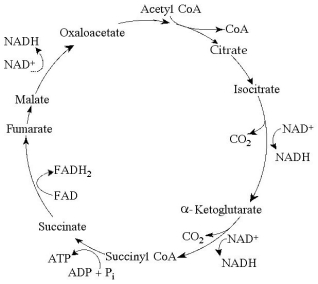 The citric acid cycle.
-If pyruvate oxidation is blocked, what will happen to the levels of oxaloacetate and citric acid in the citric acid cycle shown in the figure above?
The citric acid cycle.
-If pyruvate oxidation is blocked, what will happen to the levels of oxaloacetate and citric acid in the citric acid cycle shown in the figure above? (Multiple Choice)
4.9/5 (80)
(80) Which statement best supports the hypothesis that glycolysis is an ancient metabolic pathway that originated before the last universal common ancestor of life on Earth?
(Multiple Choice)
4.7/5 (84)
(84) The oxygen consumed during cellular respiration is involved directly in which process or event?
(Multiple Choice)
4.8/5 (91)
(91) The molecule that functions as the reducing agent (electron donor)in a redox or oxidation-reduction reaction
(Multiple Choice)
4.8/5 (89)
(89) Use the following figure to answer the questions below.
The citric acid cycle.
-Carbon skeletons for amino acid biosynthesis are supplied by intermediates of the citric acid cycle. Which intermediate would supply the carbon skeleton for synthesis of a five-carbon amino acid (see the figure above)?
The citric acid cycle.
-Carbon skeletons for amino acid biosynthesis are supplied by intermediates of the citric acid cycle. Which intermediate would supply the carbon skeleton for synthesis of a five-carbon amino acid (see the figure above)? (Multiple Choice)
4.9/5 (77)
(77) In glycolysis, for each molecule of glucose oxidized to pyruvate
(Multiple Choice)
4.9/5 (69)
(69) 
Filters
- Essay(0)
- Multiple Choice(0)
- Short Answer(0)
- True False(0)
- Matching(0)