



 Chat with AI
Exam 3: Water and Life

Exam 1: Introduction: Evolution and Themes of Biology70 Questions
Exam 2: The Chemical Context of Life90 Questions
Exam 3: Water and Life80 Questions
Exam 4: Carbon and the Molecular Diversity of Life78 Questions
Exam 5: The Structure and Function of Large Biological Molecules117 Questions
Exam 6: A Tour of the Cell96 Questions
Exam 7: Membrane Structure and Function78 Questions
Exam 8: An Introduction to Metabolism88 Questions
Exam 9: Cellular Respiration and Fermentation117 Questions
Exam 10: Photosynthesis89 Questions
Exam 11: Cell Communication77 Questions
Exam 12: The Cell Cycle83 Questions
Exam 13: Meiosis and Sexual Life Cycles74 Questions
Exam 14: Mendel and the Gene Idea82 Questions
Exam 15: The Chromosomal Basis of Inheritance66 Questions
Exam 16: The Molecular Basis of Inheritance67 Questions
Exam 17: From Gene to Protein91 Questions
Exam 18: Regulation of Gene Expression107 Questions
Exam 19: Viruses53 Questions
Exam 20: Dna Tools and Biotechnology72 Questions
Exam 21: Genomes and Their Evolution52 Questions
Exam 22: Descent With Modification: a Darwinian View of Life63 Questions
Exam 23: The Evolution of Populations86 Questions
Exam 24: The Origin of Species71 Questions
Exam 25: The History of Life on Earth83 Questions
Exam 26: Phylogeny and the Tree of Life81 Questions
Exam 27: Bacteria and Archaea86 Questions
Exam 28: Protists84 Questions
Exam 29: Plant Diversity I: How Plants Colonized Land82 Questions
Exam 30: Plant Diversity Ii: the Evolution of Seed Plants110 Questions
Exam 31: Fungi97 Questions
Exam 32: An Overview of Animal Diversity82 Questions
Exam 33: An Introduction to Invertebrates101 Questions
Exam 34: The Origin and Evolution of Vertebrates117 Questions
Exam 35: Plant Structure, Growth, and Development75 Questions
Exam 36: Resource Acquisition and Transport in Vascular Plants89 Questions
Exam 37: Soil and Plant Nutrition91 Questions
Exam 38: Angiosperm Reproduction and Biotechnology94 Questions
Exam 39: Plant Responses to Internal and External Signals116 Questions
Exam 40: Basic Principles of Animal Form and Function86 Questions
Exam 41: Animal Nutrition73 Questions
Exam 42: Circulation and Gas Exchange100 Questions
Exam 43: The Immune System110 Questions
Exam 44: Osmoregulation and Excretion79 Questions
Exam 45: Hormones and the Endocrine System82 Questions
Exam 46: Animal Reproduction104 Questions
Exam 47: Animal Development98 Questions
Exam 48: Neurons, Synapses, and Signalling81 Questions
Exam 49: Nervous Systems73 Questions
Exam 50: Sensory and Motor Mechanisms91 Questions
Exam 51: Animal Behaviour79 Questions
Exam 52: An Introduction to Ecology and the Biosphere81 Questions
Exam 53: Population Ecology87 Questions
Exam 54: Community Ecology85 Questions
Exam 55: Ecosystems and Restoration Ecology89 Questions
Exam 56: Conservation Biology and Global Change75 Questions
Select questions type


Use the following information to answer the questions below.
You live in Atlantic Canada and you are Skyping a friend in Manitoba. You are both complaining about the weather as both regions are being subjected to the same arctic air mass. As you discuss it, however, it becomes clear that she is experiencing a bitter cold that you are not. You realize that you had pretty much the same conversation last summer when it was much hotter in Manitoba than at home.
-Measurements show that the pH of a particular lake is 4.0. What is the hydroxide ion concentration of the lake?
(Multiple Choice)
4.8/5  (84)
(84) Which of the following effects is produced by the high surface tension of water?
(Multiple Choice)
4.8/5 (76)
(76) Use the following information to answer the questions below.
You live in Atlantic Canada and you are Skyping a friend in Manitoba. You are both complaining about the weather as both regions are being subjected to the same arctic air mass. As you discuss it, however, it becomes clear that she is experiencing a bitter cold that you are not. You realize that you had pretty much the same conversation last summer when it was much hotter in Manitoba than at home.
-Measurements show that the pH of a particular lake is 4.0. What is the hydrogen ion concentration of the lake?
(Multiple Choice)
5.0/5 (90)
(90) One litre of a solution of pH 9 has how many more hydroxyl ions (OH⁻)than 1 L of a solution of pH 4?
(Multiple Choice)
4.9/5 (78)
(78) Liquid water's high specific heat is mainly a consequence of the
(Multiple Choice)
4.9/5 (73)
(73) The only common substance on earth, which occurs naturally in all three physical states, is
(Multiple Choice)
4.8/5 (79)
(79) Equal volumes (5 mL)of vinegar from a freshly opened bottle are added to each of the following solutions. After complete mixing, which of the mixtures will have the highest pH?
(Multiple Choice)
4.7/5 (88)
(88) How would acidification of sea water affect marine organisms?
(Multiple Choice)
4.8/5 (81)
(81) Which of the following solutions would require the greatest amount of base to be added to bring the solution to neutral pH?
(Multiple Choice)
4.8/5 (81)
(81) The nutritional information on a cereal box shows that one serving of a dry cereal has? 200 kilocalories. If one were to burn one serving of the cereal, the amount of heat given off would be sufficient to raise the temperature of 20 kg of water how many degrees Celsius?
(Multiple Choice)
4.9/5 (69)
(69) Why does evaporation of water from a surface cause cooling of the surface?
(Multiple Choice)
4.8/5 (90)
(90) Use the following figure to answer the questions below.
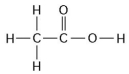 -How many grams would be equal to 1 mol of the compound shown in the figure above? (carbon = 12, oxygen = 16, hydrogen = 1)
 (Multiple Choice)
4.7/5 (82)
(82) Research indicates that acid precipitation can damage living organisms by
(Multiple Choice)
4.8/5 (73)
(73) is 180 g/mol. Which of the following procedures should you carry out to make a 0.5 M solution of glucose?
(Multiple Choice)
4.9/5 (79)
(79) You have a freshly prepared 0.1 M solution of glucose in water. Each litre of this solution contains how many glucose molecules?
(Multiple Choice)
4.9/5 (76)
(76) The slight negative charge at one end of one water molecule is attracted to the slight positive charge of another water molecule. What is this attraction called?
(Multiple Choice)
4.7/5 (86)
(86) 
Filters
- Essay(0)
- Multiple Choice(0)
- Short Answer(0)
- True False(0)
- Matching(0)