



 Chat with AI
Exam 3: Water and Life

Exam 1: Introduction: Evolution and Themes of Biology70 Questions
Exam 2: The Chemical Context of Life90 Questions
Exam 3: Water and Life80 Questions
Exam 4: Carbon and the Molecular Diversity of Life78 Questions
Exam 5: The Structure and Function of Large Biological Molecules117 Questions
Exam 6: A Tour of the Cell96 Questions
Exam 7: Membrane Structure and Function78 Questions
Exam 8: An Introduction to Metabolism88 Questions
Exam 9: Cellular Respiration and Fermentation117 Questions
Exam 10: Photosynthesis89 Questions
Exam 11: Cell Communication77 Questions
Exam 12: The Cell Cycle83 Questions
Exam 13: Meiosis and Sexual Life Cycles74 Questions
Exam 14: Mendel and the Gene Idea82 Questions
Exam 15: The Chromosomal Basis of Inheritance66 Questions
Exam 16: The Molecular Basis of Inheritance67 Questions
Exam 17: From Gene to Protein91 Questions
Exam 18: Regulation of Gene Expression107 Questions
Exam 19: Viruses53 Questions
Exam 20: Dna Tools and Biotechnology72 Questions
Exam 21: Genomes and Their Evolution52 Questions
Exam 22: Descent With Modification: a Darwinian View of Life63 Questions
Exam 23: The Evolution of Populations86 Questions
Exam 24: The Origin of Species71 Questions
Exam 25: The History of Life on Earth83 Questions
Exam 26: Phylogeny and the Tree of Life81 Questions
Exam 27: Bacteria and Archaea86 Questions
Exam 28: Protists84 Questions
Exam 29: Plant Diversity I: How Plants Colonized Land82 Questions
Exam 30: Plant Diversity Ii: the Evolution of Seed Plants110 Questions
Exam 31: Fungi97 Questions
Exam 32: An Overview of Animal Diversity82 Questions
Exam 33: An Introduction to Invertebrates101 Questions
Exam 34: The Origin and Evolution of Vertebrates117 Questions
Exam 35: Plant Structure, Growth, and Development75 Questions
Exam 36: Resource Acquisition and Transport in Vascular Plants89 Questions
Exam 37: Soil and Plant Nutrition91 Questions
Exam 38: Angiosperm Reproduction and Biotechnology94 Questions
Exam 39: Plant Responses to Internal and External Signals116 Questions
Exam 40: Basic Principles of Animal Form and Function86 Questions
Exam 41: Animal Nutrition73 Questions
Exam 42: Circulation and Gas Exchange100 Questions
Exam 43: The Immune System110 Questions
Exam 44: Osmoregulation and Excretion79 Questions
Exam 45: Hormones and the Endocrine System82 Questions
Exam 46: Animal Reproduction104 Questions
Exam 47: Animal Development98 Questions
Exam 48: Neurons, Synapses, and Signalling81 Questions
Exam 49: Nervous Systems73 Questions
Exam 50: Sensory and Motor Mechanisms91 Questions
Exam 51: Animal Behaviour79 Questions
Exam 52: An Introduction to Ecology and the Biosphere81 Questions
Exam 53: Population Ecology87 Questions
Exam 54: Community Ecology85 Questions
Exam 55: Ecosystems and Restoration Ecology89 Questions
Exam 56: Conservation Biology and Global Change75 Questions
Select questions type


A 0.01 M solution of a substance has a pH of 2. What can you conclude about this substance?
(Multiple Choice)
4.8/5  (86)
(86) Which of the following statements is true about buffer solutions?
(Multiple Choice)
4.7/5 (79)
(79) In a single molecule of water, two hydrogen atoms are bonded to a single oxygen atom by
(Multiple Choice)
4.9/5 (80)
(80) Use the following information to answer the questions below.
You live in Atlantic Canada and you are Skyping a friend in Manitoba. You are both complaining about the weather as both regions are being subjected to the same arctic air mass. As you discuss it, however, it becomes clear that she is experiencing a bitter cold that you are not. You realize that you had pretty much the same conversation last summer when it was much hotter in Manitoba than at home.
-Many mammals control their body temperature by sweating. Which property of water is most directly responsible for the ability of sweat to lower body temperature?
(Multiple Choice)
4.8/5 (68)
(68) Use the following figure to answer the questions below.
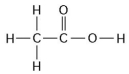 -How many grams of the compound in the figure above would be required to make 1 L of a 0.5 M solution? (carbon = 12, oxygen = 16, hydrogen = 1)
 (Multiple Choice)
4.9/5 (88)
(88) Use the following information to answer the questions below.
You live in Atlantic Canada and you are Skyping a friend in Manitoba. You are both complaining about the weather as both regions are being subjected to the same arctic air mass. As you discuss it, however, it becomes clear that she is experiencing a bitter cold that you are not. You realize that you had pretty much the same conversation last summer when it was much hotter in Manitoba than at home.
-The bonds that are broken when water vaporizes are
(Multiple Choice)
5.0/5 (80)
(80) Coastal regions tend to have more moderate climates than land-locked areas due to the
(Multiple Choice)
4.9/5 (81)
(81) One idea to mitigate the effects of burning fossil fuels on atmospheric CO₂ concentrations is to pipe liquid CO₂ into the ocean at depths of 2500 feet or greater. At the high pressures at such depths, CO₂ is heavier than water. What potential effects might result from implementing such a scheme?
(Multiple Choice)
4.9/5 (65)
(65) One of the buffers that contribute to pH stability in human blood is carbonic acid (H₂CO₃). Carbonic acid is a weak acid that dissociates into a bicarbonate ion (HCO₃⁻)and a hydrogen ion (H⁺). Thus, H₂CO₃ ↔ HCO₃⁻ + H⁺ If the pH of the blood drops, one would expect
(Multiple Choice)
5.0/5 (95)
(95) Use the following information to answer the questions below.
You live in Atlantic Canada and you are Skyping a friend in Manitoba. You are both complaining about the weather as both regions are being subjected to the same arctic air mass. As you discuss it, however, it becomes clear that she is experiencing a bitter cold that you are not. You realize that you had pretty much the same conversation last summer when it was much hotter in Manitoba than at home.
-The best explanation for this difference is that
(Multiple Choice)
4.9/5 (77)
(77) The molar mass of glucose is 180 g/mol. Which of the following procedures should you carry out to make a 1 M solution of glucose?
(Multiple Choice)
4.7/5 (88)
(88) Sulphur is in the same column of the periodic table as oxygen, but has electronegativity similar to carbon. Compared to water molecules, molecules of H₂S
(Multiple Choice)
4.8/5 (83)
(83) You have two beakers. One contains pure water; the other contains pure methanol (wood alcohol). The covalent bonds of methanol molecules are nonpolar, so there are no hydrogen bonds among methanol molecules. You pour crystals of table salt (NaCl)into each beaker. Predict what will happen.
(Multiple Choice)
5.0/5 (90)
(90) 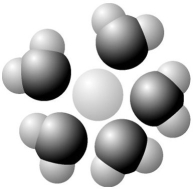 -Based on your knowledge of the polarity of water molecules, the solute molecule depicted here is most likely
 (Multiple Choice)
4.7/5 (92)
(92) One litre of a solution of pH 2 has how many more hydrogen ions (H⁺)than 1 L of a solution of pH 6?
(Multiple Choice)
4.9/5 (77)
(77) Plants transport water through their vascular system utilizing what property of water?
(Multiple Choice)
4.8/5 (72)
(72) A dietary calorie equals 1 kilocalorie. Which of the following statements correctly defines? 1 kilocalorie?
(Multiple Choice)
4.8/5 (79)
(79) 
Filters
- Essay(0)
- Multiple Choice(0)
- Short Answer(0)
- True False(0)
- Matching(0)