



 Chat with AI
Exam 15: The Urinary System

Exam 1: The Human Body: An Orientation128 Questions
Exam 2: Basic Chemistry118 Questions
Exam 3: Cells and Tissues142 Questions
Exam 4: Skin and Body Membranes108 Questions
Exam 5: The Skeletal System124 Questions
Exam 6: The Muscular System129 Questions
Exam 7: The Nervous System161 Questions
Exam 8: Special Senses128 Questions
Exam 9: The Endocrine System149 Questions
Exam 10: Blood116 Questions
Exam 11: The Cardiovascular System160 Questions
Exam 12: The Lymphatic System and Body Defenses135 Questions
Exam 13: The Respiratory System150 Questions
Exam 14: The Digestive System and Body Metabolism162 Questions
Exam 15: The Urinary System138 Questions
Exam 16: The Reproductive System169 Questions
Select questions type


Sexually transmitted infections (STIs) are primarily infections of the reproductive tracts but may also cause urinary tract infections.
(True/False)
4.8/5  (81)
(81) Identify the urinary structure with its associated description:
A) adrenal gland
B) renal cortex
C) renal pyramids or medullary pyramids
D) renal columns
E) calyces
F) renal pelvis
G) renal medulla
-Darker, reddish-brown region that is deep to the cortex
(Essay)
4.8/5 (74)
(74) When blood pH becomes too acidic, the tubule cells of the kidneys excrete bicarbonate ions and retain hydrogen ions.
(True/False)
4.8/5 (83)
(83) What is the name of the capillary bed that surrounds the renal tubule?
(Multiple Choice)
4.7/5 (91)
(91) Substances in the blood that are too large to be filtered, such as red blood cells, will travel from the afferent arteriole, through the glomerulus, and to the efferent arteriole.
(True/False)
4.7/5 (84)
(84) Identify the urinary structure with its associated description:
A) adrenal gland
B) renal cortex
C) renal pyramids or medullary pyramids
D) renal columns
E) calyces
F) renal pelvis
G) renal medulla
-Cup-shaped extensions of the pelvis that enclose the tips of the renal (medullary) pyramids
(Essay)
4.9/5 (93)
(93) The structural and functional units of the kidney are the renal (medullary) pyramids.
(True/False)
4.7/5 (69)
(69) What role does angiotensin II play in restoring blood pressure to normal?
(Multiple Choice)
4.8/5 (72)
(72) 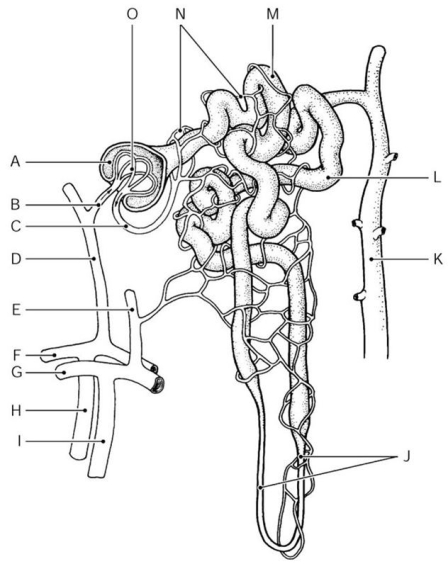 Figure 15.2
Using Figure 15.2, identify the following:
-The cortical radiate artery is indicated by ________.
Figure 15.2
Using Figure 15.2, identify the following:
-The cortical radiate artery is indicated by ________. (Multiple Choice)
4.9/5 (83)
(83) When antidiuretic hormone (ADH) is present at the collecting ducts of the kidneys, less water is reabsorbed and diuresis increases.
(True/False)
4.9/5 (89)
(89) Which of the following is NOT directly or indirectly regulated by aldosterone?
(Multiple Choice)
4.8/5 (94)
(94) Substances intended for tubular reabsorption travel from the filtrate of the proximal convoluted tubule next to the ________.
(Multiple Choice)
4.9/5 (79)
(79) Excess blood plasma in the bloodstream initiates the thirst mechanism to restore fluid balance.
(True/False)
5.0/5 (72)
(72) The medial indentation where the ureter, blood vessels, and nerves are connected to the kidney is called the ________.
(Multiple Choice)
4.8/5 (74)
(74) A diet rich in proteins such as eggs, cheese, and whole-wheat products produces urine with an alkaline pH.
(True/False)
4.8/5 (83)
(83) The smooth triangular region of the urinary bladder base that is outlined by the openings of the two ureters and the urethra is called the ________.
(Multiple Choice)
4.9/5 (73)
(73) Identify these organs of the urinary system with their associated descriptions:
A) ureter
B) urinary bladder
C) urethra
-Transports urine and sperm, in semen, in males (but never at the same time)
(Essay)
4.8/5 (73)
(73) The most important trigger for aldosterone release is the renin-angiotensin mechanism, mediated by the juxtaglomerular (JG) apparatus of the renal tubules.
(True/False)
4.8/5 (80)
(80) The nonselective, passive process performed by the glomerulus that forms blood plasma without blood proteins is called ________.
(Multiple Choice)
4.7/5 (74)
(74) What extensions of cortex-like tissue separate the renal (medullary) pyramids?
(Multiple Choice)
4.7/5 (78)
(78) 
Filters
- Essay(0)
- Multiple Choice(0)
- Short Answer(0)
- True False(0)
- Matching(0)