



 Chat with AI
Exam 10: Blood

Exam 1: The Human Body: An Orientation128 Questions
Exam 2: Basic Chemistry118 Questions
Exam 3: Cells and Tissues142 Questions
Exam 4: Skin and Body Membranes108 Questions
Exam 5: The Skeletal System124 Questions
Exam 6: The Muscular System129 Questions
Exam 7: The Nervous System161 Questions
Exam 8: Special Senses128 Questions
Exam 9: The Endocrine System149 Questions
Exam 10: Blood116 Questions
Exam 11: The Cardiovascular System160 Questions
Exam 12: The Lymphatic System and Body Defenses135 Questions
Exam 13: The Respiratory System150 Questions
Exam 14: The Digestive System and Body Metabolism162 Questions
Exam 15: The Urinary System138 Questions
Exam 16: The Reproductive System169 Questions
Select questions type


Discuss why Martina, who has blood type A, cannot receive blood type B during a transfusion.

Free
(Essay)
4.7/5  (84)
(84) Correct Answer: Verified
Martina has the antigen for A on her red blood cells. During infancy, her body built anti-B antibodies since she lacked that antigen in her blood. If she receives a transfusion of blood type B, her body will already have the anti-B antibodies in place. Agglutination will occur as the anti-B antibodies bind and clump to the foreign B antigen. The red blood cells will undergo hemolysis, hemoglobin will be released into the blood stream, and these events would lead to a transfusion reaction.
What is the final step of hemostasis in which the formation of a blood clot is accomplished?
Free
(Multiple Choice)
4.9/5 (68)
(68) Correct Answer:Verified
VerifiedC
Match the following function with its blood cell:
-Type of cell fragment involved in hemostasis
Free
(Multiple Choice)
4.9/5 (78)
(78) Correct Answer:Verified
VerifiedC
The immune serum used to prevent maternal sensitization to Rh antigens is ________.
(Multiple Choice)
4.9/5 (76)
(76) Compatibility testing for agglutination of donor RBCs by the recipients' serum is called ________.
(Multiple Choice)
4.8/5 (87)
(87) What is necessary for the transport of oxygen by an erythrocyte?
(Multiple Choice)
4.8/5 (82)
(82) Match the following blood types:
-The blood type that can receive blood types B and AB
(Multiple Choice)
4.7/5 (83)
(83) The condition in which fetal RBCs are destroyed faster than the infant liver can rid the body of the breakdown products of hemoglobin is called ________.
(Multiple Choice)
4.9/5 (90)
(90) The most common type of blood in the U.S. population is ________.
(Multiple Choice)
4.8/5 (89)
(89) If you carry the Rh antigen, you are referred to as Rh ________.
(Multiple Choice)
4.9/5 (77)
(77) Which type of leukocyte kills parasitic worms by deluging them with digestive enzymes?
(Multiple Choice)
4.9/5 (83)
(83) Physiologic jaundice occurring in newborns results from ________.
(Multiple Choice)
4.8/5 (76)
(76) What is the process whereby the binding of antibodies to antigens causes RBCs to clump?
(Multiple Choice)
4.9/5 (72)
(72) The percentage of erythrocytes in blood is known as the ________.
(Multiple Choice)
4.9/5 (73)
(73) Placing pressure on a cut will constrict blood vessels manually, and encourages ________.
(Multiple Choice)
5.0/5 (75)
(75) 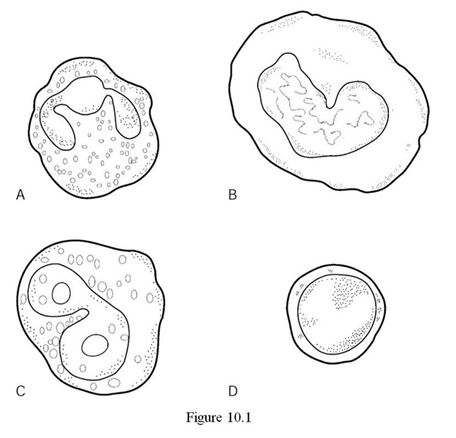 Using Figure 10.1, identify the following:
-The type of leukocyte that fights allergies and parasitic worms is indicated by ________.
Using Figure 10.1, identify the following:
-The type of leukocyte that fights allergies and parasitic worms is indicated by ________. (Multiple Choice)
4.9/5 (83)
(83) Platelets are fragments of a multinucleate cell known as a(n) ________.
(Multiple Choice)
4.8/5 (79)
(79) Normal blood pH falls in a range between ________ to ________.
(Multiple Choice)
4.9/5 (94)
(94) 
Filters
- Essay(0)
- Multiple Choice(0)
- Short Answer(0)
- True False(0)
- Matching(0)