



 Chat with AI
Exam 10: Blood

Exam 1: The Human Body: An Orientation128 Questions
Exam 2: Basic Chemistry118 Questions
Exam 3: Cells and Tissues142 Questions
Exam 4: Skin and Body Membranes108 Questions
Exam 5: The Skeletal System124 Questions
Exam 6: The Muscular System129 Questions
Exam 7: The Nervous System161 Questions
Exam 8: Special Senses128 Questions
Exam 9: The Endocrine System149 Questions
Exam 10: Blood116 Questions
Exam 11: The Cardiovascular System160 Questions
Exam 12: The Lymphatic System and Body Defenses135 Questions
Exam 13: The Respiratory System150 Questions
Exam 14: The Digestive System and Body Metabolism162 Questions
Exam 15: The Urinary System138 Questions
Exam 16: The Reproductive System169 Questions
Select questions type


Describe the antigens associated with the blood types of the ABO blood group.
(Essay)
4.9/5  (70)
(70) 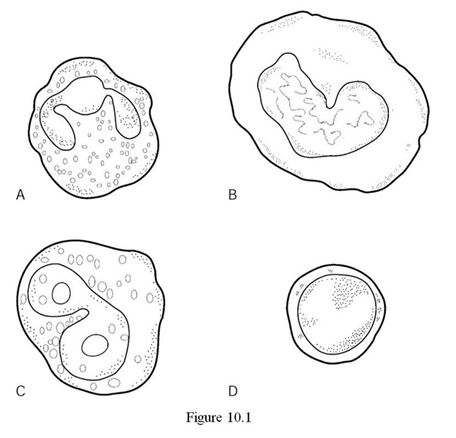 Using Figure 10.1, identify the following:
-The lymphocyte is indicated by ________.
Using Figure 10.1, identify the following:
-The lymphocyte is indicated by ________. (Multiple Choice)
4.7/5 (78)
(78) The process by which bleeding is stopped is called ________.
(Multiple Choice)
4.9/5 (88)
(88) Cross matching prevents transfusion reactions by testing for agglutination between donor and recipient blood prior to the transfusion.
(True/False)
4.8/5 (88)
(88) Which organ is largely responsible for the synthesis of clotting factors?
(Multiple Choice)
4.8/5 (87)
(87) Megakaryocytes are classified as agranulocytes since they lack visible granules in the cytoplasm.
(True/False)
4.8/5 (73)
(73) A person with type B blood can receive blood from blood type(s) ________.
(Multiple Choice)
4.7/5 (75)
(75) Match the following function with its blood cell:
-Cell fragments that form from the rupture of a megakaryocyte
(Multiple Choice)
4.7/5 (79)
(79) Match the following blood types:
-The blood type that does NOT form anti-A or anti-B antibodies
(Multiple Choice)
4.9/5 (74)
(74) In a centrifuged blood sample, the buffy coat situated between the formed elements and the plasma contains ________.
(Multiple Choice)
4.7/5 (92)
(92) An important plasma protein that contributes to the osmotic pressure of blood is ________.
(Multiple Choice)
4.9/5 (89)
(89) What is the name of the process by which white blood cells move in and out of blood vessels?
(Multiple Choice)
4.9/5 (84)
(84) Which situation do you predict to prompt the release of more erythropoietin into the blood: anemia or polycythemia? Explain.
(Essay)
5.0/5 (87)
(87) The condition in which maternal antibodies cross the placenta and destroy the baby's RBCs is called ________.
(Multiple Choice)
4.8/5 (82)
(82)
Using Figure 10.1, identify the following:
-The neutrophil is indicated by ________.
Using Figure 10.1, identify the following:
-The neutrophil is indicated by ________. (Multiple Choice)
4.8/5 (83)
(83) When antibodies bind to antigens on foreign blood types, clumping or ________ occurs.
(Multiple Choice)
4.8/5 (84)
(84) 
Filters
- Essay(0)
- Multiple Choice(0)
- Short Answer(0)
- True False(0)
- Matching(0)