



 Chat with AI
Exam 15: The Urinary System

Exam 1: The Human Body: An Orientation128 Questions
Exam 2: Basic Chemistry118 Questions
Exam 3: Cells and Tissues142 Questions
Exam 4: Skin and Body Membranes108 Questions
Exam 5: The Skeletal System124 Questions
Exam 6: The Muscular System129 Questions
Exam 7: The Nervous System161 Questions
Exam 8: Special Senses128 Questions
Exam 9: The Endocrine System149 Questions
Exam 10: Blood116 Questions
Exam 11: The Cardiovascular System160 Questions
Exam 12: The Lymphatic System and Body Defenses135 Questions
Exam 13: The Respiratory System150 Questions
Exam 14: The Digestive System and Body Metabolism162 Questions
Exam 15: The Urinary System138 Questions
Exam 16: The Reproductive System169 Questions
Select questions type


Items in the blood that are NOT filtered will travel from the glomerulus to the ________.
(Multiple Choice)
4.8/5  (84)
(84) Dilute urine would have a specific gravity closest to ________.
(Multiple Choice)
4.8/5 (73)
(73) 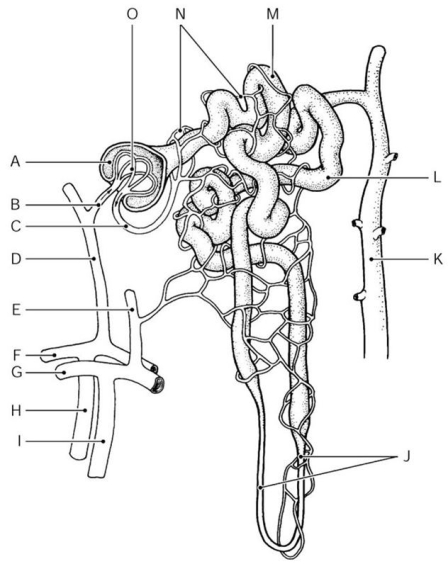 Figure 15.2
Using Figure 15.2, identify the following:
-The nephron loop, or loop of Henle, is indicated by ________.
Figure 15.2
Using Figure 15.2, identify the following:
-The nephron loop, or loop of Henle, is indicated by ________. (Multiple Choice)
4.8/5 (89)
(89)
Figure 15.2
Using Figure 15.2, identify the following:
-The glomerulus is indicated by ________.
Figure 15.2
Using Figure 15.2, identify the following:
-The glomerulus is indicated by ________. (Multiple Choice)
4.9/5 (72)
(72) The voluntarily controlled sphincter fashioned by skeletal muscle at the point where the urethra passes through the pelvic floor is called the ________.
(Multiple Choice)
4.8/5 (74)
(74) 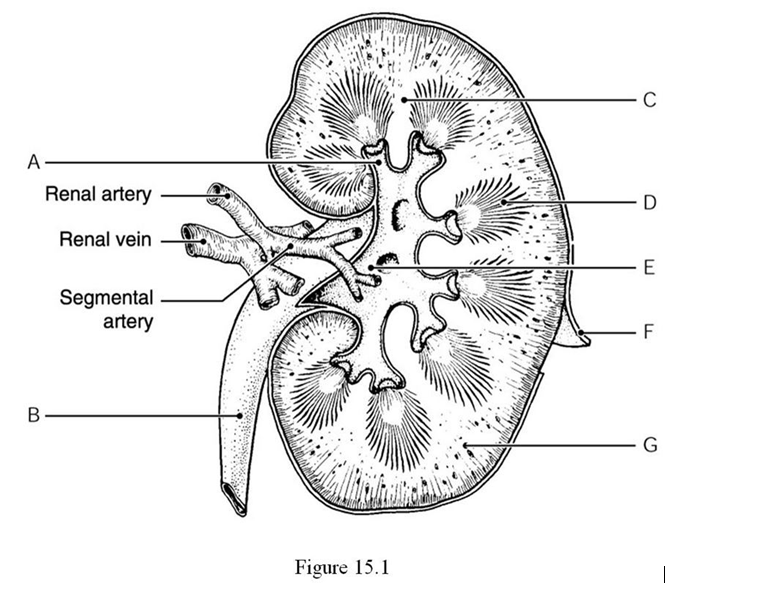 Using Figure 15.1, identify the following:
-The ureter is indicated by ________.
Using Figure 15.1, identify the following:
-The ureter is indicated by ________. (Multiple Choice)
4.9/5 (86)
(86) Trace the pathway of a red blood cell through the kidney from the renal artery to the renal vein.
(Essay)
4.9/5 (69)
(69) Identify the process that occurs in the kidney.
A) tubular reabsorption
B) glomerular filtration
C) tubular secretion
-Substances such as potassium, urea, and creatinine are moved from the blood of the peritubular capillaries into the filtrate to be eliminated in urine
(Essay)
4.9/5 (66)
(66) Control of the voluntary urethral sphincter in normal children is related to ________.
(Multiple Choice)
4.9/5 (84)
(84) Of the capillary beds associated with each nephron, which one is both fed and drained by arterioles?
(Multiple Choice)
4.8/5 (85)
(85) When blood pH begins to rise, the respiratory control centers in the brain are ________.
(Multiple Choice)
4.8/5 (65)
(65) Identify the process that occurs in the kidney.
A) tubular reabsorption
B) glomerular filtration
C) tubular secretion
-Antidiuretic hormone (ADH) promotes the movement of water from the filtrate back into the blood of the peritubular capillaries
(Essay)
4.7/5 (75)
(75) Identify these organs of the urinary system with their associated descriptions:
A) ureter
B) urinary bladder
C) urethra
-Tube that drains urine from the kidney to the urinary bladder
(Essay)
4.7/5 (93)
(93) Explain how tubular reabsorption and tubular secretion are nearly opposite processes.
(Essay)
4.8/5 (77)
(77) The main hormone that acts on the kidneys to regulate sodium ion concentration of the extracellular fluid (ECF) is ________.
(Multiple Choice)
4.9/5 (90)
(90) Hypospadias is a condition of male children that involves ________.
(Multiple Choice)
4.7/5 (71)
(71) Untreated streptococcal infections in childhood can lead to the kidney condition known as ________.
(Multiple Choice)
4.9/5 (78)
(78) Identify these organs of the urinary system with their associated descriptions:
A) ureter
B) urinary bladder
C) urethra
-Muscular sac suitable for temporary urine storage
(Essay)
4.7/5 (86)
(86) 
Filters
- Essay(0)
- Multiple Choice(0)
- Short Answer(0)
- True False(0)
- Matching(0)