



 Chat with AI
Exam 13: Antimicrobial Therapy

Exam 1: Scope and History of Microbiology55 Questions
Exam 2: Fundamentals of Chemistry63 Questions
Exam 3: Microscopy and Staining56 Questions
Exam 4: Characteristics of Prokaryotic and Eukaryotic Cells63 Questions
Exam 5: Essential Concepts of Metabolism56 Questions
Exam 6: Growth and Culturing of Bacteria58 Questions
Exam 7: Microbial Genetics60 Questions
Exam 8: Gene Transfer and Genetic Engineering57 Questions
Exam 9: An Introduction to Taxonomy: the Bacteria58 Questions
Exam 10: Viruses56 Questions
Exam 11: Eukaryotic Microorganisms and Parasites58 Questions
Exam 12: Sterilization and Disinfection60 Questions
Exam 13: Antimicrobial Therapy56 Questions
Exam 14: Host-Microbe Relationships and Disease Processes55 Questions
Exam 15: Epidemiology and Nosocomial Infections55 Questions
Exam 16: Innate Host Defenses56 Questions
Exam 17: Immunology I: Basic Principles of Adaptive Immunity and Immunization56 Questions
Exam 18: Immunology Ii: Immunological Disorders and Tests60 Questions
Exam 19: Diseases of the Skin and Eyes; Wounds and Bites56 Questions
Exam 20: Urogenital and Sexually Transmitted Diseases57 Questions
Exam 21: Diseases of the Respiratory System58 Questions
Exam 22: Oral and Gastrointestinal Diseases57 Questions
Exam 23: Cardiovascular, lymphatic and Systemic Disease57 Questions
Exam 24: Diseases of the Nervous System56 Questions
Exam 25: Environmental Microbiology55 Questions
Exam 26: Applied Microbiology57 Questions
Select questions type


The mode of action of an antimicrobial agent refers to _____.
(Multiple Choice)
4.8/5  (75)
(75) Which does not involve testing microbial sensitivity to antimicrobials?
(Multiple Choice)
4.7/5 (88)
(88) Why are resistant organisms found often in hospitalized patients?
(Multiple Choice)
4.8/5 (89)
(89) Destruction or inactivation of antimicrobial agents is an example of what kind of bacterial resistance mechanism?
(Multiple Choice)
4.9/5 (85)
(85) A decreased efficacy of an antimicrobial agent during combination therapy is called:
(Multiple Choice)
4.8/5 (79)
(79) 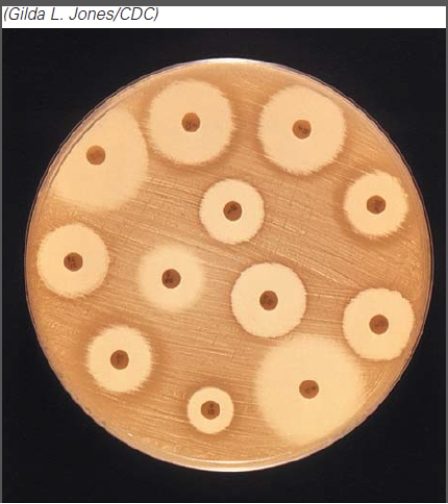
Describe three mechanisms for antibiotic resistance.If exposure to antibiotics does not induce drug-resistant mutations to occur,why do we see so many more drug-resistant strains today?
(Essay)
5.0/5 (96)
(96) Which of the following antibiotics is an inhibitor of DNA gyrase?
(Multiple Choice)
4.9/5 (83)
(83) Because the tetracyclines are effective against a large variety of different organisms,they are considered to:
(Multiple Choice)
4.8/5 (87)
(87) Penicillin was discovered by ____________ and was isolated by ________ .
(Multiple Choice)
4.9/5 (84)
(84) Clear area on agar that surrounds a filter paper disk on the disk diffusion tests and represents inhibited growth of a test microorganism is called:
(Multiple Choice)
4.7/5 (79)
(79) Which of the following directly pertain to inhibition of cellular protein synthesis by antimicrobial agents?
(Multiple Choice)
4.9/5 (88)
(88) The lowest concentration of drug that yields no growth during a second inoculation into fresh medium is called:
(Multiple Choice)
4.9/5 (89)
(89) A microorganism that can use ready-made folic acid from its environment and no longer needs to synthesize it from the PABA precursor demonstrates an example of what type of antimicrobial resistance mechanism?
(Multiple Choice)
4.8/5 (83)
(83) Characteristics of an ideal antimicrobial agent include all of the following except:
(Multiple Choice)
5.0/5 (87)
(87) Which of the characteristics apply to an ideal antimicrobial agent?
(Multiple Choice)
4.9/5 (78)
(78) Which one of the following pairs is incorrectly matched with antibiotic and its target?
(Multiple Choice)
4.9/5 (71)
(71) A patient comes to you from a nursing home with a high fever. Is it better to start the patient on a broad spectrum drug or a narrow spectrum drug? Is it better to start the patient on one antibiotic or multiple antibiotics? Defend your decision.
(Essay)
4.9/5 (89)
(89) 
Filters
- Essay(0)
- Multiple Choice(0)
- Short Answer(0)
- True False(0)
- Matching(0)