



 Chat with AI
Exam 10: Viruses

Exam 1: Scope and History of Microbiology55 Questions
Exam 2: Fundamentals of Chemistry63 Questions
Exam 3: Microscopy and Staining56 Questions
Exam 4: Characteristics of Prokaryotic and Eukaryotic Cells63 Questions
Exam 5: Essential Concepts of Metabolism56 Questions
Exam 6: Growth and Culturing of Bacteria58 Questions
Exam 7: Microbial Genetics60 Questions
Exam 8: Gene Transfer and Genetic Engineering57 Questions
Exam 9: An Introduction to Taxonomy: the Bacteria58 Questions
Exam 10: Viruses56 Questions
Exam 11: Eukaryotic Microorganisms and Parasites58 Questions
Exam 12: Sterilization and Disinfection60 Questions
Exam 13: Antimicrobial Therapy56 Questions
Exam 14: Host-Microbe Relationships and Disease Processes55 Questions
Exam 15: Epidemiology and Nosocomial Infections55 Questions
Exam 16: Innate Host Defenses56 Questions
Exam 17: Immunology I: Basic Principles of Adaptive Immunity and Immunization56 Questions
Exam 18: Immunology Ii: Immunological Disorders and Tests60 Questions
Exam 19: Diseases of the Skin and Eyes; Wounds and Bites56 Questions
Exam 20: Urogenital and Sexually Transmitted Diseases57 Questions
Exam 21: Diseases of the Respiratory System58 Questions
Exam 22: Oral and Gastrointestinal Diseases57 Questions
Exam 23: Cardiovascular, lymphatic and Systemic Disease57 Questions
Exam 24: Diseases of the Nervous System56 Questions
Exam 25: Environmental Microbiology55 Questions
Exam 26: Applied Microbiology57 Questions
Select questions type


The most conclusive evidence that viruses cause cancers is provided by:
(Multiple Choice)
4.9/5  (84)
(84) Which of the following structures do viruses use to attach themselves and enter the host cells?
(Multiple Choice)
4.9/5 (77)
(77) Which of the following viruses are known for causing latent infections?
(Multiple Choice)
4.9/5 (67)
(67) Viruses have some of the properties of cellular life forms.Which of the following is a characteristic of all organisms except viruses?
(Multiple Choice)
4.8/5 (86)
(86) Identify the portion of the growth curve that represents the time after penetration to the release of mature phages. 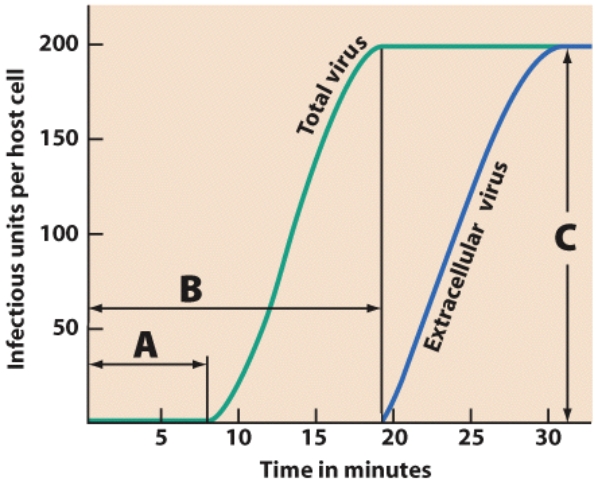
(Multiple Choice)
4.8/5 (64)
(64) Viruses are referred to as obligate intracellular parasites because:
(Multiple Choice)
4.9/5 (87)
(87) Much of the information about how viruses work has been gleaned from studying T- even phages that infect:
(Multiple Choice)
4.7/5 (81)
(81) DNA viruses are grouped into families based on the following characteristics except:
(Multiple Choice)
4.8/5 (82)
(82) Some viruses have a lipid bilayer,also known as the viral envelope.The viral envelope is most likely to come from the following source:
(Multiple Choice)
5.0/5 (72)
(72) All of the following viruses may stay inside of a cell for many years and remain inactive except:
(Multiple Choice)
4.8/5 (77)
(77) What would be a reasonable number of new phages to expect from one round of viral replication in one cell?
(Multiple Choice)
4.8/5 (75)
(75) Which of the following is used by (-)sense RNA viruses such as measles and influenza during their replication cycle?
(Multiple Choice)
4.9/5 (73)
(73) 
Filters
- Essay(0)
- Multiple Choice(0)
- Short Answer(0)
- True False(0)
- Matching(0)