



 Chat with AI
Exam 6: Growth and Culturing of Bacteria

Exam 1: Scope and History of Microbiology55 Questions
Exam 2: Fundamentals of Chemistry63 Questions
Exam 3: Microscopy and Staining56 Questions
Exam 4: Characteristics of Prokaryotic and Eukaryotic Cells63 Questions
Exam 5: Essential Concepts of Metabolism56 Questions
Exam 6: Growth and Culturing of Bacteria58 Questions
Exam 7: Microbial Genetics60 Questions
Exam 8: Gene Transfer and Genetic Engineering57 Questions
Exam 9: An Introduction to Taxonomy: the Bacteria58 Questions
Exam 10: Viruses56 Questions
Exam 11: Eukaryotic Microorganisms and Parasites58 Questions
Exam 12: Sterilization and Disinfection60 Questions
Exam 13: Antimicrobial Therapy56 Questions
Exam 14: Host-Microbe Relationships and Disease Processes55 Questions
Exam 15: Epidemiology and Nosocomial Infections55 Questions
Exam 16: Innate Host Defenses56 Questions
Exam 17: Immunology I: Basic Principles of Adaptive Immunity and Immunization56 Questions
Exam 18: Immunology Ii: Immunological Disorders and Tests60 Questions
Exam 19: Diseases of the Skin and Eyes; Wounds and Bites56 Questions
Exam 20: Urogenital and Sexually Transmitted Diseases57 Questions
Exam 21: Diseases of the Respiratory System58 Questions
Exam 22: Oral and Gastrointestinal Diseases57 Questions
Exam 23: Cardiovascular, lymphatic and Systemic Disease57 Questions
Exam 24: Diseases of the Nervous System56 Questions
Exam 25: Environmental Microbiology55 Questions
Exam 26: Applied Microbiology57 Questions
Select questions type


Organisms with special nutritional needs are said to be _____.
(Multiple Choice)
4.9/5  (65)
(65) All of the following are ways microorganisms adapt to limited nutrients except:
(Multiple Choice)
4.9/5 (77)
(77) Which of the following bacterial counting techniques relies on a statistical estimate to determine the number of bacteria in a culture?
(Multiple Choice)
4.9/5 (70)
(70) Halophiles require an environment with a high concentration of ________ for optimal growth.
(Multiple Choice)
4.9/5 (90)
(90) Which of the following is most likely to have evolved to live in the deep layers of mud,where there is a complete lack of free oxygen?
(Multiple Choice)
4.9/5 (77)
(77) 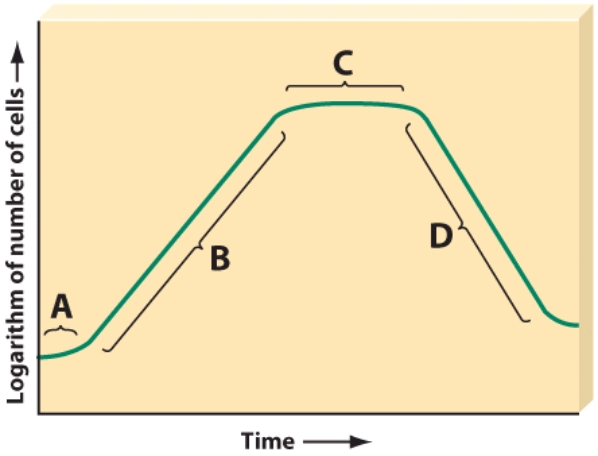
When a bacterial cell divides into two new cells,the new cells are called:
(Multiple Choice)
4.8/5 (85)
(85) A living,growing culture whose purpose is to maintain a pure culture of an organism indefinitely is a _____.
(Multiple Choice)
4.7/5 (66)
(66) Which of the following statements about bacterial growth is false?
(Multiple Choice)
4.7/5 (83)
(83) Draw and label a standard growth curve. Describe each of the 4 phases. Why do you think bacteria do not continue to double indefinitely? You sample a culture that has reached the fourth phase after 2 days,can you think of one reason why the culture would begin to increase on day 4?
(Essay)
5.0/5 (93)
(93) A bacterial culture can be kept in the log phase of growth indefinitely with the help of a/an:
(Multiple Choice)
4.8/5 (75)
(75) Which of the following counting techniques does not differentiate between live and dead bacterial cells in a culture?
(Multiple Choice)
4.9/5 (92)
(92) 
Filters
- Essay(0)
- Multiple Choice(0)
- Short Answer(0)
- True False(0)
- Matching(0)