



 Chat with AI
Exam 9: Externalities: Pollution, Education, and Health Care

Exam 1: Getting Started337 Questions
Exam 2: The Us and Global Economies201 Questions
Exam 3: The Economic Problem273 Questions
Exam 4: Demand and Supply322 Questions
Exam 5: Elasticities of Demand and Supply335 Questions
Exam 6: Efficiency and Fairness of Markets352 Questions
Exam 7: Government Actions in Markets349 Questions
Exam 8: Global Markets in Action276 Questions
Exam 9: Externalities: Pollution, Education, and Health Care290 Questions
Exam 10: Production and Cost266 Questions
Exam 11: Perfect Competition275 Questions
Exam 12: Monopoly377 Questions
Exam 13: Monopolistic Competition and Oligopoly316 Questions
Exam 14: Gdp: a Measure of Total Production and Income253 Questions
Exam 15: Jobs and Unemployment283 Questions
Exam 16: The Cpi and the Cost of Living263 Questions
Exam 17: Potential Gdp and Economic Growth328 Questions
Exam 18: Money and the Monetary System360 Questions
Exam 19: Aggregate Supply and Aggregate Demand301 Questions
Exam 20: Fiscal Policy and Monetary Policy223 Questions
Select questions type


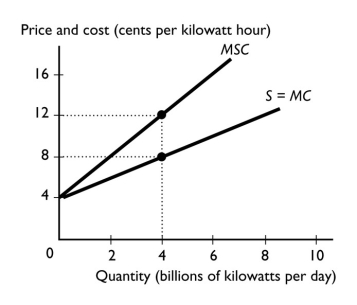 -The figure above shows the marginal social cost of generating electricity and the marginal private cost. For 4 billion kilowatts, what is the marginal external cost?
 (Multiple Choice)
4.9/5  (81)
(81) Suppose Julie plants a beautiful garden in her front yard. The benefits of the garden to Julie and to her neighbors equals the
(Multiple Choice)
4.9/5 (70)
(70) A problem with pollution charges or taxes as a solution to pollution is that
(Multiple Choice)
4.8/5 (81)
(81) If the government taxes an industry that creates pollution, the tax i. decreases the pollution.
Ii. increases the price of the product produced by the firms.
Iii. decreases the quantity of the good produced.
(Multiple Choice)
4.8/5 (81)
(81) When the government uses a private subsidy in a market with an external benefit, to reach the efficient quantity of production, the subsidy must be equal to the marginal
(Multiple Choice)
4.8/5 (77)
(77) In the figure, the unregulated market equilibrium occurs at a price of ________ a ton and quantity of ________ tons.
(Multiple Choice)
4.9/5 (75)
(75) A cost that arises from the production or consumption that falls on someone other than the producer or consumer is called
(Multiple Choice)
4.8/5 (84)
(84) The production of a good or service by an authority that receives the most of its revenue from the government is referred to as
(Multiple Choice)
4.9/5 (75)
(75) Which of the following is NOT an example of a good with an external cost?
(Multiple Choice)
4.9/5 (72)
(72) In the figure above, if a pollution tax is imposed that is equal to the marginal external cost of pollution, then when the market is in equilibrium, the deadweight loss is ________ thousand per month.
(Multiple Choice)
4.9/5 (83)
(83) In the figure above, when the market is unregulated and in equilibrium, the deadweight loss is ________ thousand per month.
(Multiple Choice)
4.9/5 (70)
(70) Marginal social cost (dollars per course) Quantity of students Marginal private benefit Marginal social benefit 100 4,500 20 60 80 4,000 40 80 60 3,500 60 100 40 3,000 80 120 20 2,500 100 140
-The table above gives the marginal social cost (which equals the price), marginal private benefit, and marginal social benefit of students attending Diablo Valley College (DVC)in Concord, California.
a. When 4,500 students attend DVC, what does the marginal external benefit equal?
b. If the market is competitive and left without government intervention, what is the quantity of students that will attend DVC and what will be the price of a course?
c. What is the efficient quantity of students attending DVC?
d. If the government can set the price per course, in order to have the efficient quantity of students attending DVC, what should the government set as the price?
(Essay)
4.8/5 (95)
(95)  -The figure above shows the market for college education in the United States. If the government does not intervene in this market, the number of students going to college is ________ and the efficient number of students is ________.
 (Multiple Choice)
4.9/5 (75)
(75)  -The figure above illustrates the gasoline market. There is no external benefit from gasoline. If this market is left unregulated and no pollution tax is imposed, the equilibrium quantity of gasoline is
 (Multiple Choice)
4.9/5 (85)
(85) Suppose unregulated production of pesticides results in an equilibrium price and quantity of $400 and 1,000 tons per day, respectively, and a marginal external cost of $10 a ton.
a. If the government were to eliminate the external cost by using pollution charges, what should the pollution charge be set at?
b. If the government were to eliminate the external cost by using taxes, what should the tax equal?
c. Would the government actions described above affect the quantity of pesticides produced?
If yes, how?
If no, why not?
(Essay)
4.8/5 (80)
(80) 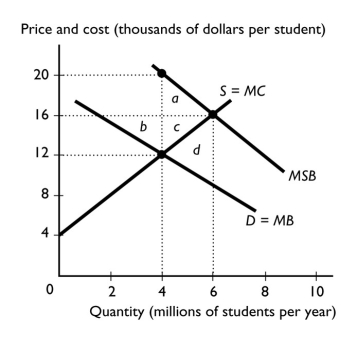 -The figure above shows the market for college education. Left to itself without any government intervention, a competitive market would create a deadweight loss equal to
 (Multiple Choice)
4.8/5 (79)
(79) 
Filters
- Essay(0)
- Multiple Choice(0)
- Short Answer(0)
- True False(0)
- Matching(0)