



 Chat with AI
Exam 9: Externalities: Pollution, Education, and Health Care

Exam 1: Getting Started337 Questions
Exam 2: The Us and Global Economies201 Questions
Exam 3: The Economic Problem273 Questions
Exam 4: Demand and Supply322 Questions
Exam 5: Elasticities of Demand and Supply335 Questions
Exam 6: Efficiency and Fairness of Markets352 Questions
Exam 7: Government Actions in Markets349 Questions
Exam 8: Global Markets in Action276 Questions
Exam 9: Externalities: Pollution, Education, and Health Care290 Questions
Exam 10: Production and Cost266 Questions
Exam 11: Perfect Competition275 Questions
Exam 12: Monopoly377 Questions
Exam 13: Monopolistic Competition and Oligopoly316 Questions
Exam 14: Gdp: a Measure of Total Production and Income253 Questions
Exam 15: Jobs and Unemployment283 Questions
Exam 16: The Cpi and the Cost of Living263 Questions
Exam 17: Potential Gdp and Economic Growth328 Questions
Exam 18: Money and the Monetary System360 Questions
Exam 19: Aggregate Supply and Aggregate Demand301 Questions
Exam 20: Fiscal Policy and Monetary Policy223 Questions
Select questions type


Firm A and Firm B emit 300 tons of pollution each and each have marketable permits that allow each to emit 100 tons of pollution. If it costs $5,000 for Firm A to eliminate 100 tons of pollution and it costs Firm B $6,000 to eliminate 100 tons of pollution, then
(Multiple Choice)
4.8/5  (76)
(76)  -The figure above illustrates the gasoline market. There is no external benefit from gasoline. If a pollution tax equal to the marginal external cost is imposed on gasoline, then the quantity of gasoline produced and consumed equals
 (Multiple Choice)
4.7/5 (95)
(95) In order for pollution taxes to be effective in eliminating the deadweight loss resulting from pollution, the pollution tax must be set equal to the
(Multiple Choice)
4.8/5 (77)
(77)  The figure above shows the demand for college education (D), the marginal social benefit of college education (MSB), and the marginal cost of the private schools (MC).
-In the figure above, suppose the government provides vouchers worth $15,000 per student per year. Then the market equilibrium occurs at a tuition of ________ a year and ________ million students.
The figure above shows the demand for college education (D), the marginal social benefit of college education (MSB), and the marginal cost of the private schools (MC).
-In the figure above, suppose the government provides vouchers worth $15,000 per student per year. Then the market equilibrium occurs at a tuition of ________ a year and ________ million students. (Multiple Choice)
4.9/5 (87)
(87)  -The figure above shows the market for private elementary school education in Chicago. There is no external cost of private elementary education. If the government does not intervene in this market, the deadweight loss equals
 (Multiple Choice)
4.9/5 (79)
(79) The marginal social cost of burning garbage in Houston is the sum of the marginal private cost and the marginal external cost." Is this assertion correct or incorrect?
(Essay)
4.8/5 (90)
(90) Which of the following is true?
A)
(Not Answered)
This question doesn't have any answer yet
 -The figure above shows the market for college education in the United States. If the government has a goal of enrolling the efficient number of students each year, the government should provide a voucher to students equaling ________.
 (Multiple Choice)
4.9/5 (86)
(86) 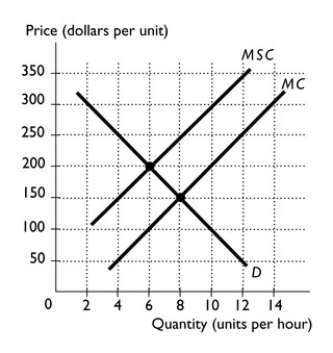 -Use the figure above to answer this question. Explain what the marginal social cost curve and the marginal external cost mean. In the figure, if the market is competitive and unregulated, what is the equilibrium price and quantity?
What is the efficient amount of output?
Illustrate the deadweight loss.
-Use the figure above to answer this question. Explain what the marginal social cost curve and the marginal external cost mean. In the figure, if the market is competitive and unregulated, what is the equilibrium price and quantity?
What is the efficient amount of output?
Illustrate the deadweight loss. (Essay)
4.8/5 (91)
(91)  -The figure above shows the market for a good with an external benefit. If the government wants to grant a subsidy so that the efficient quantity is produced, the subsidy must equal ________ per unit.
 (Multiple Choice)
4.8/5 (84)
(84) 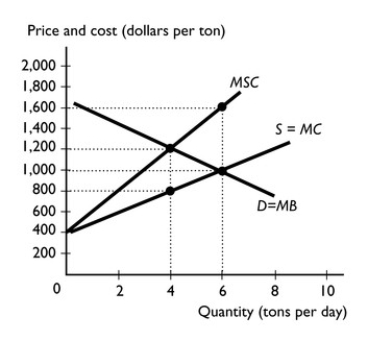 -The above figure shows the market for fertilizer. When fertilizer is applied to lawns, it runs off into neighboring streams and ponds, killing fish and creating an external cost.
a. What is the equilibrium price and quantity of fertilizer in an unregulated, competitive market?
b. What is the efficient quantity of fertilizer?
c. Suppose government imposes a tax equal to the marginal external cost. What is the equilibrium price paid by consumers and the equilibrium quantity after implementation of the tax?
d. At the output level in part (c), how much is the tax?
e. How much tax revenue does government collect?
f. What is the deadweight loss borne by society if the externality is left uncorrected?
-The above figure shows the market for fertilizer. When fertilizer is applied to lawns, it runs off into neighboring streams and ponds, killing fish and creating an external cost.
a. What is the equilibrium price and quantity of fertilizer in an unregulated, competitive market?
b. What is the efficient quantity of fertilizer?
c. Suppose government imposes a tax equal to the marginal external cost. What is the equilibrium price paid by consumers and the equilibrium quantity after implementation of the tax?
d. At the output level in part (c), how much is the tax?
e. How much tax revenue does government collect?
f. What is the deadweight loss borne by society if the externality is left uncorrected? (Essay)
4.8/5 (97)
(97) Which of the following is the best example of a good or service with an external benefit?
(Multiple Choice)
4.8/5 (74)
(74) Quantity of Steel (millions of tons per week) Marginal benefit (dollars per ton) Marginal social cost (dollars per ton) 5 40 20 10 35 25 15 30 30 20 25 35 25 20 40
-The table above shows information about the costs and benefits of a steel smelter that pollutes the air of a city. If the marginal external cost is $10 per ton at every quantity of steel produced, the equilibrium quantity when the steel industry is unregulated is ________ tons per week.
(Multiple Choice)
4.8/5 (60)
(60) If the marginal social cost of producing a ton of cement is $4,000 and the marginal private cost is $3,500, then the
(Multiple Choice)
4.8/5 (69)
(69) Does inoculation against chicken pox have both private and external benefits?
(Essay)
4.9/5 (90)
(90)  -The figure above shows an education market in which the government is providing households with vouchers. What is the dollar value of a voucher in this market?
 (Multiple Choice)
4.9/5 (71)
(71)
-The figure above shows the market for college education in the United States. If the government intervenes in the market and provides a subsidy to colleges to enroll the efficient number of students, the amount of the subsidy equals ________ per student.
-The figure above shows the market for college education in the United States. If the government intervenes in the market and provides a subsidy to colleges to enroll the efficient number of students, the amount of the subsidy equals ________ per student. (Multiple Choice)
4.9/5 (91)
(91)  -The figure above shows the market for annual influenza immunizations the United States. If the government does not intervene in this market, deadweight loss equals ________.
 (Multiple Choice)
5.0/5 (94)
(94) 
Filters
- Essay(0)
- Multiple Choice(0)
- Short Answer(0)
- True False(0)
- Matching(0)