



 Chat with AI
Exam 8: Firms in the Global Economy: Export Decisions, Outsourcing, and Multinational Enterprises

Exam 1: Introduction37 Questions
Exam 2: World Trade: an Overview18 Questions
Exam 3: Labor Productivity and Comparative Advantage: the Ricardian Model47 Questions
Exam 4: Specific Factors and Income Distribution62 Questions
Exam 5: Resources and Trade: the Heckscher-Ohlin Model66 Questions
Exam 6: The Standard Trade Model45 Questions
Exam 7: External Economies of Scale and the International Location of Production37 Questions
Exam 8: Firms in the Global Economy: Export Decisions, Outsourcing, and Multinational Enterprises69 Questions
Exam 9: The Instruments of Trade Policy71 Questions
Exam 10: The Political Economy of Trade Policy57 Questions
Exam 11: Trade Policy in Developing Countries33 Questions
Exam 12: Controversies in Trade Policy46 Questions
Exam 13: National Income Accounting and the Balance of Payments72 Questions
Exam 14: Exchange Rates and the Foreign Exchange Market: an Asset Approach73 Questions
Exam 15: Money, Interest Rates, and Exchange Rates64 Questions
Exam 16: Price Levels and the Exchange Rate in the Long Run74 Questions
Exam 17: Output and the Exchange Rate in the Short Run114 Questions
Exam 18: Fixed Exchange Rates and Foreign Exchange Intervention72 Questions
Exam 19: International Monetary Systems: an Historical Overview153 Questions
Exam 20: Financial Globalization: Opportunity and Crisis113 Questions
Exam 21: Optimum Currency Areas and the Euro100 Questions
Exam 22: Developing Countries: Growth, Crisis, and Reform112 Questions
Select questions type


An imperfectly competitive firm has the following total cost curve: C = 100 + 4Q. What is total cost equal to when Q = 10?
(Short Answer)
4.9/5  (75)
(75) International trade based on external scale economies in both countries is likely to be carried out by
(Multiple Choice)
4.7/5 (83)
(83) If there are a large number of firms in a monopolistically competitive industry
(Multiple Choice)
4.9/5 (86)
(86) Product differentiation and internal economies of scale yield gains from trade in the form of
(Multiple Choice)
4.7/5 (92)
(92) An imperfectly competitive firm has the following demand curve: Q = 100 - 2P. What is marginal revenue equal to when P = 30?
(Essay)
4.7/5 (91)
(91) In the model of monopolistic competition, if firms have ________ average cost curves, then opening trade will ________ the total number of firms and ________ the average price.
(Multiple Choice)
4.9/5 (92)
(92) An imperfectly competitive firm has the following demand curve: Q = 100 - 2P. What is marginal revenue equal to when P = 40?
(Essay)
4.7/5 (85)
(85) An imperfectly competitive firm has the following total cost curve: C = 100 + 4Q. What is average fixed cost equal to when Q = 10?
(Short Answer)
4.7/5 (71)
(71) What are the consequences of outsourcing production on the welfare of countries?
(Essay)
4.9/5 (62)
(62) In the model of monopolistic competition, an increase in industry output will cause individual firms' demand curves to become ________, which will ________ demand for higher-priced goods and ________ demand for lower-priced goods.
(Multiple Choice)
4.8/5 (78)
(78) International trade based solely on internal scale economies in both countries is likely to be carried out by
(Multiple Choice)
4.7/5 (75)
(75) An imperfectly competitive firm has the following total cost curve: C = 100 + 4Q. What is average total cost equal to when Q = 10?
(Short Answer)
4.7/5 (88)
(88) In the model of monopolistic competition, if firms have ________ average cost curves, then opening trade will cause ________ firms to ________ the industry.
(Multiple Choice)
4.9/5 (83)
(83) The simultaneous export and import of widgets by the United States is an example of
(Multiple Choice)
4.9/5 (84)
(84) A product is produced in a monopolistically competitive industry with scale economies. If this industry exists in two countries, and these two countries engage in trade with each other, then we would expect
(Multiple Choice)
4.9/5 (78)
(78) Imperfectly competitive firms have a demand curve that ________ and a marginal revenue curve that ________ and is ________ the demand curve.
(Multiple Choice)
4.8/5 (81)
(81) In the model of monopolistic competition, trade costs between countries cause
(Multiple Choice)
4.7/5 (84)
(84) Intra-industry trade is most common in the trade patterns of
(Multiple Choice)
4.8/5 (65)
(65) 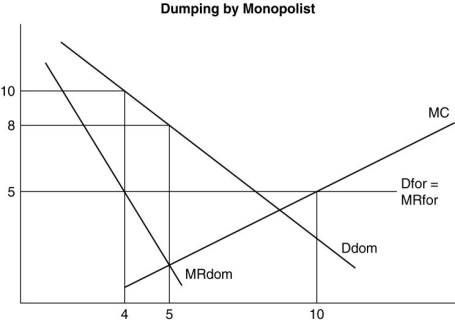 -The figure above represents the demand and cost functions facing a Brazilian steel producing monopolist. The Brazilian firm is charging its foreign (U.S.) customers one half the price it is charging its domestic customers. Is this good or bad for the real income or economic welfare of the United States?
Is the Brazilian firm engaged in dumping?
Is this predatory behavior on the part of the Brazilian steel company?
-The figure above represents the demand and cost functions facing a Brazilian steel producing monopolist. The Brazilian firm is charging its foreign (U.S.) customers one half the price it is charging its domestic customers. Is this good or bad for the real income or economic welfare of the United States?
Is the Brazilian firm engaged in dumping?
Is this predatory behavior on the part of the Brazilian steel company? (Essay)
4.8/5 (78)
(78) 
Filters
- Essay(0)
- Multiple Choice(0)
- Short Answer(0)
- True False(0)
- Matching(0)