



 Chat with AI
Exam 8: Firms in the Global Economy: Export Decisions, Outsourcing, and Multinational Enterprises

Exam 1: Introduction37 Questions
Exam 2: World Trade: an Overview18 Questions
Exam 3: Labor Productivity and Comparative Advantage: the Ricardian Model47 Questions
Exam 4: Specific Factors and Income Distribution62 Questions
Exam 5: Resources and Trade: the Heckscher-Ohlin Model66 Questions
Exam 6: The Standard Trade Model45 Questions
Exam 7: External Economies of Scale and the International Location of Production37 Questions
Exam 8: Firms in the Global Economy: Export Decisions, Outsourcing, and Multinational Enterprises69 Questions
Exam 9: The Instruments of Trade Policy71 Questions
Exam 10: The Political Economy of Trade Policy57 Questions
Exam 11: Trade Policy in Developing Countries33 Questions
Exam 12: Controversies in Trade Policy46 Questions
Exam 13: National Income Accounting and the Balance of Payments72 Questions
Exam 14: Exchange Rates and the Foreign Exchange Market: an Asset Approach73 Questions
Exam 15: Money, Interest Rates, and Exchange Rates64 Questions
Exam 16: Price Levels and the Exchange Rate in the Long Run74 Questions
Exam 17: Output and the Exchange Rate in the Short Run114 Questions
Exam 18: Fixed Exchange Rates and Foreign Exchange Intervention72 Questions
Exam 19: International Monetary Systems: an Historical Overview153 Questions
Exam 20: Financial Globalization: Opportunity and Crisis113 Questions
Exam 21: Optimum Currency Areas and the Euro100 Questions
Exam 22: Developing Countries: Growth, Crisis, and Reform112 Questions
Select questions type


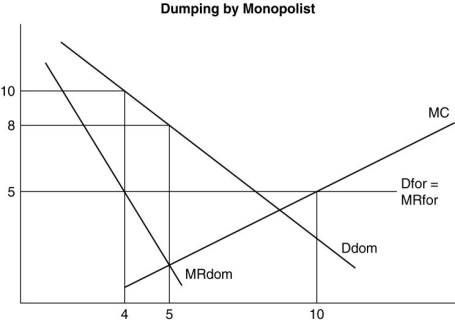 -The figure above represents the demand and cost functions facing a Brazilian steel producing monopolist. If it were unable to export, and was constrained by its domestic market, what quantity would it sell at what price?
 (Essay)
4.9/5  (66)
(66) A corporation is considered a multinational ________ if ________.
(Multiple Choice)
5.0/5 (87)
(87) An industry is characterized by scale economies, and exists in two countries. Should these two countries engage in trade such that the combined market is supplied by one country's industry, then
(Multiple Choice)
4.7/5 (84)
(84) During the past decade, U.S. imports of business services have ________, U.S. exports of business services have ________, and U.S. net exports of business services have ________.
(Multiple Choice)
4.8/5 (82)
(82) Under oligopoly, firms' pricing policies are ________ and, under monopolistic competition, they are ________.
(Multiple Choice)
4.9/5 (84)
(84)  -Refer to above figure. While selling exports it would also maximize its domestic sales by equating its marginal (opportunity) cost to its marginal revenue of $5. How much steel would the firm sell domestically, and at what price?
 (Short Answer)
4.8/5 (81)
(81) In the model of monopolistic competition, trade costs between countries will cause domestic and foreign markets to have ________ prices, ________ quantities sold, and ________ profit levels.
(Multiple Choice)
4.9/5 (79)
(79) In the model of monopolistic competition, an increase in industry output will ________ market shares and ________ profits of producers of higher-priced goods and will ________ market shares and ________ profits of producers of lower-priced goods.
(Multiple Choice)
4.8/5 (84)
(84) Two countries engaged in trade in products with scale economies, produced under conditions of monopolistic competition, are likely to be engaged in
(Multiple Choice)
4.8/5 (69)
(69) The most common form of price discrimination in international trade is
(Multiple Choice)
5.0/5 (72)
(72) When a multinational affiliate replicates production in a foreign country it is called ________ foreign direct investment.
(Multiple Choice)
4.9/5 (86)
(86) Modeling trade in imperfectly competitive industries is problematic because
(Multiple Choice)
4.9/5 (83)
(83) An industry is characterized by scale economies and exists in two countries. In order for consumers of its products to enjoy both lower prices and more variety of choice
(Multiple Choice)
4.9/5 (92)
(92) Complaints are often made to the International Trade Commission concerning foreign "dumping" practices. These complaints typically claim that
(Multiple Choice)
4.8/5 (82)
(82) When a country both exports and imports a type of commodity, the country is engaged in
(Multiple Choice)
4.9/5 (87)
(87) Intra-industry trade will tend to dominate trade flows when which of the following exists?
(Multiple Choice)
4.8/5 (78)
(78) A corporation is considered a multinational ________ if ________.
(Multiple Choice)
4.9/5 (83)
(83) In an industry where firms experience internal scale economies, the long-run cost of production will depend on
(Multiple Choice)
4.8/5 (76)
(76) We often observe "pseudo-intra-industry trade" between the United States and Mexico. Actually, such trade is consistent with
(Multiple Choice)
4.8/5 (80)
(80) 
Filters
- Essay(0)
- Multiple Choice(0)
- Short Answer(0)
- True False(0)
- Matching(0)