



 Chat with AI
Exam 17: Material Requirements Planning MRP and ERP

Exam 1: Operations and Productivity126 Questions
Exam 2: Operations Strategy in a Global Environment135 Questions
Exam 3: Project Management123 Questions
Exam 4: Forecasting144 Questions
Exam 5: Design of Goods and Services137 Questions
Exam 6: Managing Quality130 Questions
Exam 7: Statistical Process Control154 Questions
Exam 8: Process Strategy131 Questions
Exam9: Capacity and Constraint Management107 Questions
Exam 10: Location Strategies140 Questions
Exam 11: Layout Strategies161 Questions
Exam 12: Human Resources, Job Design, and Work Measurement191 Questions
Exam 13: Supply-Chain Management145 Questions
Exam 14: Outsourcing as a Supply-Chain Strategy73 Questions
Exam 15: Inventory Management155 Questions
Exam 16: Aggregate Planning134 Questions
Exam 17: Material Requirements Planning MRP and ERP169 Questions
Exam 18: Short-Term Scheduling139 Questions
Exam 19: Just-In-Time and Lean Options137 Questions
Exam 20: Maintenance and Reliability130 Questions
Exam 21: Decision-Making Tools97 Questions
Exam 22: Linear Programming100 Questions
Exam 23: Transportation Models94 Questions
Exam 24: Waiting-Line Models135 Questions
Exam 25: Learning Curves111 Questions
Exam 26: Simulation93 Questions
Select questions type


Compare MRP in services to MRP in manufacturing. Utilize a simple example in your comparison.
(Essay)
4.9/5  (69)
(69) "Phantom bills" are bills of material for subassemblies that do not exist in reality.
(True/False)
4.9/5 (71)
(71) What information is necessary for an operations manager to make effective use of a dependent inventory demand model?
(Essay)
4.9/5 (81)
(81) In MRP, the number of units projected to be available at the beginning of each time period refers to
(Multiple Choice)
4.8/5 (91)
(91) Which portion of the master production schedule is normally fixed, frozen, or firm?
(Multiple Choice)
4.9/5 (77)
(77) By convention, the top level in a bill of material is designated level 1.
(True/False)
4.9/5 (69)
(69) The supply-chain systems that result from using ERP in the grocery industry are called efficient consumer response (ECR) systems.
(True/False)
4.9/5 (93)
(93) Time fences divide that segment of the MPS that can be revised from that section that is "frozen."
(True/False)
4.9/5 (83)
(83) In continuous (stock-to-forecast) operations, the master production schedule is usually expressed in terms of
(Multiple Choice)
4.8/5 (90)
(90) A very simple product (A) consists of a base (B) and a casting (C). The base consists of a plate (P) and three fasteners (F). There are currently 30 castings and 100 bases on hand. Final assembly takes one week. The casting has a lead time of three weeks. All other parts have one week lead times. There are no scheduled receipts. All components are lot-for-lot. The MPS requires 80 units of product A in week 5 and 120 in week 8. Produce the MRP for the upcoming eight weeks. Produce a list of all planned order releases.
(Essay)
4.9/5 (75)
(75) Consider the bill of material for Product J and the data given in the following table. The gross requirements for J are 200 units in week 6 and 250 units in week 8. Develop the MRP tables for each item for an 8-week planning period. Use the lot-for-lot lot-sizing rule.
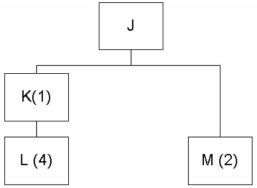 Item Lead Time Quantity on Hand Scheduled receipts 1 0 2 20 30 week 2 2 0 1 20 10 week 1
 (Essay)
4.8/5 (80)
(80) __________ is a lot-sizing technique that generates exactly what is required to meet the plan.
(Short Answer)
4.8/5 (86)
(86) Which of the following statements regarding Wheeled Coach is False?
(Multiple Choice)
4.9/5 (86)
(86) Each X requires 2 of component Y and 1 of part W. Each Y requires 10 of Z. Each W requires 3 of Q and 2 of R. Lead times are X = 1 week, Y = 1 week, W = 2 weeks, R = 1 week, Z = 3 weeks, and Q = 3 weeks.
a. Construct the time-phased product structure.
b. Construct the bill of material.
(Essay)
4.8/5 (75)
(75) When safety stock is deemed absolutely necessary, the usual policy is to build it into which category of the MRP logic?
(Multiple Choice)
4.9/5 (87)
(87) 
Filters
- Essay(0)
- Multiple Choice(0)
- Short Answer(0)
- True False(0)
- Matching(0)