



 Chat with AI
Exam 17: Material Requirements Planning MRP and ERP

Exam 1: Operations and Productivity126 Questions
Exam 2: Operations Strategy in a Global Environment135 Questions
Exam 3: Project Management123 Questions
Exam 4: Forecasting144 Questions
Exam 5: Design of Goods and Services137 Questions
Exam 6: Managing Quality130 Questions
Exam 7: Statistical Process Control154 Questions
Exam 8: Process Strategy131 Questions
Exam9: Capacity and Constraint Management107 Questions
Exam 10: Location Strategies140 Questions
Exam 11: Layout Strategies161 Questions
Exam 12: Human Resources, Job Design, and Work Measurement191 Questions
Exam 13: Supply-Chain Management145 Questions
Exam 14: Outsourcing as a Supply-Chain Strategy73 Questions
Exam 15: Inventory Management155 Questions
Exam 16: Aggregate Planning134 Questions
Exam 17: Material Requirements Planning MRP and ERP169 Questions
Exam 18: Short-Term Scheduling139 Questions
Exam 19: Just-In-Time and Lean Options137 Questions
Exam 20: Maintenance and Reliability130 Questions
Exam 21: Decision-Making Tools97 Questions
Exam 22: Linear Programming100 Questions
Exam 23: Transportation Models94 Questions
Exam 24: Waiting-Line Models135 Questions
Exam 25: Learning Curves111 Questions
Exam 26: Simulation93 Questions
Select questions type


The MPS calls for 120 units of Product M. There are currently 30 of Product M on hand. Each M requires 4 of Component N. There are 20 units of N on hand.
a. Calculate the net requirements for M.
b. Calculate the gross requirements for N.
c. Calculate the net requirements for N.
(Essay)
4.9/5  (74)
(74) The __________ technique may be applicable where a firm's parts and subassemblies are common to a variety of its products.
(Short Answer)
4.8/5 (84)
(84) The MPS calls for 110 units of Product M. There are currently 30 of Product M on hand. Each M requires 4 of Component N. There are 20 units of N on hand. The net requirements for N are
(Multiple Choice)
4.9/5 (76)
(76) An error has been detected in the technical drawing of a product about to be placed on a master production schedule. The part should be 9" by 12", not 9 cm by 12 cm; further, the part should be stainless steel, not ordinary steel. What document transmits the needed change?
Where is the corrected information recorded?
Why is this important to the master production schedule?
(Essay)
4.9/5 (84)
(84) Which of the following statements is true about the MRP plan when using lot-for-lot ordering?
(Multiple Choice)
4.8/5 (79)
(79) If the explosion of the bill of material tells MRP how much of each part is needed, how does MRP learn when each of these parts is needed?
(Essay)
4.7/5 (66)
(66) Firms making many different final products use __________ to facilitate production scheduling.
(Multiple Choice)
4.8/5 (85)
(85) __________, unlike MRP, recognizes that departments and machines have limitations on their capacity that must be observed if the schedule is to be realistic.
(Short Answer)
4.9/5 (84)
(84) Identify the several lot-sizing algorithms used in MRP. Provide at least one advantage and one disadvantage of each.
(Essay)
4.8/5 (78)
(78) A(n) __________ is a listing of the components, their description, and the quantity of each required to make one unit of a product.
(Short Answer)
4.9/5 (84)
(84) Which of the following statements best compares modular bills and phantom bills?
(Multiple Choice)
4.9/5 (74)
(74) The extension of MRP which extends to resources such as labor hours and machine hours, as well as to order entry, purchasing, and direct interface with customers and suppliers is
(Multiple Choice)
4.8/5 (75)
(75) The time-phased product structure, unlike the bill of material, adds the concept of lead times.
(True/False)
4.8/5 (74)
(74) Wheeled Coach insists all of the following tasks are key to successful MRP use except
(Multiple Choice)
4.9/5 (85)
(85) Given the following bill of material  If the demand for product A is 30 units, and there are 10 units of B on hand and none of C, how many units of part D will be needed?
 (Multiple Choice)
4.9/5 (88)
(88) Explode the following Bill of materials assuming 1 A is to be made. If there are 20 of every item except A in on-hand inventory how many As can be assembled?
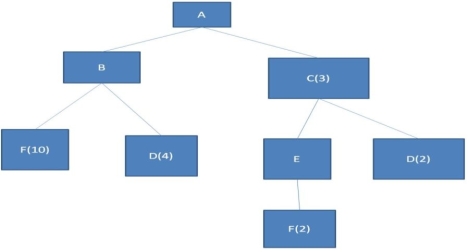
(Essay)
4.8/5 (74)
(74) 
Filters
- Essay(0)
- Multiple Choice(0)
- Short Answer(0)
- True False(0)
- Matching(0)