



 Chat with AI
Exam 26: Demand-Side Equilibrium: Unemployment or Inflation

Exam 1: What Is Economics232 Questions
Exam 2: The Economy: Myth and Reality155 Questions
Exam 3: The Fundamental Economic Problem: Scarcity and Choice255 Questions
Exam 4: Supply and Demand: an Initial Look313 Questions
Exam 5: Consumer Choice: Individual and Market Demand206 Questions
Exam 6: Demand and Elasticity214 Questions
Exam 7: Production, Inputs, and Cost: Building Blocks for Supply Analysis221 Questions
Exam 8: Output, Price, and Profit: the Importance of Marginal Analysis194 Questions
Exam 9: Securities: Business Finance and the Economy: the Tail That Wags the Dog203 Questions
Exam 10: The Firm and the Industry Under Perfect Competition212 Questions
Exam 11: Monopoly208 Questions
Exam 12: Between Competition and Monopoly230 Questions
Exam 13: Limiting Market Power: Regulation and Antitrust155 Questions
Exam 14: The Case for Free Markets: the Price System225 Questions
Exam 15: The Shortcomings of Free Markets219 Questions
Exam 16: Externalities, the Environment, and Natural Resources222 Questions
Exam 17: Taxation and Resource Allocation221 Questions
Exam 18: Pricing the Factors of Production233 Questions
Exam 19: Labor and Entrepreneurship: the Human Inputs271 Questions
Exam 20: Poverty, Inequality, and Discrimination172 Questions
Exam 21: Is Useconomic Leadership Threatened75 Questions
Exam 22: An Introduction to Macroeconomics216 Questions
Exam 23: The Goals of Macroeconomic Policy212 Questions
Exam 24: Economic Growth: Theory and Policy228 Questions
Exam 25: Aggregate Demand and the Powerful Consumer219 Questions
Exam 26: Demand-Side Equilibrium: Unemployment or Inflation216 Questions
Exam 27: Bringing in the Supply Side: Unemployment and Inflation228 Questions
Exam 28: Managing Aggregate Demand: Fiscal Policy210 Questions
Exam 29: Money and the Banking System224 Questions
Exam 30: Monetary Policy: Conventional and Unconventional210 Questions
Exam 31: He Financial Crisis and the Great Recession66 Questions
Exam 32: The Debate Over Monetary and Fiscal Policy219 Questions
Exam 33: Budget Deficits in the Short and Long Run215 Questions
Exam 34: The Trade-Off Between Inflation and Unemployment219 Questions
Exam 35: International Trade and Comparative Advantage223 Questions
Exam 36: The International Monetary System: Order or Disorder218 Questions
Exam 37: Exchange Rates and the Macroeconomy219 Questions
Select questions type


 -In Table 9-1, inventories will be increasing as long as output is above
 (Multiple Choice)
4.8/5  (83)
(83) An expenditure schedule shows the relationship between GDP and total output.
(True/False)
4.9/5 (67)
(67) The slope of the aggregate demand curve illustrates that real GDP demanded will increase when
(Multiple Choice)
4.9/5 (73)
(73) If the U.S.economy is experiencing falling price levels, the
(Multiple Choice)
4.8/5 (85)
(85) High unemployment and high rates of inflation are examples of coordination successes.
(True/False)
4.8/5 (73)
(73) Given the slope of the aggregate demand curve, real GDP demanded will decrease when
(Multiple Choice)
4.8/5 (68)
(68) The slope of the aggregate demand curve illustrates that as the price level rises,
(Multiple Choice)
4.7/5 (75)
(75) The multiplier can be expressed as the ratio of the change in Y over the change in I.
(True/False)
4.8/5 (86)
(86) If total spending is greater than the value of output, firms will
(Multiple Choice)
4.8/5 (83)
(83) Figure 9-4
 -In Figure 9-4, if the economy faces an inflationary gap, what must happen to reach potential GDP?
 (Multiple Choice)
4.9/5 (65)
(65) Using the standard 45-degree line diagram, how does an increase in autonomous consumption effect the expenditure schedule?
(Multiple Choice)
4.9/5 (82)
(82) The full employment level of GDP is sometimes referred to as "potential GDP."
(True/False)
5.0/5 (77)
(77) If savings exceeds investment at full employment, demand will fall short of total output.
(True/False)
4.9/5 (83)
(83) Figure 9-4
-In Figure 9-4, which expenditure level will cause an inflationary gap?
-In Figure 9-4, which expenditure level will cause an inflationary gap? (Multiple Choice)
4.8/5 (78)
(78) Figure 9-5
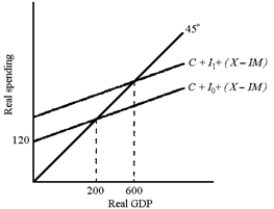 -In Figure 9-5, if the second round effect of an increase in autonomous spending of $100,000 is $75,000, then the multiplier is
 (Multiple Choice)
4.9/5 (70)
(70) The basic reason for the multiplier effect is that, when you spend money,
(Multiple Choice)
4.8/5 (85)
(85) According to Baumol and Blinder, the real-world multiplier will be smaller than 1/(1 − MPC) because the 1/(1 − MPC) measure is based on
(Multiple Choice)
4.8/5 (80)
(80) If inventories are being depleted, firms may respond by cutting prices.
(True/False)
4.7/5 (97)
(97) 
Filters
- Essay(0)
- Multiple Choice(0)
- Short Answer(0)
- True False(0)
- Matching(0)