



 Chat with AI
Exam 20: Poverty, Inequality, and Discrimination

Exam 1: What Is Economics232 Questions
Exam 2: The Economy: Myth and Reality155 Questions
Exam 3: The Fundamental Economic Problem: Scarcity and Choice255 Questions
Exam 4: Supply and Demand: an Initial Look313 Questions
Exam 5: Consumer Choice: Individual and Market Demand206 Questions
Exam 6: Demand and Elasticity214 Questions
Exam 7: Production, Inputs, and Cost: Building Blocks for Supply Analysis221 Questions
Exam 8: Output, Price, and Profit: the Importance of Marginal Analysis194 Questions
Exam 9: Securities: Business Finance and the Economy: the Tail That Wags the Dog203 Questions
Exam 10: The Firm and the Industry Under Perfect Competition212 Questions
Exam 11: Monopoly208 Questions
Exam 12: Between Competition and Monopoly230 Questions
Exam 13: Limiting Market Power: Regulation and Antitrust155 Questions
Exam 14: The Case for Free Markets: the Price System225 Questions
Exam 15: The Shortcomings of Free Markets219 Questions
Exam 16: Externalities, the Environment, and Natural Resources222 Questions
Exam 17: Taxation and Resource Allocation221 Questions
Exam 18: Pricing the Factors of Production233 Questions
Exam 19: Labor and Entrepreneurship: the Human Inputs271 Questions
Exam 20: Poverty, Inequality, and Discrimination172 Questions
Exam 21: Is Useconomic Leadership Threatened75 Questions
Exam 22: An Introduction to Macroeconomics216 Questions
Exam 23: The Goals of Macroeconomic Policy212 Questions
Exam 24: Economic Growth: Theory and Policy228 Questions
Exam 25: Aggregate Demand and the Powerful Consumer219 Questions
Exam 26: Demand-Side Equilibrium: Unemployment or Inflation216 Questions
Exam 27: Bringing in the Supply Side: Unemployment and Inflation228 Questions
Exam 28: Managing Aggregate Demand: Fiscal Policy210 Questions
Exam 29: Money and the Banking System224 Questions
Exam 30: Monetary Policy: Conventional and Unconventional210 Questions
Exam 31: He Financial Crisis and the Great Recession66 Questions
Exam 32: The Debate Over Monetary and Fiscal Policy219 Questions
Exam 33: Budget Deficits in the Short and Long Run215 Questions
Exam 34: The Trade-Off Between Inflation and Unemployment219 Questions
Exam 35: International Trade and Comparative Advantage223 Questions
Exam 36: The International Monetary System: Order or Disorder218 Questions
Exam 37: Exchange Rates and the Macroeconomy219 Questions
Select questions type


A minority candidate may not have the same chances as a white candidate for a job simply based on an employer's misconceptions about minorities.
(True/False)
4.8/5  (67)
(67) Roughly what was the median level of household income in the U.S.in 2012?
(Multiple Choice)
4.9/5 (84)
(84) If the United States is to reduce poverty by using a negative income tax, the guaranteed income should be
(Multiple Choice)
4.8/5 (83)
(83) Economists generally agree that in reducing poverty, policies should be sought that do the
(Multiple Choice)
4.8/5 (79)
(79)
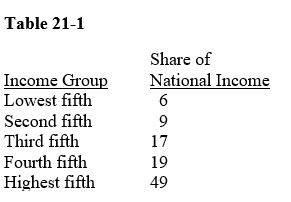 -Consider the economy described by the income distribution in Table 21-1.From this table, we can conclude that the
 (Multiple Choice)
4.8/5 (84)
(84) Discuss the criticisms leveled against the Aid to Families with Dependent Children program.
(Essay)
4.7/5 (73)
(73) Two policies to combat discrimination are affirmative action and right-to-work laws.
(True/False)
4.7/5 (95)
(95) Employers near military bases are aware that wives generally accompany their servicemen husbands when they are transferred.When presented with nonservice-wife applicants and wives of servicemen, they hire the nonservice-wife applicants.This is an example of
(Multiple Choice)
4.9/5 (82)
(82) In the negative income tax framework, a break-even point of $16,000 and a tax rate of 25 percent imply a guarantee of which of the following figures?
(Multiple Choice)
4.8/5 (86)
(86) Redistribution programs that reduce poverty and income inequality
(Multiple Choice)
4.8/5 (71)
(71) Which of the following is not a source of inequality in incomes?
(Multiple Choice)
5.0/5 (78)
(78) If you fall short of a certain minimum standard of living, you are poor; once you pass this standard, you are no longer poor.This refers to the ____ definition of poverty.
(Multiple Choice)
4.8/5 (84)
(84) Which of the following is a source of inequality in incomes?
(Multiple Choice)
4.8/5 (75)
(75) Figure 21-1
 -In Figure 21-1, a reform in the distribution system that achieves the same distribution with less damage to work incentives is represented by a move from which points?
 (Multiple Choice)
4.8/5 (88)
(88) Assume that a company has several male workers who do not give their full cooperation to female supervisors making them less effective as supervisors.Economists would refer to this type of situation as ____.
(Multiple Choice)
4.8/5 (66)
(66) What is the difference between the absolute and relative concepts of poverty?
What are the major problems in measuring poverty with them?
(Essay)
4.9/5 (81)
(81) There are several reasons why incomes are unequal, including differences in luck, experience, and schooling.
(True/False)
4.9/5 (79)
(79) 
Filters
- Essay(0)
- Multiple Choice(0)
- Short Answer(0)
- True False(0)
- Matching(0)