



 Chat with AI
Exam 14: The Case for Free Markets: the Price System

Exam 1: What Is Economics232 Questions
Exam 2: The Economy: Myth and Reality155 Questions
Exam 3: The Fundamental Economic Problem: Scarcity and Choice255 Questions
Exam 4: Supply and Demand: an Initial Look313 Questions
Exam 5: Consumer Choice: Individual and Market Demand206 Questions
Exam 6: Demand and Elasticity214 Questions
Exam 7: Production, Inputs, and Cost: Building Blocks for Supply Analysis221 Questions
Exam 8: Output, Price, and Profit: the Importance of Marginal Analysis194 Questions
Exam 9: Securities: Business Finance and the Economy: the Tail That Wags the Dog203 Questions
Exam 10: The Firm and the Industry Under Perfect Competition212 Questions
Exam 11: Monopoly208 Questions
Exam 12: Between Competition and Monopoly230 Questions
Exam 13: Limiting Market Power: Regulation and Antitrust155 Questions
Exam 14: The Case for Free Markets: the Price System225 Questions
Exam 15: The Shortcomings of Free Markets219 Questions
Exam 16: Externalities, the Environment, and Natural Resources222 Questions
Exam 17: Taxation and Resource Allocation221 Questions
Exam 18: Pricing the Factors of Production233 Questions
Exam 19: Labor and Entrepreneurship: the Human Inputs271 Questions
Exam 20: Poverty, Inequality, and Discrimination172 Questions
Exam 21: Is Useconomic Leadership Threatened75 Questions
Exam 22: An Introduction to Macroeconomics216 Questions
Exam 23: The Goals of Macroeconomic Policy212 Questions
Exam 24: Economic Growth: Theory and Policy228 Questions
Exam 25: Aggregate Demand and the Powerful Consumer219 Questions
Exam 26: Demand-Side Equilibrium: Unemployment or Inflation216 Questions
Exam 27: Bringing in the Supply Side: Unemployment and Inflation228 Questions
Exam 28: Managing Aggregate Demand: Fiscal Policy210 Questions
Exam 29: Money and the Banking System224 Questions
Exam 30: Monetary Policy: Conventional and Unconventional210 Questions
Exam 31: He Financial Crisis and the Great Recession66 Questions
Exam 32: The Debate Over Monetary and Fiscal Policy219 Questions
Exam 33: Budget Deficits in the Short and Long Run215 Questions
Exam 34: The Trade-Off Between Inflation and Unemployment219 Questions
Exam 35: International Trade and Comparative Advantage223 Questions
Exam 36: The International Monetary System: Order or Disorder218 Questions
Exam 37: Exchange Rates and the Macroeconomy219 Questions
Select questions type


A factory in a centrally planned economy produces 1,000 left shoes and no right shoes.No corresponding factory produces only right shoes.This outcome is an example of inefficiency in
(Multiple Choice)
4.8/5  (80)
(80) Production planning without the market mechanism is very efficiently handled by central planners.
(True/False)
4.8/5 (88)
(88) Under a pure system of laissez faire, the government would not do which of the following?
(Multiple Choice)
4.8/5 (77)
(77) Figure 14-2
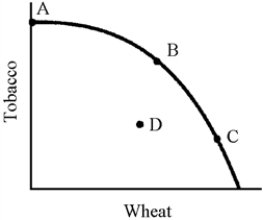 -In Figure 14-2, which of the points are efficient allocations of resources?
 (Multiple Choice)
4.9/5 (63)
(63) In many cities, the price of summer pops concerts has risen.In Charlotte, North Carolina, and Columbus, Ohio, for example, concerts that were once free now cost $5.If there are only fixed costs and no variable costs nor marginal costs in an orchestra concert, what is the efficient price?
Explain the reason why some people will find the efficient price unfair.
(Essay)
4.9/5 (83)
(83) In an idealized laissez-faire world, the distribution of products is
(Multiple Choice)
4.8/5 (78)
(78) Higher prices can discourage use/consumption, which in turn may better allocate scarce resources.
(True/False)
4.9/5 (84)
(84) Politicians and citizens may often choose policies that reduce economic efficiency because they are perceived as "fairer."
(True/False)
4.9/5 (79)
(79) Under laissez faire, the allocation of resources among different products depends on
(Multiple Choice)
4.7/5 (67)
(67) If MU = MC = P, an economist can judge with certainty that the distribution of output is
(Multiple Choice)
4.9/5 (86)
(86) In a free-market economy, the pricing mechanism always operates to
(Multiple Choice)
4.8/5 (75)
(75) Which type of economic system will produce the highest degree of allocative efficiency?
(Multiple Choice)
4.9/5 (92)
(92) Figure 14-1
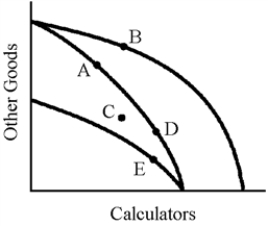 -In Figure 14-1, a cost-reducing technological breakthrough in calculator production would cause which movement?
 (Multiple Choice)
4.9/5 (83)
(83) Input-output analysis is a technique used to solve complicated market equations.
(True/False)
4.9/5 (86)
(86) Before a market allocation of goods on the production possibilities curve can be judged efficient, one must evaluate "what" goods the market produced.
(True/False)
5.0/5 (72)
(72) Which of the following holds true in a market when the invisible hand functions properly?
(Multiple Choice)
4.9/5 (88)
(88) With a monopoly, the consumer's surplus is lower than it would be with a perfectly competitive industry.
(True/False)
4.9/5 (102)
(102) An efficient allocation of resources is demonstrated by a point
(Multiple Choice)
4.9/5 (70)
(70) 
Filters
- Essay(0)
- Multiple Choice(0)
- Short Answer(0)
- True False(0)
- Matching(0)