



 Chat with AI
Exam 12: Between Competition and Monopoly

Exam 1: What Is Economics232 Questions
Exam 2: The Economy: Myth and Reality155 Questions
Exam 3: The Fundamental Economic Problem: Scarcity and Choice255 Questions
Exam 4: Supply and Demand: an Initial Look313 Questions
Exam 5: Consumer Choice: Individual and Market Demand206 Questions
Exam 6: Demand and Elasticity214 Questions
Exam 7: Production, Inputs, and Cost: Building Blocks for Supply Analysis221 Questions
Exam 8: Output, Price, and Profit: the Importance of Marginal Analysis194 Questions
Exam 9: Securities: Business Finance and the Economy: the Tail That Wags the Dog203 Questions
Exam 10: The Firm and the Industry Under Perfect Competition212 Questions
Exam 11: Monopoly208 Questions
Exam 12: Between Competition and Monopoly230 Questions
Exam 13: Limiting Market Power: Regulation and Antitrust155 Questions
Exam 14: The Case for Free Markets: the Price System225 Questions
Exam 15: The Shortcomings of Free Markets219 Questions
Exam 16: Externalities, the Environment, and Natural Resources222 Questions
Exam 17: Taxation and Resource Allocation221 Questions
Exam 18: Pricing the Factors of Production233 Questions
Exam 19: Labor and Entrepreneurship: the Human Inputs271 Questions
Exam 20: Poverty, Inequality, and Discrimination172 Questions
Exam 21: Is Useconomic Leadership Threatened75 Questions
Exam 22: An Introduction to Macroeconomics216 Questions
Exam 23: The Goals of Macroeconomic Policy212 Questions
Exam 24: Economic Growth: Theory and Policy228 Questions
Exam 25: Aggregate Demand and the Powerful Consumer219 Questions
Exam 26: Demand-Side Equilibrium: Unemployment or Inflation216 Questions
Exam 27: Bringing in the Supply Side: Unemployment and Inflation228 Questions
Exam 28: Managing Aggregate Demand: Fiscal Policy210 Questions
Exam 29: Money and the Banking System224 Questions
Exam 30: Monetary Policy: Conventional and Unconventional210 Questions
Exam 31: He Financial Crisis and the Great Recession66 Questions
Exam 32: The Debate Over Monetary and Fiscal Policy219 Questions
Exam 33: Budget Deficits in the Short and Long Run215 Questions
Exam 34: The Trade-Off Between Inflation and Unemployment219 Questions
Exam 35: International Trade and Comparative Advantage223 Questions
Exam 36: The International Monetary System: Order or Disorder218 Questions
Exam 37: Exchange Rates and the Macroeconomy219 Questions
Select questions type


To maximize sales revenue, an oligopoly will expand output until the price is zero.
(True/False)
4.9/5  (72)
(72) A perfectly contestable market is one in which there are excessive costs to entry and exit.
(True/False)
4.8/5 (87)
(87) ____ is one in which exactly the amount one competitor gains must be lost by other competitors.
(Multiple Choice)
4.7/5 (76)
(76) Displayed below is the payoff matrix of firm A for four different strategies, A1, A2, A3, and A4, and the potential retaliatory responses of firm B (B1, B2, B3, B4).?
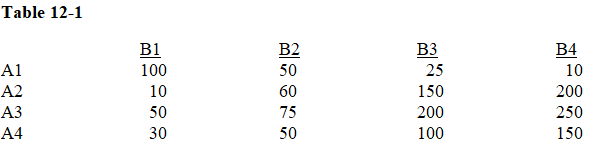 If firm A uses the maximin criterion, which strategy will it choose?
 (Multiple Choice)
4.8/5 (82)
(82) What are the assumptions of the kinked demand curve model?
What is its main conclusion about oligopoly behavior?
(Essay)
4.8/5 (81)
(81) Oligopolists use advertising as a way of differentiating their products.
(True/False)
4.9/5 (80)
(80) If in a given market of more than one producer, there were to exist for a long interval of time a positive gap between price and average cost (P > AC), this would suggest that
(Multiple Choice)
4.7/5 (71)
(71) Which of the following best expresses the attitude toward competition of a firm engaged in tacit collusion with its rivals?
(Multiple Choice)
4.8/5 (82)
(82) Figure 12-3
 -In Figure 12-3, according to economic theory, the kink in the demand curve will occur at point
 (Multiple Choice)
4.8/5 (81)
(81) The key difference between oligopoly and other market structures is the interdependence among producers.
(True/False)
4.9/5 (87)
(87) Figure 12-4
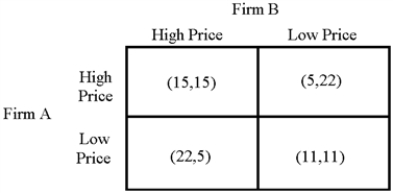 -The above matrix (Figure 12-4) displays the possible profit results of two firms, A and B, from following two different possible strategies: charging a high price and charging a low price.In each cell, the first number is the profit of firm A, and the second number is the profit of firm B.
a.Assume that collusion is not possible.Determine the optimal strategy for each firm.Explain why it is the best strategy to follow.
a., explain why firms collude.What are the pitfalls of collusion?
b.Based on your answer to
-The above matrix (Figure 12-4) displays the possible profit results of two firms, A and B, from following two different possible strategies: charging a high price and charging a low price.In each cell, the first number is the profit of firm A, and the second number is the profit of firm B.
a.Assume that collusion is not possible.Determine the optimal strategy for each firm.Explain why it is the best strategy to follow.
a., explain why firms collude.What are the pitfalls of collusion?
b.Based on your answer to (Essay)
4.7/5 (92)
(92) Which of the following conditions distinguishes the monopolistic competitor from the monopolist?
(Multiple Choice)
4.9/5 (80)
(80) Price leadership works only if there is a single, dominant firm in the oligopoly.
(True/False)
5.0/5 (86)
(86) Monopolistically competitive firms can earn large profits in the long run.
(True/False)
4.7/5 (76)
(76) 
Filters
- Essay(0)
- Multiple Choice(0)
- Short Answer(0)
- True False(0)
- Matching(0)