



 Chat with AI
Exam 1: What Is Economics

Exam 1: What Is Economics232 Questions
Exam 2: The Economy: Myth and Reality155 Questions
Exam 3: The Fundamental Economic Problem: Scarcity and Choice255 Questions
Exam 4: Supply and Demand: an Initial Look313 Questions
Exam 5: Consumer Choice: Individual and Market Demand206 Questions
Exam 6: Demand and Elasticity214 Questions
Exam 7: Production, Inputs, and Cost: Building Blocks for Supply Analysis221 Questions
Exam 8: Output, Price, and Profit: the Importance of Marginal Analysis194 Questions
Exam 9: Securities: Business Finance and the Economy: the Tail That Wags the Dog203 Questions
Exam 10: The Firm and the Industry Under Perfect Competition212 Questions
Exam 11: Monopoly208 Questions
Exam 12: Between Competition and Monopoly230 Questions
Exam 13: Limiting Market Power: Regulation and Antitrust155 Questions
Exam 14: The Case for Free Markets: the Price System225 Questions
Exam 15: The Shortcomings of Free Markets219 Questions
Exam 16: Externalities, the Environment, and Natural Resources222 Questions
Exam 17: Taxation and Resource Allocation221 Questions
Exam 18: Pricing the Factors of Production233 Questions
Exam 19: Labor and Entrepreneurship: the Human Inputs271 Questions
Exam 20: Poverty, Inequality, and Discrimination172 Questions
Exam 21: Is Useconomic Leadership Threatened75 Questions
Exam 22: An Introduction to Macroeconomics216 Questions
Exam 23: The Goals of Macroeconomic Policy212 Questions
Exam 24: Economic Growth: Theory and Policy228 Questions
Exam 25: Aggregate Demand and the Powerful Consumer219 Questions
Exam 26: Demand-Side Equilibrium: Unemployment or Inflation216 Questions
Exam 27: Bringing in the Supply Side: Unemployment and Inflation228 Questions
Exam 28: Managing Aggregate Demand: Fiscal Policy210 Questions
Exam 29: Money and the Banking System224 Questions
Exam 30: Monetary Policy: Conventional and Unconventional210 Questions
Exam 31: He Financial Crisis and the Great Recession66 Questions
Exam 32: The Debate Over Monetary and Fiscal Policy219 Questions
Exam 33: Budget Deficits in the Short and Long Run215 Questions
Exam 34: The Trade-Off Between Inflation and Unemployment219 Questions
Exam 35: International Trade and Comparative Advantage223 Questions
Exam 36: The International Monetary System: Order or Disorder218 Questions
Exam 37: Exchange Rates and the Macroeconomy219 Questions
Select questions type


A graph's origin is the point of intersection of all lines or curves in the graph.
(True/False)
4.7/5  (79)
(79) Many believe that fairness calls for higher income taxes on the wealthy.Using one of the "Ideas for Beyond the Final Exam," explain how higher taxes on the wealthy will affect output.
(Essay)
4.7/5 (87)
(87) Carefully define the following terms, and explain their importance in economics.
a.opportunity cost
b.abstraction
c.theory
d.model
e.marginal analysis
(Essay)
4.7/5 (89)
(89) The use of chlorofluorocarbons in refrigerators and air conditioners is alleged to cause the destruction of the ozone layer that surrounds the earth.This layer protects humans from ultraviolet radiation, which causes skin cancer.Industry has been prohibited from using these substances in aerosol cans, but the government has been reluctant to ban their use altogether because of the serious economic consequences.Economists analyze such problems and refer to them as
(Multiple Choice)
4.8/5 (83)
(83) Over the past century, the main factor responsible for rising living standards in the United States has been productivity growth.
(True/False)
4.9/5 (79)
(79) It is impossible for both nations to gain when trading with one other.
(True/False)
4.7/5 (83)
(83) In terms of the competing claims of equality and efficiency, in the United States we have
(Multiple Choice)
4.9/5 (71)
(71) People generally purchase less of a commodity as its price increases.This implies that the relationship between quantity purchased and the price of the commodity must have a
(Multiple Choice)
4.9/5 (81)
(81) 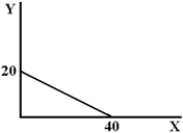 -The slope of the line in Figure 1-1 is
Which of the following is an example of a fiscal policy initiative?
(Multiple Choice)
4.8/5 (84)
(84) In the United States the distribution of income is relatively unequal, and output is relatively high, while in the former Soviet Union the distribution of income was more equal and output per worker was much lower.Give one possible explanation for this phenomenon.
(Essay)
4.9/5 (80)
(80) Opportunity cost is the value of the next best alternative to a given choice.
(True/False)
4.9/5 (84)
(84) Inaccurate prediction generally invalidates the use of theory in economics.
(True/False)
4.9/5 (77)
(77) 
Filters
- Essay(0)
- Multiple Choice(0)
- Short Answer(0)
- True False(0)
- Matching(0)